Thursday, October 16, 2008

2008 Shuangjiang Mengku "Wild Arbor King"


The dry leaf fills eager nostrils with the smell of light smokyy tobacco, mixed with slight sweet fruity undertones and an undeniable greeness. This tea smells good...

The leaf is also a pleasure to look at, nice full dark leaves that are so loosely compressed, a few lighter yellowy leaves only add contrast to the darkness. This tea looks good...

This tea is quite smoky and a bit creamy through the first infusions. Although smoky it unfortunately carries very little of that wonderful tobacco scent emitting from the dry leaves. The high cooler notes draw out banana, the lower notes, mushrooms. The mouthfeel is smooth, pleasant as well as slightly astringent and, if overbrewed, harsh.

In later infusions the smokiness is dropped for more of a creamy taste and its mouthfeel balances out. Overall its flavour is quite regular for a young puerh.

This tea has stamina as it was brewed for three days straight. Each day the mouthfeel got smoother and silkier, its flavour holding its own.
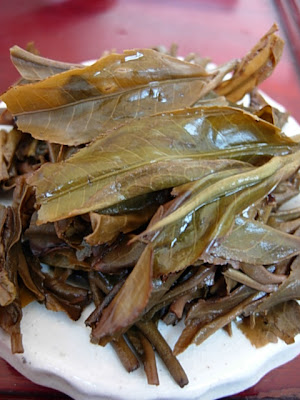
The wet leaves show evidence of full leaves mixed with smaller growth still attached to the twig. There is a lot of twig.

The qi of this tea flows softly through one's body nicely warming it and gently stirs one out of an early morning stupor.

Peace

Saturday, October 11, 2008

Lee Qwang's Brazier Style


These electric braziers by Lee Qwang are a step away from the earthy puncheongwear usually found on this blog. His use of thick, ultra shiny glazes are a treat for the eyes. His braziers all contain lids which cover the heating coils when not in use. The greenish glazed braziers contain a lotus motif where the brown glazes contain a woody motif. Staring at them, you simply get lost in the glaze.


Peace

Wednesday, October 8, 2008

2008 Raon Mao Cha


This tea was produced in Yunnan by a Korean shop owner under the guidance of his Chinese teamaster who authored a few books about tea in China. He assured me that his puerh was made of high quality spring shoots.


The dry leaves smell of light and fresh green. The rolled leaves contain many of the whiter hairy variety. They are so wonderful to view.

The leaves hit the pot. Then so does the hot water. The odor that escapes from the pot resembles the scent of ddok cha- this tea is very green.

It tastes full of light fresh high notes. Mint, cool light creamy peppermint is one such note. It shares tastebuds with other more subtle light spices that dance on the tongue. A nice sweetness is initially apparent then slowly slides away. Everything about this tea is cool in nature, like tasting freshly fallen snow melting on contact with the tongue.

The aftertaste is soft and sweet. The initial taste makes up for what the follow through lacks. Weak astringency follows cool to complete the mouthfeel of this tea. The qi of this tea is efficiently strong but clean and definitely not overpowering.

The wet leaves are full of small tips some connected to branches. There are no big leaves found here just a plethora of full, small, spring growth. As one spills these leaves onto a ceramic coaster, one gives thanks to these leaves.

One is content with the purity and simplicity of this tea. It truly lacks any deep nuances or over-the-top tones. It's just a light smooth tea. There is something about this tea that reminds one of the 2008 Nok Ya Won ddok cha, perhaps its green smell or even its taste, or energy. Either way, somehow this puerh carries with it a distinct Korean feel.

Peace

Monday, October 6, 2008

Kim Kyoung Soo's Hwa Row Style


Kim Kyoung Soo's hwa rows are of the electric type.

They exude earthiness and somewhat give the feeling of a wonderfully maintained rock garden.

The square ceramic base is unglazed and mat. It is a wonderful attempt to merge the naturalness of Korean tea culture with modern day conveniences.

Peace

Sunday, October 5, 2008

2008 Yunnan Yunxian Huimin Chachang Chupin High Mountain Cultivated Wild Puerh


One submits to the soft smell of the dark reddish dry leaves apparently picked from altitudes above 1700 meters. The odour is soft, deep, muted tobacco, barely a touch of fruit.

One carefreely prepares this tea. It is smooth, very slick in taste and feel. A little soft tobacco, a bit of a very light but deep spice finish is even sometimes apparent. The aftertaste is cool and flat.

This tea is really mild for being so young. Its mild taste leaves a faint veil of mystery that covers the tongue. Its flat barely nuanced aftertaste requires one to continue to drink as its soft energies slowly deplete themselves in a quite transmission from tea leaf to tea drinker.

One thought that this tea would be best enjoyed by those with little experience with puerh as it seems to lack the sharp, punchy, edginess that usually characterize the energy and taste of infant shang. Because of this you can really stuff the pot with this leaf and still not be overpowered by its youthful exuberance.

Today, as one sits down and sips this tea with a friend, the friend comments,

“This is good tea.”

Peace

A Hwa Row By Uh Sang Myung


As one contently sits cross-legged on the floor, next to the tea table sits Uh Sang Myung's hwa row.


Its form is quite a deviation from the traditional Japanese style. The whole unit rests on a circular ceramic base that is a bit darker from that of the main body. The base of this hwa row gives it a firm grounding feeling. Light ceramic with subtle rose blotches create a natural softness.

The main body of the hwa row is complete genius. It resembles a square which acts to balance the circular base and cylindrical kettle. The shape slowly morphs from its spherical bottom in to a square-like edged opening on top. The main body is separated from the base by three legs- a signature of Uh Sang Myung found on his pots and vases. The colour is flecked with ash that swirls in the kiln. These ashy marks contrast as well as compliment the ghastly white glaze that coats the main body.

One stares meditatively into the burning embers contained through the rusty edged side opening. Caging hot glowing charcoal is a three pronged metal stand. Atop this stand sits the cylindrical kettle.

The kettle has two square lungs and metal rings which now rest ready for action on the floor beside the base. These metal rings occasionally pierce the lungs to move the hot kettle off the heat as needed.


The lid of the kettle trembles as one's hand moves thoughtfully toward the small knob atop the lid. One grasps it and then removes the lid, placing it on a white hemp cloth just beside the base. This same hemp cloth also shares its surface with the pyo chew bak which one's hand now reaches for. It's time to draw water from this boiling hot kettle.

It's time for tea.

Peace

Wednesday, October 1, 2008

A Korean Spin On Japanese Style Braziers: the Hwa Row


Koreans have a long history of creating innovative, functional, practical, and completely unique teaware. Korea created works and utensils independent of China and Japan, a lot of teaware that comes from Korea are truly Korean inventions and served a functional as well as an ascetic purpose. This was also true for the devices created for bringing the water to a boil.

Throughout Korea's history braziers were commonly made of stone, iron, or silver and usually sat atop three legs. Sometimes a kettle was just hung over hot coals, but most likely some kind of device was used for boiling the kettle. With the invasion of Korea by Japan in the early 1900s, Japanese style iron brazers became the dominant style in most tea circles. Even today this influence can sometimes be seen in the Korean tea rooms.

The functional and practical spirit of boiling water coupled with Korea's modern fast pace, go-go-go, always on the move lifestyle has almost lead to the extinction of the use of charcoal heated braziers. Nowadays, in all but a few tea houses, electric heated braziers are used. These devices use an electric coil to heat the kettle above. Some are in the shape of old Japanese style braziers with the heating coil placed where coals once were. But, most are completely new creations fusing old ceramic techniques with the new modern conveniences of electric power.

One exception to this rule are the braziers of Uh Sang Myung. They so exemplify Korean tea culture that they should only be referred to as 'Hwa Row', the Korean word for brazier meaning 'fire box'. The top picture is a photo of Uh Sang Myung's style of Hwa Row.

Peace