Wednesday, September 10, 2008

A Hishaku Is No Pyo Choo Bak


The rattling lid of the brazier, barely containing the boiling water and steam that occasionally sprays out, signals a hand to reach for the pyo choo bak. It's time to make tea.

The hand that reaches for the pyo choo bak makes such beautiful circular motions, once grasped, the pyo choo bak continues to be beautifully wafted through the air. Landing in boiling water before scooping some out, it moves full of water, guided in dance before trickling its boiling contents upon unsuspecting tea leaves, or, more often then not, into the echoing hallows of the cooling bowl.

When a Korean tea master holds the pyo choo bak in their hands, they preform the dance of all dances. The motions with the pyo choo bak are smooth, soft, circular, and free. These motions imitate the motions of life, of earth, of nature. These motions could surely be those of the annual vine that this gourd once grew from, before being dried, before a piece was sliced from its side, before being hollowed, before being used today.

These movements are a far cry from the motions of the Japanese tea ceremony, where the motions of the bamboo laddle, the hishaku, cut through the air. Made by bamboo, the hishaku moves through the air in sharp, strait, contrived motions. Just as the growth of bamboo is straight and so deliberate, so are the movements with the hishaku.

The hishaku slices through the air beautifully like the blade of a samurai in battle. The samurai that once popularized and lead to the spread of the tea ceremony had forever influenced and instilled their movements upon it. So too did the litiri of Korea instill their movements upon the Korean tea ceremony. Unlike the sharp movements of a blade, the curved free movements of a pen, calligraphy brush, or watercolour brush are the movements of the litiri. The circular free motion of a hand that writes, the strokes of black ink on rice paper, or the mellow blobs of a watercolour brush, have influenced the movements of the Korean tea ceremony. Unconsciously, free from thought, after drawing water for tea, these are the movements of the pyo choo bak as one rests it upon a white hemp cloth right now.

Peace

Monday, September 8, 2008

Sample # 4 from Thomas at Tuo Cha Tea (Later found to be a 2007 Darjeeling Thurbo Oriental White First Flush)


Thomas generously sent four mystery samples. This sample is labeled #4. The dry leaves are partially crushed and exhibited both curled, hairy white buds, and smaller darker green unfurrowed leaves. This tea appeared to be a white tea.


It was prepared mindfully. The first infusion brings with it very lightsweet high notes, fresh, silky mouthfeel, and a quiet flavour of mint and fruit.


The second infusion caries a strong grape flavour, it tastes very sweet, almost artificial. Much like the purple grape bubble gum cubes that one can fetch in a pack at the corner store. This tea is candy. Its mouthfeel remains silky with just enough astringency to make it feel just right.
The third infusion is much of the same as the second. One is quite surprised that this tea lacks almost completely that green vegitalness that is found in almost very green tea, then again, this is most likely a white tea. The tea becomes thicker in the mouth, the flavour, grapier than ever.
The fourth infusion has tones of a deeper, mustier quality that is barely detected under its sweet candy body.


After the forth infusion one was interrupted and unfortunately couldn't get back to this tea (don't you hate it when that happens). This mystery tea could have probably taken a few more steepings, but, either way, it was enjoyed. Thank you Thomas for supplying one with such a flavourful delight.

Peace

Edit: One just did some snooping at Tuo Cha Tea and found this tea. It's a Darjeeling Thurbo Oriental White First Flush, one is sure that it is the one sampled above.

There was some discussion about the steeping parameters on Thomas' original post, but one was quite pleased with the result when using lot of leaf, water that was reduced to a low temperature (appox 80C), and short 30 sec to 40 sec infusions.


Peace Again (there's no such thing as too much peace :)

Saturday, September 6, 2008

2008 Emperor's Jiri Mountain Yellow Tea


“This is one of those teas that you have tried before.”

Opening the bag of one of the most popular oxidized teas (Hwang Cha) in Korea, one's sense of smell reminds one of this. These leaves are very fragrant. They emit a sour and sweet odour, white chocolate covered in natural notes of pines covering a mountain side. They give off a roasted smell indicative of the high level of oxidization that yellow teas undergo during their production.

One prepares the tea with near boiling water and drinks it mindfully. The colour of its soup is beautiful, the taste too. Grainy roasted barley, mellow sweetness, woody pine, nutty... quite nutty.

The mouthfeel evolves in the mouth from slippery and watery to dry as it travels down the throat. As this tea is strung through multiple infusions it leaves more dryness on the tongue, but still retains a slippery feeling.

The qi of this tea is very warming, fast flowing and active. It has enough kick to really get you going.

As one reflects on this tea one discovers its simple autumnal warmth.
Like a sunny day in the chilly fall.
Soon these days will be here.
Then, how appropriate will this tea be?

Peace

Thursday, September 4, 2008

A Ceramic One-Cup Tea Maker in the Pu Gak Style


There is always much talk on tea blogs about the problem of how to brew tea in the office quickly and efficiently without surrendering flavour. This is probably a legitimate concern for us teaist who strive for perfection in the cup. Out of all the excellent posts one has came across, none seem to suggest, the ceramic one-cup tea maker.


It only makes sense that this functional teawear was first created in Korea. In a country that is always on the go and has one of the longest work weeks in the world, this simple one cup design seems perfect for both the traditional herbal teas as well as loose leaf greens that Korean tea drinkers consume.

There are many different designs, but all contain three essential parts: the cup body, the inside filter, and the lid/ filter rest. It's pretty self-explanatory you just preheat/ rinse, put the leaves in the filter that is already resting in the cup, add warm water, put the lid on, when you feel the tea is ready remove the lid, take out the filter with the leaves inside and rest it on the lid, drink the tea, repeat. Simple.

A lot of these one cup tea makers are mass produced in factories, by machines, or made by unknown, lesser experienced artists that work in a shop with others producing the same product. But, it is possible to acquire some original pieces like this one by artist Huh Sang Wook. Out of all the one cup makers one has used this one consistently produces the best cup of tea. It softens the tea and rounds out bitter edges. This one-cup tea maker is crafted in the pu gak style. This style is similar to pak ji but shows some important differences.

In the pak ji style the white glaze is carefully etched away but no deep impressions are left on the surface, so the surface remains smooth. In the pu gak style the images are not etched on the surface, but the clay is deeply striped away so it leaves a relief image on the surface.

This work by Huh Sang Wook features a mugunghwa flower, the national flower of Korea. This flower is a symbol of immortality.

Peace

Monday, September 1, 2008

A Brazier by Shin Hyun Churl


This enormous brazier is fit for a large tea room.


Though its shape reflects the Japanese style, this brazier is made of thick, earthy clay. To the touch it feels as if the artist glued fine grit sand to its earthy brown body.


Inside the kettle the chun mok style is seen behind glossy sheen and smooth texture. This must have been done to accentuate and contrast it from the outer. The chun mok technique is characterized by yellowish-green blotches that overlap black.

This brazier's smooth shape and clean slopes coupled with its earthy colour and texture lends itself to a nice balance. Because of this, this brazier could easily make its way into the more elegant tea houses of Seoul, and yet still feel at home in the more natural decor of the south.


And, not to be forgotten, is the focal point and signature characteristic of Shin Hyun Churl's works, the blossoming lotus flower adorning the lid.

Peace

Saturday, August 30, 2008

Ddok Cha Discussion at Cha Dao

There is a very informative article by Steven Owyoung on the facts about ddok cha and then an interesting discussion to follow. Please check it out if you haven't already by clicking on this link... http://chadao.blogspot.com/2008/08/primer-on-ddok-cha.html

Peace

Thursday, August 28, 2008

An Experience With an Erabo Style Tea Drinking Bowl by Sel Young Jin


This bowl is chosen off a wall of about a hundred, all magnificent pieces of art and a testament to the craftsmanship of Korean potters. One doesn't choose it, a friend does the honours. Then that same friend prepares powered green tea in it the same way she does many times daily.

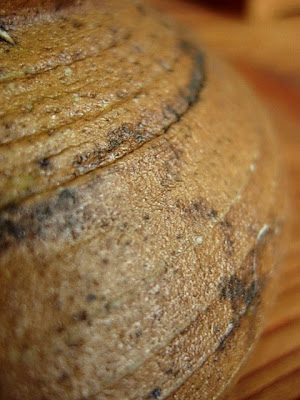
She reaches across the grainy wood table and places it in front of one. Embracing it with cupped hands, this tea bowl's shape just feels right. It reclines in the palms of one's hands like a ball carved from wood, half a ball. The texture is softer than it looks, soft sand. The colour of the bowl bares the badge of large black markings, a result of the ash in the wood fired kiln.


Bringing it toward ones lips, one reverently drinks the tea.


The rings that encircle the outer body of the bowl are a real treat to both the eyes and hands. This bowl imitates the dendrochronology of an old tree. The lines that circumnavigate this bowl trigger deep reflection on life. Just as the rings of a tree allow us to reflect on its life, the rings around this bowl allow one to reflect upon the one who, now, holds it in their hands savoring the moment, savoring life.

Peace