Showing posts with label Sel Young Jin. Show all posts

Saturday, September 24, 2011

One of Korea's True Master Potters Calls It Quits- Thank You Sel Young Jin

One of Korea's best potters has stopped making wares. David Louveau passed this information on with kind words and a gift, a beautiful teapot, a few weeks ago. David Louveau studied under Sel Young Jin- heavy influences of this master can be seen in his work.

Sel Young Jin specialized in erabo style and his pieces were some of the most stunning of any modern potter. He infused a Zen mind with that of a potters mind and made them one in his works. Drinking from his cups and tea bowls you can taste this mind- peaceful and still within the contrasting raw and natural texture of his works.

According to David Louveau, Sel Young Jin has taken to deepening his meditation. One takes solace in knowing that he is still sharing many cups of tea with family and friends at his tea table.

Thank you Sel Young Jin.

Peace

Click here then scroll down to see some of his beautiful teaware.

Double Peace

Friday, December 11, 2009

A Winter Pot By Master Sel Young Jin


Sel Young Jin's works harmonize with winter.

This rustic pot exudes the feeling of early winter/ late fall- winter's first snowfall. Thick white glaze barely covering the rocky earth beneath. A light snowfall, a veil over the land. It hints at more snow to come.

Peace

Saturday, August 29, 2009

Sel Young Jin's Zen Tea Pots: Same Form, Different Finish


If this pot looks familiar it should. It is identical in form to a pot posted a few days ago. As you can see, this particular form is a signature of Sel Young Jin.

In the tradition of Korean pottery, the same form is replicated tirelessly until one reaches a meditative state. Potters create hundreds even thousands of similar works.

Only when the conceptual mind is transcended will the best works be produced. Master Sel Young Jin is one of the purest meditative ceramicists. It truly shows in the spirit of his art.

The beautiful pot stand is the work of a very innovative Korean potter, Kim Kyoung Soo.

One particularly enjoys how his rugged stand complements the look of the very glossy pot resting atop.

Peace

Thursday, August 27, 2009

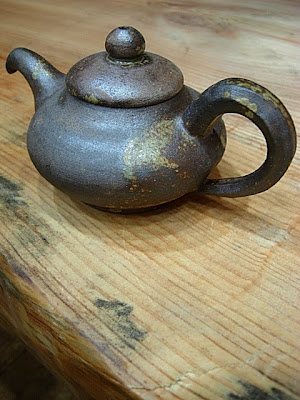
A Teapot by Master Sel Young Jin


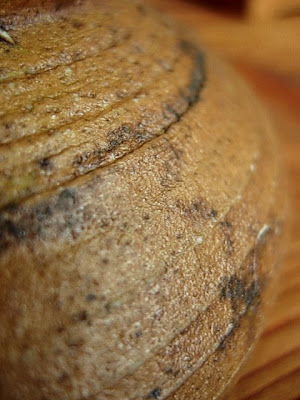
The material of this pot- the texture and colour is woodsy.

The texture of the pot in ones hands feels soft and rough. It is wet, rough beach sand between the fingers. The texture of this pot makes one smile.

Especially beautiful is the blotching covering the handle and the area where it attaches which inevitably becomes the initial focal point of the piece.

One attention is sustained by this pots carefree high looping handle. This capricious handle is cleverly balanced by the downward looping spout on the opposite side.

The form of this pot suggests action from the upward motion of tilting the handle to the downward motion of pouring tea. The middle bulbous body of the pot harness this movement, centering and concentrating it on the water and tea which embrace each other as tea steeps inside.

The flow of tea from the spout, and the peace from which its slow pour suggests, is like no other. A perfect pot for enjoying Korean Greens.

Like the soft trickle of a sparse mountain stream, ones mind flows free once more.

Peace

Sunday, June 14, 2009

Sel Young Jin's Phenomenal Rustic Erabo Style Tea Cups, Part 2: A Mini 'Hal Gu Dae' Style Foot


There is some interesting points about the form of these amazing cups and how they influence the flavour of tea in the comments section of Part 1. Please do check it out.

This petite white cup is a touch smaller than the other, making it the smallest cup one currently uses. In fact it can even be stacked into the other.

It's form is similar to the 'snail foot' but still very individual. It makes up for its size by standing much more pronounced and confident than the other.

This little cup is far from arrogant though. This is partly because of its small stature, but also due to the myriad of interesting imperfections that can be found on this piece.

Its cracks seem finer with greater density than the other. The white glaze barely covers some aspects of this work. We can see the pinkish hues from the clay staring at us from underneath the thin gloss. In one spot on the outside wall of the cup, there is a large blotchy birthmark where the clay almost breaks through. There are so many tinny embedded rocks that stare out at you, only adding to its uniqueness.


But of all these elements, the foot of this piece is the kicker. It is a beauty. This type of foot is usually only found on 'Hal Gu Dae' style tea bowls.

The 'Hal Gu Dae' style, which originated in sixteenth century Korea, is a very difficult style to pull off and, perhaps for this reason, is rarely attempted by the master potters of today. It is characterized by its famous eye-catching foot and the balance that it creates with the main body of the bowl. The original 'Hal Gu Dae' foot has four protruding extensions forming a hollowed-out cross that can be seen on the very bottom of the foot if you flip the bowl over.

This style of foot has a inclination to overwhelm the grace and naturalness of a bowl. The challenge is to make such a monstrous and pompous foot look harmonious, natural, and more modest- not as easy as it sounds.

It is perhaps this very successful attempt at balance and slight standoffishness subdued by such natural imperfections found in Sel Young Jin's favorite 'Hal Gu Dae' style bowl that got Louis Vuitton's attention a few years ago (link doesn't show picture of this 'Hal Gu Dae' bowl but gives the deets on the story).


This mini version, a Sel Young Jin modification, only has three protrusions which seem to properly fit with the size and form of this little guy. The combination of rugged imperfections paired with the slight flashiness of this foot is what one values in the 'Hal Gu Dae' style. It goes without saying that this foot definitely makes a statement.
And as one fashionably sips tea from its innards in a room with old furniture and bare walls, one wonders if Louis Vuitton is doing the same in his big mansion somewhere.

Peace

Monday, June 8, 2009

Sel Young Jin's Phenomenal Rustic Erabo Style Tea Cups, Part One: 'Snail Foot'


It was Hobbes from The Half-Dipper that noticed this little guy in action with some young shang puerh a few posts ago. These three pieces were a gift from a close friend before one departed from Korea.
The care that master Sel Young Jin puts into his cups are beyond what most masters put into there pots and tea bowls. Every micro space of these pieces are beautiful.

Both of these cups are quite small (think small Chinese cup), this one is just a bit bigger than the other. It sits staunchly, its form cute and natural. Its white body resembling the white caps of mountains.

The outside and inside of this cup is riddled with cracks, holes, blotches, and other so perfect imperfections. When ones eyes climb over its lip and onto the inside wall, it is met by a latticework of large cracks. These cracks meet a ring of little holes when the inside starts to level out. One especially enjoys the sight of the lonely hole in the middle of the the cups shallow- as if the poor guy was trying to lend some symmetry to this eccentrically wabi-sabi piece.

The outside wall tells a similar story of cracks that reach down toward a spattering of teeny, tinny holes at the base of the foot.

Yes, this cup has a foot much in a way that a tea bowl (chawon) would have. The detail of it is astonishing.

This foots style is 'Dal Paeng E' style. 'Dal Paeng E' translates to 'snail' because of its obvious similarity to the swirling of a snails shell. Traditionally a nail, twig or whatever was with an arms length was used in clear moment of zen to create the swirl. Although never a perfect swirl, the 'snail foot' adds balance, symmetry, and finality as well as an obvious air of natural beauty. The rustic look of this 'snail foot' was probably made by such a device and imbues such a feeling. The foot has an unfinished feel to it with three exposed blotches of unglazed clay, a permanent marking, a badge of honour only eared in the kiln. Most pieces have these imperfections sanded off. One enjoys the fact that Sel Young Jin choose to leave them on. Perhaps an attempt to roughen the effect of the snail swirl, or perhaps a statement on change.

The change this little rugged cup has undergone doesn't stop after it is cooled from the kiln. It's important to note that this cup didn't look like this at all when first made, but acquired its appearance through ware. This cup was completely white like blanketing fresh shimmering snow when first used. Only as tea penetrated its barely viable imperfections did it acquire the look it does in these pictures.

And as one sips tea from it now, change continues. The snow melts from the mountain peeks that one views from big windows, tea penetrating its cracks and hollows. But for a microsecond everything is clear once more.

Peace

Thursday, December 18, 2008

A Wintery Erabo Style Tea Bowl By Sel Young Jin


Fall has passed. Winter is here.

A few weeks ago one awoke at the break of morning to little wet snowflakes that coated everything as they rode the light mountain winds to the ground. It was marvelous to embrace the red hot embers of the brazier so early this frigid morning and share tea with the first snowflakes of the year. They barely clung to their majestic, ice-crystallized form, dancing outside one's large windows before melting into the ground, quenching the dry winter's thirst.

As the seasons slowly change to winter, one usually migrates from loose leaf green tea and spring oolongs to yellow and black teas, as well as puerh. But the one thing that stays pretty much consistent, is one's consumption of matcha.


Drinking matcha from Sel Young Jin's erabo style bowls are like drinking matcha from the snowy winter mountain. This bowl is heavily glazed, like the slick snow that is beaten by the winds and molded by the blinding winter's sun upon the eves of a mountain temple. It gleams like it too was born of the elements.

It's form only further validates this imagery of cold winter. It's rim is most impressive as it maintains this feeling of snow bulging over the eves, a haphazard drift of snow whipped about by cold winds now leans above one's head.


It's foot is littered with dark black cracks which seem to jump out in the backdrop of white. These could as well be the cracking ice that covers the winter pond. The other small markings left by the ash in the kiln are amplified in these whiteout conditions.


The three spur marks left on the rim of the foot almost resemble foot prints in the snow.

Sipping tea, one marvels at the beauty of this tea bowl, the beauty of this season.

Peace

Tuesday, October 21, 2008

A Tea Pot and Cup by Sel Young Jin


Natural and wild, this erabo tea pot and cup look like they could be newly excavated pieces dating back thousands of years. Sel Young Jin sure has a talent for producing wonderfully textured ceramics that intrigue the senses and the mind.

The pot feels wonderful in one's hands, gloss covering rocky earth. The feel of these works are not matched by the sheer exquisite look of the cracking glaze. The joints that connect the handle and spout of the pot are particularly wonderful as they exhibit a natural roughness and uncut beauty. The grey sandy clay found under and inside this pot is a perfect contrast and allows an unadulterated view at its earthy origins.

Peace

Thursday, August 28, 2008

An Experience With an Erabo Style Tea Drinking Bowl by Sel Young Jin


This bowl is chosen off a wall of about a hundred, all magnificent pieces of art and a testament to the craftsmanship of Korean potters. One doesn't choose it, a friend does the honours. Then that same friend prepares powered green tea in it the same way she does many times daily.

She reaches across the grainy wood table and places it in front of one. Embracing it with cupped hands, this tea bowl's shape just feels right. It reclines in the palms of one's hands like a ball carved from wood, half a ball. The texture is softer than it looks, soft sand. The colour of the bowl bares the badge of large black markings, a result of the ash in the wood fired kiln.


Bringing it toward ones lips, one reverently drinks the tea.


The rings that encircle the outer body of the bowl are a real treat to both the eyes and hands. This bowl imitates the dendrochronology of an old tree. The lines that circumnavigate this bowl trigger deep reflection on life. Just as the rings of a tree allow us to reflect on its life, the rings around this bowl allow one to reflect upon the one who, now, holds it in their hands savoring the moment, savoring life.

Peace

Wednesday, July 23, 2008

Sel Young Jin's Snowy Night

Coming from the extreme heat of the Korean summer, to the air conditioned cool, one sits down to enjoy a bowl of matcha.

One selects a beautiful piece by Sel Young Jin, one that emulates cool, its name, 'Snowy Night'.
The Yame matcha prepared within froths and bubbles with delight, how happy it is to lay within such a cool place. It's radiance beaming from its heady froth, reflecting off the uncut, rugged lip of the bowl.


As one's hands reach for the bowl, pleasurable tactile sensations abound, contradicting visual information. Although this bowl looks extraordinarily rough, it feels much softer and smoother. A thin translucent gloss is felt that blankets gritty earth and large pebbles underneath, like the first winter snowfall atop the mountain, it blankets the dead lifeless earth. Passifying it. Softening it. Beautifying it.


This bowl is gracefully disproportionate, exhibiting marked asymmetry. One side is rocky, earthy, dark brown, dotted with large white pebbles, imitating the slow elegant snowfall of big wet snowflakes, the first snowfall of winter. The other side is coated in thick white glaze blanketing a warped sidewall topped by an irregular protruding notch on the lip of the bowl. This white glaze is remarkably thick and soft on the fingers. The glaze is an accumulation of white, a fresh newly formed snowbank.


The contrast between the sides is so stark that if one were to only view one side of the bowl and then the other, they would surely think that they were viewing two separate bowls. But, now, cradling it in one's hands it seems so natural, so right. Each side completing each other, completing the story this bowl tells.


As one takes the final gulp of tea from this bowl, one's mind is chill. Reflecting on the light purple summer flower resting comfortably in Sel Young Jin's miniature ceramic vase, one is reminded that it is in fact summer. As one puts away the bowl and heads out side, stepping once more into the smug enveloping humidity and extreme heat of summer, one smiles knowing that in frigid winter months one will yearn for even a second of such sweltering heat.

Peace