Showing posts with label ddok cha. Show all posts

Wednesday, June 12, 2013

A Chance to Try Some Aged Peasent Style Korean Tea

Even in Korea it is quite hard to find aged Korean teas. Although the jury is out as to even whether they even improve with age, why not try some for yourself and make your own call on the issue?

Pedro has just came back from this annual tea sourcing trip with some goodies. He is opening his bag with a few teas of note from Korea standing out.

He has brought back some 8 years aged clay covered ddok cha called seong gang ko cha. It was produced by a local farmer, Ga Hee-Jah who is now retired. Have never heard of this tea before but can only imagine that it is some sort of Korean peasant tea, produced in the rural tradition of tea making.

He also has some ujeon grade balhyocha from Kim Jeong Yeol of Butea. Wonder if it will be similar to the 2011 Kim Jeong Yeol Saebyeok that Pedro sent a few years ago?

Pedro will be brewing these teas up at a special event titled "Tales From the Back Road" along with some others. If you are at all curious about Korean teas that are harder to come by, it should be worth your time.

Peace

Monday, September 24, 2012

The Five Traditional Types of Korean Tea


Inspired by this chart found in a post by Toki on The Seven Types of Chinese Tea and this article by Brother Anthony of Taize called The Varieties of Tea in Korea published in The Leaf. Both fall a bit short in explaining or categorizing Korean tea types and their production, so thought one would take a shot at it...

Peace

(click on picture to enlarge)

Thursday, September 13, 2012

Challenging Assumptions: A Groundbreaking English Research Paper on the History of Korean Tea

In a recent article in the journal, Transaction of the Royal Asiatic Society, Korea Branch, Volume 86, 2011, ISSN 1220-0009, by the foremost English authority on Korean tea, Brother Anthony of Taize, published a piece which challenges some older assumptions about the history of Korean tea. The paper is ground breaking as it slightly shifts the lens of which we can view Korean tea culture, in particular tea in the Late Joseon Dynasty (1392-1897). The article looks at the actual historical literature of this period, some of which has just been recently discovered. The following post looks at five previous assumptions about Korean tea that are challenged in this thought provoking article.


Assumption #1: It was the suppression of all things Buddhist, including tea drinking, by the ruling Confucian Joseon Dynasty which contributed to the decline of tea culture in Korea.


"When we turn to the history of Korean tea, the first difficulty we face is the lack of documents from the Goryeo period [918-1392]. It is usually assumed that tea-drinking, which had been introduced from China along with Buddhism in the earlier Silla period [57BC-935], continued to be widely practiced in the strongly Buddhist Goryeo period. Tea trees had been planted near temples in the southern areas early on. Yet from the early Joseon period, when records start to become more plentiful, there is no sign of tea being drunk as a sophisticated or civilized pursuit anywhere, in the court, by scholars or by monks. It might be that this decline had already begun under Goryeo."


The first mention that tea was drank in such as way came, according to Brother Anthony, is from a poem by Jeom Pil Je, Kim Jong-jik (1431-1492) in 1481 where he suggests two important points. First, that tea production has declined, at least in his area of Hamyang. In the maps and detailed geological records from 1454-1530 called Sejong Shilrok Jiriji or The Cultural Geography in the Veritable Records of King Sejong Of the Joseon Period, show that there were over 30 areas of tea production in Southren South Korea, with Hamyang being one of them. Secondly, the Korean Kings demanded tribute tea from certain areas of Korea, and likely had some refined way of enjoying their tribute.


This shows us that although there is a record that showed that tea grew abundantly in Korea, there is no record of a sophisticated tea culture and therefore no proof that it indeed existed in the Early Joseon Dynasty at all.


Assumption #2: Yi Mok's (1471-1492) ChaBu (Rhapsody to Tea) is evidence of sophisticated tea culture in Korea and suggests the depth of Korean tea culture.


"There is no indication as to when or why he [Yi Mok] composed the ChaBu (Rhapsody to Tea), which is unlike any other text devoted to the Way of Tea found in Korea or China, although the influence of the Classic of Tea and other Taoist Chinese tea texts is evident in it. The most striking absence is the total lack of any mention of tea being grown or drunk in Korea. The text is only about the Chinese Tradition."


This suggests that Yi Mok's ChaBu was strongly based on Chinese tea culture and contains no evidence of tea culture in Korea.


Assumption #3: Korean tea culture was kept alive throughout the Joseon Dynasty at Buddhist Temples.


"Tea, we may say with some assurance, was only known in the Joseon dynasty when scholars and diplomats brought some back from China. There is no record indicating that anyone made and drank it for pleasure in Korea. The first extensive text about Korean tea making known from the Joseon Dynasty is Bupung Hyangcha Bo (Record of Native Tea Made At Buan c. 1756) by Pil Seon Yi Un-Hae [1710-?]."


Pil Seon Yi Un-Hae, states in this record, "I heard that there was famous tea growing at Seonun-sa Temple in Bupung. Neither officials nor ordinary folk knew how to drink it, they treated the bushes as mere weeds and used them for kindling, so they were in a bad state."


Yi Deok-ni's Record of Korean Tea states, "In our Eastern land (Korea) tea grows in various localities of Honam (the South-west) and Yeongnam (the South-East). The places listed in the (offical geographical texts) Dongguk yeoji seungnam and the Gosa chwalyo etc are only one tenth, one hundredth of the total. It is customary in our land to use what is known as "jakseol" in medicines but most people do not realize that "cha" and "jakseol" are the same thing. The reason is that for a long time now nobody has made "cha" (tea) or drunk tea. Supposing some dilletante buys tea at a market in China and brings it back, nobody knows how to appreciate it."


It goes on to say, "Once tea reached Korea by ship in Gyeongjin year (1760), the whole country learned what tea looks like. It was drunk widely for the next ten years, and although stocks were exhausted a long time ago now, nobody knows how to pick and make more. Since tea is not so important for our countrymen, it is obvious that they are unconcerned wheather it exists here or not."


Brother Anthony reiterates this message, "It is clear [by interpretation of Stanza 12 of DongChaSong] that he [Cho'Ui, the Saint of Korean tea (1786-1866),] felt the art of making good tea was barely known anywhere in Korea, even among monks."


"There is an often repeated claim among Korean tea experts that it was Hyejang [a monk] who introduced Dasan [1762-1836] [a Confucian] to tea; recently, however, Professor Jeong Min of Hanyang University has argued convincingly that the opposite was the case. Certainly in the poem [of their first meeting] Dasan implies that he knows what to do with tea leaves once he has them, he does not ask Hyejang to give him already dried tea and indeed it is clear from later texts that Hyejang knew nothing about tea except for what he learned from Dasan."


This suggests the opposite is actually true, where confucians likely knew more about tea durring the Joson Dynasty than the Buddhists. Their knowledge likely came through close trade ties to China.


Assumption #4: Tea was drank in a loose leaf form durring the Joseon Dynasty because of the sophistication of the literi which preferred it this way over the more Buddhist cake style of drinking tea. Afterall, the use of loose leaf tea was described in the ChaSinJeon which Cho'Ui, the Saint of Korean tea, made a copy of it.


In Bupung Hyangcha Bo (Record of Native Tea Made At Buan c. 1756) by Pil Seon Yi Un-Hae states that, "many buds are picked, pounded, formed into cakes and roasted."


Brother Anthony states, "Rather strangely, the Ming style tea described in the Chinese text is leaf-tea, and the text was not revised to refer to the caked variety of tea that Cho-ui had learned from Dasan. It seems from various writings of Cho-ui that he only began to make tea around this time. The method he used was that which he must have learned from Dasan years before, that know as "caked tea"


In the Epilogue of the article Brother Anthony states, "Yi Han-yeong (1868-1956), who continued to make and sell caked tea in Gangjin during the Japanese occupation (1910-1945) in a manner he always claimed to have inherited from the practice of Dasan and his students. He called his tea Baekun-okpan-cha. He was the only person known to have been producing and selling a specifically Korean form of tea during the Japanese colonial period."


This suggests that tea was consumed in Korea with very little sophistication, tea not as fine loose leaves but produced as medicine, likely in a form similar to ddok cha.


Assumption #5: Korea developed and used its own tea implements for appreciating tea.


In Yi Deok-ni's DongChaGi he states, "In the spring of Gyehae year (1743)... Our host had prepared places beneath the pines, close to a tea-brazier; brazier and utensils were all Chinese antiques and we each enjoyed a cup."


This shows us that Korean tea implements were not used in the consumption and appreciation of fine tea, which was not local tea but that imported from China.


Besides challenging these old beliefs about Korean tea, Brother Anthony's article gives those interested deep historical background to which we can understand the Korean classics in a more complete way. Highly recommended reading.


Peace

Tuesday, September 4, 2012

Aged Korean Tea: Ten Year Evolution of Ddok Cha


Pictured above is traditional coin shaped ddok cha from different producers in different years. From left to right and top to bottom: 2002 Teamaster Mrs. Beak, 2007 Teamaster Mrs. Jung, 2008 Joytea, 2012 Bohyang. You can see from the photo the change in colour as the coins age from a dark green colour of the 2012 coins to dark slight reddish tinged brown of the 2002 coin. The odour of the dry coins also change considerably from vibrant, sour, slightly pungent, floral notes in the fresh coin to more rich, deeper, fruity, slightly medicinal, odour after five years, to a more grainy, deeper, fermented smelling 10 year coin.


Please stay tuned to future posts where we will explore the changes in taste, smell, mouthfeel, and qi as we steep up some of these old rare ddok cha coins.

Peace

Tuesday, June 26, 2012

Preparing Coin Type Ddok Cha the Traditional Way: Tasting of 2008 Bo Hyang Tea Certified Organic Boseong Ddok Cha


One has been storing a bunch of coin type ddok cha for a while now in hopes of obtaining a ceramic tea roaster. The preparation of coin type ddok cha with the ceramic tea roaster was outlined in an old post. Steven Owyoung's recent detailed post covered the steps taken to charcoal roast ddok cha as done by Master Hyo Am and witnessed at the Korean Tea Exhibition. This moved one to finally prepare these coins in the traditional way without the long awaited tea roaster.
One decided to try a 2008 coin type ddok cha from the certified organic gardens of Bo Hyang Tea that Pedro had recently obtained from an early spring trip to Korea. These flower shaped coins were once strung together with straw and stored in a box. They emit a very faint, almost spicy odour.


Korean charcoal is lit and the coins are roasted over the hot charcoal with common Asian restaurant disposable bamboo chopsticks. The coins release a subtle roasted tea odour that is very similar to the odour released from the recent re-roasting of stale green tea experiments. The coins darken in colour over the heat of the charcoal and are removed from the heat as the edges of the coins stared to toast.


A glass kettle of local spring water is brought to boil and the coins are broken into thirds or halves and placed in the boiling kettle. The kettle is turned to simmer and the tea is left to steep. The room fills with a pleasant roasted tea, almost-oolong-like odour as the liquor turns from yellow to a deep amber colour.


After 10 minutes of simmering a clean hemp cloth is unfolded over a large buncheong Kim Jae Son tea cup so that the cup is under the middle portion of the hemp cloth. The tea is slowly and meditatively poured through the hemp cloth and into the cup. When the tea no longer filters into the cup, the cup is full. The hemp cloth is folded in half with the far end being folded over the bottom so that the crease of the cloth is covering half of the cup. The cloth is then folded into a triangle and the remainder of the tea is left to filer out the corner crease into the cup. The cloth is them placed next to the cup.


The tea mindfully sipped and reveals subtle watery-spicy notes over a subtle grain-cereal base. The mouthfeel is full in the mouth, a soft coarseness, with soft simulation even trailing into the mid-throat. Cereal notes linger in the aftertaste. The qi is calming, powerful, relaxing, and slightly warming.


The kettle is left to simmer another 5 minutes and the tea is filtered and imbibed once again. The tea is virtually the same as above. The cereal notes seem to carry more sweetness now and the mouthfeel is also more expansive here. Subtle forest notes are spotted under the cereal base. As the broth cools a bit it develops more subtle spicy aftertastes. The qi clears the eyes and mind and leaves one very relaxed. The chaqi tranquilizes all errant thoughts leaving peace.

For more information on ddok cha see past posts here which also have links embedded in them to Steven Owyoung's brilliant Ddok cha articles.

Peace

Wednesday, January 4, 2012

The Tradition of Korean Peasant Teas


If you think that the farmers that scatter the rual south of Korea are drinking the finest first pick Ujeon grade teas in the teaware of old ceramic masters, you are wrong.  Most farmers and labourers in tea producing areas choose to sell their best teas for cash or give it as gifts and sometimes drink more modest teas prepared in a very simple way.  Koreans are very practical people.  Throughout history Korea has gone through periods where the price of tea was beyond the reach of the average person, this is especially true for the finer Korean teas.  Even today, Korean tea is quite expensive.

Today Koreans who don't or can't purchase the finer teas can easily enjoy inexpensive Korean tea the way that the world's common people enjoy it, in a tea bag.  The tea bag is a relatively modern invention of the last century.  In the hundreds of years before the invention and use of teabags these Koreans resorted to peasant teas.

There are two practical considerations that have lead to the development of peasant teas in Korea.  The first is to not waste good quality tea.  The second is to make use of lesser quality leaves.

Tea in Korea is picked according to seasonal markers.  The most subtle teas are picked in the early spring (ujeon grade) and become deeper with a larger leaf as they are picked later into spring and summer (in this order: saejak, jungjak, daejak).  Loose summer teas are rarely picked and sold because they have lost much of their complexity at this point.  However, they are still perfectly drinkable, often organic or semi-wild, tea.  One method of preparing these later picked spring/ summer leaves is by producing chung cha.  Chung cha is produced by a very simple technique which involves roasting the freshly picked leaves in an iron cauldron to kill-green, hand rolling, allowing short time to wither, second roasting, then sun drying.  This crude technique is very similar to the way puerh tea is produced.

Sometimes later picked spring and summer leaves are used for ddok cha especially coin type ddok cha.  This is because the later picked leaves have a deeper, hardier quality to them that are in some ways better for aging than the more subtle picks of Ujeon and Seajak grades.  These less expensive leaves can also be stored for a longer time when they are compressed into cake forms.  This allows them to be enjoyed at a later time, after the higher quality tea has been consumed.  Very simple, peasant style ddok cha can also be produced by freshly picked, but leftover, tea leaves that have not undergone the rather labour intensive production of green tea.  Even cruder forms of peasant style ddok cha can be made by using up old stale green tea that is left over from last season.  These finished but stale loose green tea leaves are steamed, pulverized with a wooden mallet, pressed into cakes, and then left to dry.  It is important to note that the ddok cha that is available for sale in Korean teashops is not produced in this style but rather from high quality, fresh, seajak or jungjak grade leaves.  The ddokcha for sale in shops is produced using a very deliberate and refined method of production.

Ddok cha is not the only type of peasant tea that Koreans make with older stale green tea.  They may also crush this old green tea up in an attempt to oxidize the tea, then they store/age it as balhyocha.  They also re-roast green tea, especially higher quality but stale green teas.  The re-roasting is done just before the tea is consumed to awaken the qi of the tea.  One has seen this re-roasting done over a ceramic device than looks very similar to a tea warmer.  A small, wide-angled, cylindrical-cone shaped ceramic cup is warmed by being placed in the ceramic holder.  The ceramic cone rests in the holder directly above a tea light or small oil lamp.  When the ceramic cone shaped cup is warm the stale green tea is placed in the cup.  It is removed from the heat and shaken to mix it up and give it an even roast before being placed back over the heat source.  This tea is roasted in very small batches, just enough for one pot.  The awakened green tea is placed in the pot either immediately after the roast or after it has sat out for a short while.

As you can see Korean peasant teas are inexpensive teas that undergo simple even crude production.  Nowadays these teas are quite rare especially outside the rural tea producing regions of the south, even few tea people in Korea are familiar with them.  However, they are an interesting but rarely discussed part of Korea's tea culture and history.

Peace

Sunday, September 25, 2011

Is Jukro's 2011 Ball Shaped Cake "Tong E Cha" Uricha The Same As Its Loose Form "Bal Hyo Cha" Uricha???


Balhyocha (Korean yellow tea) pressed into a bell/ball form cake is a rather new trend in Korea these days. Even a few years back, the bell shaped balhyocha couldn't be found in Korea. Joytea was perhaps the first in recent times to offer the tea in this form. Ever since Joytea's bell shaped balhyocha won some international tea awards more balhyocha has been popping up pressed into the bell shape.

Over the last year or two, famous tea producer Jukro has began to offer its balhyocha in a 100g ball shape. It is packaged beautifully in a wooden box with two cakes per box. It retails for 120 000 Won (approx $120 for 100g x 2) for the boxed set or 50 000 Won (approx $50 for 100g) for a single ball without the fancy packaging. The Jukro site lists this product as "Tong E Cha" or "cake tea".

Jukro has traditionally offered its balhyocha in loose form only and continues to do so. One has been drinking this tea for ages now and it is consistently touted as one of the best (see here and here). It retails for 50 000 Won (approx $50) for the 100g box or 25 000 Won (approx $25) for the 50g bag. The Jukro site lists this product simply as "Bal hyo cha".

Ever since the introduction of Jukro's ball shaped bal hyo cha ("Tong E Cha"), one has wondered how the change of shape and variance in production impacts the experience of this classic Korean tea. The following post will examine the question of whither these two teas are the same or are different and will look at how they differ.

Readers may have noticed that there have never been side by side cuppings here on Mattcha's Blog. This will not change today. Although multiple cuppings reveal much about two similar teas under the same conditions, this method also has its disadvantages. If you are drinking two teas at once how can you determine the qi of one tea from another? How can you note how a teas flavour, fragrance, and mouthfeel compounds throughout a tea session? Also certain subtle nuances of one tea can always interfere with the nuances of another if you are drinking them together. In the rare instance that a close comparison of two teas is warranted, one usually compares them over a few days. Drinking tea A one day one, tea B on day two, then a complete session with tea B early in the day followed by a session with tea A that same day.

With the Fall Equinox signaling the perfect time to consume balhyocha what better time to compare these two teas. The loose balhyocha was purchased with this years tea order from Korea and a ball cake sample was kindly gifted by Pedro for this comparison. Throughout this post the loose balhyocha will always be pictured above the ball cake balhyocha. So let's look at the dry leaves...


The loose balhyocha's leaves seem a bit larger and have more of a blue green sheen to them that can even be seen in the picture above. The loose balhyocha leaves are coated in a dusty film that the ball shape does not have at all. The ball cake's leaves are smaller in size and are a deep dark brown-black colour. Appearance aside, the odour of these two leaves is also markedly different. The loose balhyocha smells of more subtle roasted nuts and light cereals with more of a creamy chocolate finish, even slight wood notes can be sensed. The ball cake's odour is of very deep chocolate odours that lean to a more brisk, deep, bitter dark chocolate.


Both pour an identical deep gold-yellow and share the most distinct chocolate tastes. The first few infusions of the loose balhyocha have distinctly creamy-nut and chocolate notes. The ball shape has less of the nutty notes and has a slightly richer, smoother, mellower taste and feel. The chocolate taste of the ball shape is barely more sour and bitter in these earlier infusions. These differences are very subtle. Both share the same long mellow chocolate aftertaste that slowly parts from the initial flavours.


At around the fourth infusions, the loose balhyocha has a slight juicer edge to it. The loose balhyocha also shows more woodiness here among its creamy nutty chocolate base. The ball shape now comes closer to the loose forms slightly more nutty taste. The differences are barely noticeable, so slight. The mouthfeel is also very similar with the ball shape having slightly more presence in the throat and the loose balhyocha perhaps having a juicier edge, both exhibit a very soft, mellow, velvet mouthfeel.

The later infusions suggest that the loose balhyocha has slightly less stamina- this makes sense when referencing other cake teas such as puerh as the leaves take a bit longer to awaken from their pressed posture. Compared to other balhyocha both have excellent stamina.

As a result, the loose balhyocha seems to flirt with woodier and citrus notes among its milky-nutty flavours earlier than the ball form. The bell cake only reveals these nuances in the last few pots and remains slightly more mellow and rich in taste and feel.


The qi of these two teas also shares very subtle differences. The loose balhyocha has slightly stronger qi in the body and is just a bit more warm and active especially in the middle of the body. The ball cake has a more mellow presence. Both are strongly comforting and slightly warm and have a reasuring and relaxing affect.


In the end the differences are barely noticable and could simply be caused from storage and the slight differences in production.


Peace

Edit: The loose "balhyocha" is currently available from CoreaColor (see here).  
Le Palais Des Thes was the first company to offer the loose Balhyocha to the Western audience and still does (see here).  
TeaMoutain made a recent addition to the Korean teas they sell and is the only Western dealer to stock Tong E Cha (see here).

Double Peace


Edit (Jan 22/2012): A representative from Jukro confirms that there are slight differences between these two very similar teas.  Both of these teas undergo around 3 months of aging before released.  The loose balhyocha undergoes an oxadative fermentation rate over 80% and is less bioactive than the cake Tong E Cha because it is sealed in an airtight bag.  The cake Tong E Cha has an oxidative fermentation rate over 95% and is more bioactive because it is not packaged airtight and can continue to ferment as it interacts with the air.  This no doubt explains the slight differences in these two teas.

TRIPLE PEACE!!!

Wednesday, July 28, 2010

2009 Joytea Organic Hadong Disk Type Ddok Cha


This ddok cha is the disk type from Joytea. There is also a five pack available on their web page that is wrapped in bamboo leaves and bound with three strands of tradtional Korean paper (click here then scroll down). The production of this disk type ddok cha is consistent with the usual steps for this type as follows.

After the tea is picked it undergoes a kill green stage where the tea is hand tossed in a heated iron cauldron after it is picked. Then the tea undergoes a shaping/rolling process that should strike a nice balance between being the lighter shaping of green tea and the violent shredding of red tea-leaning much closer to green tea production of course. Proper pressure and technique here very much influence the final product. The leaves are spread out evenly over bamboo baskets and left to dry for 1-2 days in the open air where they are libel to catch the rising and setting of the sun and moon. They are then pressed into cakes. Joytea uses cloth to press them in much the same way puerh tea is pressed, as a result, the imprint of the fabric is found on the final product. They are then dried in a well ventilated room.

The dry leaf looks quite nice and is examined closely as one widdles away the longish mix of leaves that comprise of this cake. Upon closer inspection the leaves are mainly medium-largish with a slight greenish tint to them. There are also reddish, yellowish, and white outliers mixed in for good measure. This cake is stone pressed and carries with it the imprint of the fabric bag with which it was pressed. The compression is pretty tight for disk type ddok cha which can also be pressed between two large planks. It is about equivalent to a lighter stone pressed puerh. The odour of the leaf is sweet, rich, and deep. It has a sour musky green smell that is also sweet. It has faint notes of raison and pine wood in it as well- a great smelling ddok cha.


When the water has cooled just slightly in the cooling bowl it is added to the pot of dry ddok cha leaves. Out pours a bright yellow. It is light, sweet, and a very musky dingy floral that evolves into pine wood then into a very sweet finish. It has a dry forest like aftertaste and fills the mouth with a thin coat that is thick and viscous.

The second pot is prepared and consumed with great care. A juicy, thick liquid starts musky and deep and turns into welcomed strong floral sweetness. It finishes dry with deep green forest-like aftertaste. The aftertaste is deep and long.


The thickness of this tea is apparent throughout the session. In the third infusion this thick viscous soup offers deep flavours especially a more pronounced floral that trails into the aftertaste and is a bit bland. A musky floral scent lingers in the nose. After the tea is gulped down it leaves a slightly sandy and dry sensation on the lips and in the tongue. The qi of this tea hits ones mind and is strong. Things are clear, ones mind and spirit are open. It seems to flood the middle jiao but refrains from attaching it and simply mellows there.

The fourth and fifth infusions offer a light, more up-front, bland, sweet, floral profile which turns into a dry, deep forested, slightly floral, green tea aftertaste. The tea now starts to show its green tea bottom that is now exposed in the thinning complexity. Dry astringency also emerges especially in the finish.


The sixth and seventh infusions become progressively more bitter but retain the thick oily and smooth mouthfeel which is such a treat for the tactile receptors of the mouth. There is still a flash of sweet floral taste in these infusions, sometimes even an undulation of fruitier notes. The aftertaste remains bitter and musky with much depth.

The chaqi slowly radiates outward from the middle. The age of this ddok cha puts its thermal energy somewhere near neutral. On this cool summer day it feels as though it is slightly on the cooler side of the spectrum still. Ones body and mind feel extraordinarily quiet and relaxed.

The eight, ninth, and tenth infusions comprise of a light, floral sweet tea, with still some bitter, forestlike depth. The mouthfeel is still quite oily and the aftertaste is mainly just bitter and bland.


This tea can be taken for many infusions, stamina is definitely a good quality of disk type ddok cha of this age. So it is enjoyed throughout the next day like this- the infusions coming and going with the rising and setting of the sun and moon- a wonderful ending mirroring its production.

Peace

Saturday, July 10, 2010

Joytea Introduction And A Sampling Of 2009 Joytea Organic Hadong "Balhyocha" (Yellow Tea) Disk Type Ddok Cha


Joytea was the first Korean tea company to begin selling ddok cha a few years back. Before this company started selling ddok cha, it was only available from small family and temple productions. Joytea has gained some notoriety in the last two years in Korea by promoting its traditional hand made product, by winning some tea awards at tea festivals domestically and in Japan, and by certifying its tea plantation with the highest level of organic certification available in Korea. As a result, the price of their new product has almost tripled since 2008.

All of the tea that Joytea produces comes from its plantation in Hadong 400 meters above sea level. Besides offering three grades of yellow tea and three grades of green tea, Joytea also sells coin type ddok cha, disk type ddok cha, and this interesting yellow tea disk type ddok cha. The ddok cha products will receive their own posts in the coming weeks and months.

This sample of yellow tea disk type ddok cha actually didn't come from a disk at all but came from a 100g bowl/ bell shape (click here for a picture). This tea can also be purchased in a five pack that is strung together with Korean traditional paper straw and wrapped in bamboo (click here then scroll down for a picture of this packaging).

This Yellow (Bal hyo cha, Hwang cha, semi-oxidized tea) disk type ddok cha is only classified as "ddok cha" because the final step of production involves the tea being pressed into a cake. It is truly a yellow tea pressed into a cake form. The product description on joytea's web page describes the normal production for a Korean yellow tea which involves oxidization by vigorous rubbing on a rush mat and withering until the desired level of oxidization is achieved, in this case 60% oxidization. This tea is then shaped into a cake.

This tea is a bit of a rarity because it is the only yellow tea one has ever came across that is cake pressed. Generally Korean semi-oxidized teas don't possess the strenth nor the depth acceptable for aging. All other ddok cha that one has encountered is essentially pressed green tea. So this tea is a bit unique in that respect.


The kettle shakes as water boils, one closely examines this sample. It smells of sweet raison and is composed of long, straggly, dark brown with slight red tinged leaves.


The first infusion is prepared with water that was cooled for a short time. It is full of light, watery, plumy tastes. Its mouthfeel is soft and huddles on the middle of the tongue and front of the mouth. The aftertaste is light, fruity, and dry but has a dusky finish that hits at a grittier bottom.


The second infusion is plumy also peachy at first then fades somewhat into dryness in the mouth. The mouthfeel is more at the front but feels full enough there- nice.


More water is boiled up and the third infusion is prepared. It tastes fruity but at the same time soft, gritty, grainy, and dry. The flavour of this tea is fairly stably throughout infusions. The mouthfeel is now coarse and dry.

The fourth infusion is enjoyed as light spice flavours mix with slight fading fruitiness. The mouthfeel becomes tart, dry, and a touch gritty.


This tea continues on for a few more infusions but doesn't offer any real change in its profile other than becoming more watery and flat. Strangely it offers some strange soft fermented-tea like depth in its aftertaste even as its flavours are quick to fade.

Peace

Friday, June 25, 2010

Defining Two Distinct Types of Ddok Cha: Differentiation Based On Appearance, Production, Preparation & Taste Profile


Ddok cha (tok cha, ttok cha, dok cha), a rare and very traditional form of tea produced in Korea, has drawn the attention of the tea drinking community world-wide. Besides the information on this blog and a wonderful article by Steven Owyoung on Cha Dao, little has been written about this interesting tea. Of what has been written, there seems to be some confusion as to what constitutes a tea being ddok cha (see comment section of Cha Dao article).

Ddok cha, simply put, is Korean cake tea. Under this definition any tea from Korea that is pressed into a cake can be classified as ddok cha. Because of such a broad definition, you may be thinking that there must be an infinite number of different sizes and styles of ddok cha. Not really. In ones experience with this type of tea there seems to be two types of ddok cha. These two types can be classified by different appearance, production, preparation, and flavour profile.

The first type is the coin/ heavily pounded type. The coin type is about the size of a fairly densely packed silver dollar coin and many are often strung together, through the middle, like the way you would picture old Chinese coins. According to Brother Anthony of Taize, this type is sometimes referred to as "yop jon cha" or cash tea.

This coin type goes through the last steps of its production by being pounded with a large wooden mallet on large wood planks or pounded mortar and pestle style using large wood logs in a large stone bowl. When the tea is reduced to a gunky pulp it is placed into moulds, dried to form, and quite often strung together. A picture of traditional moulds can be found on the bottom picture of this post by Toki of The Mandarin's Tea. Click here for a detailed video outlining the production.

The coin type ddok cha is best enjoyed the traditional way, a way very similar to the way Lu Yu describes Chinese Tang Dynasty tea in his book The Classic of Tea (circa 760-780 AD). Click on these posts on Cha Dao and A Tea Addicts Journal of attempts to make Tang tea with ddok cha.

The traditional way of preparing coin ddok cha involves roasting, breaking, then boiling (or at the very least long steeps with just off boiling water). The roasting stage is quite important because if the tea is over roasted it will loose its essence or even taste burnt. On the other hand, if the tea is under roasted its full flavour can't be appreciated and the tea may be too bitter. It is ones understanding that some Koreans roast the whole coin and others break it up first and use unique teaware, a ceramic tea roaster, to roast the tea.

A Korean tea roaster looks much like a ceramic Korean tea warmer. Fitting with the style of southren wares it looks very rustic and natural and usually looks almost stonelike. It is hollowed out and has a place where a tea light can be placed. On top there is a hole, into which the conical metal or sometimes ceramic piece is placed over. The cone is placed right over the tealight. Tea is added into the hollowed out cone and is roasted there. Stirring is required to distribute the roast evenly across the broken tea pieces.

After the tea has been roasted to perfection, the tea is either broken into pieces (if it hadn't been previous broken) then it is added to either a kettle (sometimes a ceramic kettle) on very light boil or it is steeped in a tea pot using water that is just off boil. After boiling in a kettle, place a clean hemp cloth over a cup or serving pot and pour the tea through the hemp cloth so that the froth and teabits are filtered out.

Its taste is spicy, medicinal, and bitter when prepared in this traditional way. Due to its tighter compression, crushed composition, and more extreme preparation, aging coin type ddok cha tastes much better as it mellows with age.

The other type of ddok cha is the larger disk/ pressed type. Usually about 100 grams of tea are pressed into a disk shape that resembles a mini bing but can also take other forms such as bell shapes or ball shapes similar to tuo cha. The compression is not as tight as the coin type ddok cha. These cakes are wrapped in traditional Korean paper and are often tied together with hay or bamboo string in groups of 3s or 5s or wrapped in bamboo leaf similar to a tong of puerh.

Unlike coin type ddok cha, disk type ddok cha doesn't get pounded to a pulp. During the last steps of its production it is either pounded lightly or pressed between large wood planks. After the right amount of tea is measured out then it is often pressed by planks into form.

The disk type ddok cha is prepared in a Korean ceramic tea pot. It is wise to not use just off boiling water for young cakes as the tea can still be a bit bitter if prepared in this manner.

Fresh disk type ddok cha tastes somewhere between a Korean yellow tea and green tea. Due to its loose compression, it ages quicker than the coin type. Its full intact leaves allow for much less bitterness and more full flavoured profile. With age this tea gets much more mellow in taste, stronger in qi, and more floral in nature.

To avoid confusion on the topic of ddok cha in the future, one believes that ddok cha should be referred to using these subtypes- coin ddok cha or disk ddok cha.

Peace

Thursday, October 23, 2008

Kind Simplicity: A Tasting Of 2008 Red Box Ddok Cha


One received this tea as a gift from a friend who received it from another as a gift. He knew absolutely nothing about this tea except that it was traditional style ddok cha. He said that it probably came from the Jiri mountain area but even that was just mere speculation. The only thing that one knows for sure is that it came with kindness in a red box.


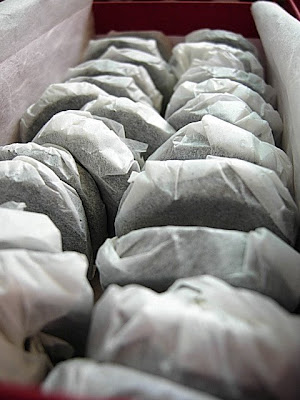
Opening the red box and removing the thin white rice paper which veils its contents below reveals a strong smell of slightly medicinal spicy cinnamon and two long quaint rows of tiny coin-shaped ddok cha cakes all individually rapped in rice paper. The scent of anything resembling tea is lost in the spicy blanket of odours. One takes up a single coin, unwraps it, breaks it into smaller chunks, and drops it into the bottom of the tea pot. Soon near boiling water embraces these pieces and the resulting infusion is poured into a serving pot then from a serving pot into small ceramic cups.


This tea fills ones mouth with a simple, very watery, flat, sweet, clear cinnamon taste. This tea is probably the very opposite of complex and doesn't hardly change at all from infusion to infusion other than conjuring a bit more astringency. The faint aftertaste mirrors the initial taste- a testament to its simplicity.


When two cakes are added as opposed to just one this tea is much more enjoyable as a bit more astringency pushes this tea to a more complete, yet incomprehensibly simple, feeling and taste in one's mouth.


One basks in and gives thanks to this tea's uncut, transparency.

Peace