In Korea many years ago it occurred to me that any type of tea can be aged into something different and potentially interesting. I came to an understanding that it doesn’t even have to be the typical type of aged tea or hei cha (puerh, liu bao, liu ann) to be aged. I came to this revelation earlier than some, influenced by the different types of tea produced in Korea many of which can be aged.
Wednesday, February 20, 2019
Any Tea Can Be Aged, I Suppose
In Korea many years ago it occurred to me that any type of tea can be aged into something different and potentially interesting. I came to an understanding that it doesn’t even have to be the typical type of aged tea or hei cha (puerh, liu bao, liu ann) to be aged. I came to this revelation earlier than some, influenced by the different types of tea produced in Korea many of which can be aged.
Monday, February 20, 2012
2011 Dong Cheon "Dan Cha" Semi-Wild Hwagae Valley Red Tea
First, there needs to be a comment on the name of this tea, "Dan-cha". Arthur stated that the teamaster at Dong Cheon Tea, Kim Jong Gyun, prefered to call this tea "Dan-cha". This is interesting because red tea in Korea is commonly known as "hongcha", the Chinese transliteration. What is also interesting is that this tea is not named the literal red colour in Korean which is "Bbal kang". So this begs the question, "Why is the name "Dan-cha" preferred?
The name "Dan-cha" has Daoist roots and implies good health. More specifically "Dan" here is alluding to the "Dantian" or "cinnabar field". Essentially it is referring to a deeper essence of red or cinnabar red. It has health implications because it suggests that the chaqi of this tea can touch our essence as it traverses the three chambers of our body. Arthur has since commented that the name was intended to imply "Dan-yak" or "miracle cure", another Daoist view of the teas potential health benefits.
Let's sit down with this tea meditatively and see if this tea is truly red tea, if it stands up to its name, and if its chaqi is at all penetrating.
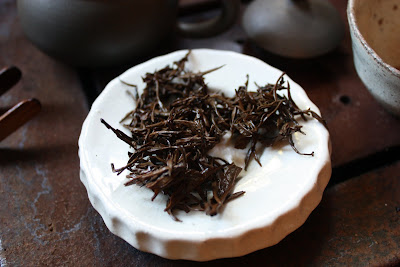
The dry leaf is comprised of small black saejak grade leaves. They smell of deep, meaty, licorice notes with light woody-raisin notes in the distance. There is an interesting meaty-pungent odour in there as well.
These leaves are placed in a warm pot and water that spends only seconds in the cooling pot is makes its way over these leaves.
The first infusion presents with smooth-creamy bitter-sweet mild astringent black tea initial taste. The colour of the pour is a vibrant red-brown- if any doubts about it being a hongcha have arisen they are completely gone. A woody-raisin taste with a smooth sweet finish fills the mouth. There is a lingering mahogany-date quality to the finishing taste. The mouthfeel is full and goes down to the lower throat, coating it. One breaks a sweat all over, cheeks feel flushed, ones mind accelerated. A maple syrup-like sweetness is left on the breath appearing minutes later.
The third infusion has tangy notes that are almost citrus and present first over the wood-raisin base. They evolve to a creamy, raisin, walnut, almost-chocolate, deep wood taste. There is a prominent and even sweetness throughout. The mouthfeel is more chalky and thick but a soft quality coats the full throat and mouth. A sweet syrupy-nut-raisin is left in the long aftertaste.
The fourth has a soft chalky wood start which becomes tangy before the deeper raisin wood is revealed. It turns tangy again as the wood-faded raisin sweetness holds in the aftertaste. The mouthfeel now has a soft, dry quality to it. The qi still pushes hard with each cup.
The fifth sees the soft, sweet, deep walnuty-wood taste becoming lighter now and evolving into a deeper mahogany raisin which comes out later and lingers with sweetness.
In the sixth soft, sweet, tangy wood start fades into a juicy and faint fruity nutty watery raisin taste. The fruit notes come out in this infusion. The mouthfeel is slowly coming out of the throat and more into the mouth, it is a little drying.
The seventh infusion is much the same with fruit notes more obvious and a touch of malty-syurpy sweet finish noted. The mouthfeel continues its evolution to a thinner chalkier type.
The eighth infusion presents more of the fruity-wood bark initial taste with that red tea astringency gone this tea now tastes like quality balhyocha. It evolves into a deeper woody taste. The mouthfeel hold the upper throat and mouth.
This tea is enjoyed for another four or five pots. Here woody notes are more dominant but still full complex flavours can be found. Of note are the appricot and faint coco undertones enjoyed in these late infusions.
Link to Cha Yi Ji's Tasting Notes
Link to dicipleoftheleaf's Tasting Notes
Currently 2011 Dan-cha is available from the following vendors:
Morning Crane Tea
Phoenix Tea House
Peace
Monday, December 12, 2011
2009? Wild Lapsong Souchong
Monday, February 21, 2011
The Types of Tea and Their Chaqi: Darjeeling Second Flush
Darjeeling tea is known for its warming properties. These warm thermal properties of second flush Darjeeling are due to a variety of factors. Most of the warmth develops as the green tea leaf is oxidized. Oxidization induces warm thermal energy. The once green, cool properties of the plucked leaf undergo a process where heat is generated as the leaf oxidizes. The result is a dry leaf that is dark often with a reddish tinge to them, a liquor that is red-brown, and wet leaves that are coppery brown. All of these colours contain the colour spectrum of a dark red. Red is the colour of summer. Early Summer, late spring is when these leaves are picked. As a result they contain in them the heat of summer. Red is the colour of the Heart, therefore this tea is especially good for preventing heart conditions (see here and here and here). Because these leaves grow slowly at such high altitudes often among the high misty mountain tops they generate more heat, more yang. These leaves also contain in them dark colours. Darker colours indicate depth, like the depth of space or that of a deep ocean. In this way the qi of Darjeeling second flush is warm and deep, qualities that are often sought to balance the cold depths of Winter, or simply when we feel cold.
The taste of Darjeeling Second Flush also is an indication of its qi. Hong cha is sometimes known for its rather bitter taste, especially when production dictates heavy oxidization. Bitter tastes are descending in nature and have a special relationship with heat in the body as it is often associated with the communicating transfer of heat from the upper (yang) parts of the body to the lower (yin) parts of the body and conversely from the lower parts of the body to the upper parts of the body. This is especially true with second flush as it contains both the colour red, warmth, and darker colours that represent depth. Bitter tastes also descend deep in the body.
However if it was a strong bitter taste, its properties would be too harsh and would simply have a draining effect on the body, thereby depleting our qi. This is not the case because there is balance between Taste and Smell. The deep bitter taste anchors the warm qi downward and the light smell of florals and fruits lift it up. There is good movement of energy, a communication between upper and lower imparting heat there.
The bitter descending taste is also moderated by a fruity, often muscatel, sweetness. Sweet tastes strengthen and ascend, remedying much of the harsher effects of the bitter taste while circulating the warm thermal energy.
Second flush Darjeeling is processed in a way that a large surface area of the leaf and the enzymes released in production are quickly exposed when steeped in hot water. The release of its energy is quick and often dramatic and powerful, usually resulting in fewer more powerful infusions.
The nature of Darjeeling second flush is such that Middle Way is therefore maintained as Yin (descending, deep, dark, more taste, and bitter) is masterfully balanced in the cup by Yang (ascending, light, red, floral odour, and sweetness). The balance and harmony of this tea along with its characteristic cha qi is why Darjeeling Second Flush is even prized by the teamasters of Asia, least those with an open mind.
Peace