Friday, June 7, 2019

2019 white2tea Is A Gift I Can Accept


There are two kinds of people in the world

One who has a more difficult time giving a gift

And one who has a more difficult time receiving one.

                                                -Unknown

I think it’s safe to say that I am the later and Paul of white2tea is the former… And so here we are in this current predicament… There is a bit of history to the name of this puerh cake “Is A Gift”...

Its origin can be partly traced all the way back to a reddit thread and a review of 2015 white2tea Little Walk by commenter tinkle4 who called the cake a real snoozefest.  This meaning is one of the generally accepted origins of the famous limited 2017  & 2018 Black Friday sheng puerh offerings at white2tea, the Snoozefest.  By naming these cakes “Snoozefest” , Paul has essentially  responded to a critic with the response of a pink coloured cake along with finishing the cake description with “All Love ;-) “

On this blog I put this cake under the microscope over the past few years, in part as an analogy that represented the white2tea brand (and in part a critique of the puerh industry as a whole even consumerism as a whole).  The first article I published about the 2017 Snoozefest cake was a very critical article about the philosophical underpinnings of Paul and white2tea.  In fact, I have published a few fair but pretty critical articles about white2tea (here and here).  Conversely, I also try to show Paul and white2tea lots of, well deserved, love as well (here).  When the cake was released again in 2018, I published a second article about the 2018 Snoozefest which was apologetic about my overly critical position, it struck a tone of positivity.  The final conclusion that I reached about these Snoozefest is as follows:

I realize that “Snoozefest” has a different meaning all together.  Offering a puerh cake at $0.08/g of fresh puerh has to be pushing that lower profit limit for most of our western puerh vendors like white2tea…  So, I now feel that offering fresh puerh at $0.08/g is probably a gift  in and of itself.  Something, I failed to understand a year ago.

The wider meaning of “Is A Gift” is sharing, giving, positivity, love, forgiveness, apology, all inspiring themes that are repeated over and over in the 2019 white2tea spring sheng puerh line up.  The wrapper then states “Be Nice” with a heart dotting the “I”. In the same way Snoozefest is a response to tinkle4 and his critique of 2015 Little Walk, the name, wrapper design, and description of 2019 white2tea Is A Gift is a response to my critique and later realization that Snoozefest is a gift.

In the email that launched the 2019 white2tea Spring sheng puerh line up there was quick list of recommendations with links that best describe you.  The link to 2019 white2tea Is A Gift was “I’m a millionaire who enjoys a good fight.”  This description was the most unusual of all the descriptions, I think.  However, it spoke to the fact that this cake was designed for the critics  “who enjoy a good fight.”  Conversely, it also criticizes the critics.  It points out that those who often seem to be the most critical (tinkle4 and MattCha) are also criticizing the absolute cheapest, or bottom of the white2tea brand.  In a way, calling us a millionaire is calling us out.

Alternatively, the name “Is A Gift” is kind of fitting for this cake because the description of the cake seems to make it an immediate target for its critics (i.e. the description is such that it makes this puerh a gift to those who criticize the white2tea philosophical brand). The description is as follows:

2019 is a gift is a small production of difficult to acquire material that rarely sees the light of day in the larger market.

Basically, this description seems like Paul is saying that this is gushu (ancient arbour puerh) without actually stating it outright.  What else is small production, difficult to acquire, that rarely gets offered???  I guess it could be Gouyoulin (protected state park material)? Or from a famous producing area? Or from a Secret Garden in a remote location?  This comment is playing with the marketing ploy of presenting rarity, scarcity, and limited access.  For someone who doesn’t like to use the word Gushu to describe sheng puerh, it sounds like he pretty much said everything he could without actually saying it.  In the end, the description has the same marketing effect of outright stating “gushu” without actually saying it… just say it… its OK…

A few other interpretations of the wrapper design…  The use of blurry imaging that represents a common critique of white2tea’s use of blurry messaging as a marketing strategy.  Many other cakes in the 2019 line up also have this feature.  Also, the use of red (Republicans) and Blue (Democrats) could also have a subtle political innuendo “Be Nice” which speaks to the current combatant political climate and can be interpreted in a similar way as “We Go High”.

The description of 2019 Is A Gift ends with this:

A strong and engaging tea for special occasions.

I wonder if it is a subtle dig at a comment I made recently here on the blog that stated “I don't buy puerh for special occasions”.  Either way, I definitely fell for it and picked up one of these 200g cakes at $249.00 ($1.25/g).  If someone names a puerh cake after you, you best buy it.

Anyways, the question about this puerh has to be framed like this…

Is 2019 white2tea Is A Gift truly a special and rare tea gift that is maybe priced well under Paul’s normal mark up like the Snoozefest cakes only more premium (many Western vendors end up reducing the mark up on the most expensive productions) ?  Or maybe it offers us an experience that no other puerh could offer?

Or

Is 2019 white2tea Is A Gift essentially a gift to critics because you are basically paying large sums of money for apparent scarcity and limited access but that which the quality of the tea and the tea experience cannot justify or support?

There is only one way to find out…

The dry leaves smell of intensely piercingly fresh fruity candy cherry sweetness, intense pungent almost black pepper, rainforest, and underlying very faint woodiness.

The wet leaves look and smell ultra fresh green and melon fruit and I’m left immediately thinking this is a boarder tea.

The first infusion has a warm spicy pungent start which converts to soft sugar pungency and long evolving sweetness.  The aftertaste is slightly mellon.  The mouthfeel and tongue carry a nice stickiness to them which carry melon fruit tastes into the distance.  The Qi starts to feel relaxing in the head.

The second has a more yeasty, bready warm spices pungent onset which has a very mild bitterness underneath and pushes out tastes of honeydew melon and, to a lesser extent sweet bread in the aftertaste.  The taste is really smooth and pretty gentle.  The mouthfeeling and throatfeel are moderately sticky.  The tongue is the most obviously stimulated by the stickiness.  The Qi is already having a mild spacy feeling.

The third infusion has a spicy, almost bready and moderately bitter onset.  The mouthfeel is pretty thick and sticky almost sandy-sticky especially on the tongue.  The throatfeel is medium deep and is stimulating enough to push saliva into the mouth.  This infusion the bitterness strengthens and becomes moderate-strong but the initial flavours disappear under the bitter and are not powerful.  Mainly a faint honeydew melon trailing in the aftertaste.  The Qi is pretty strong though, very spacy almost stoner feeling in head.  My head feels like its floating away from neck.

The fourth infusion has a strong burst of initial flavor- of bitter and sweet mellon which splash up into the mouth.  The taste is really clean and pure with not much depth.  The pungent coolness and returning sweetness are very very mild and the taste is mainly just an extension of these intial simple polarities of moderate bitter and sweet honeydew melon and faint sweet bread.  There are soft glimpses of rainforest in there as well.  The Qi is building in the head and spacing me out nicely.

The fifth infusion start very bitter with mellon and now a floral note with honeydew and sweet bread.  The taste is very simple.  The bitterness is become quite intense.  The mouthfeeling starts to pucker up a bit and is really stimulating but it fails to push much interesting flavor out.  The aftertaste is bitter, and a melon sweetness.  Qi in head is very distinct and obvious.  This cake is about the Qi.

The sixth infusion starts off with an intense bitter and bread and honeydew mellon taste.  The mouthfeeling is very pucker and the throat is medium deep and quite stimulating from the barrage of bitter tastes.  The taste profile is very clear, pure, simple, unadulterated- this is single origin arbor material.  Qi is really big and strong.  It clouds the mind in stupor, head heavy and floating.  Feeling unproductive and can’t find words.  This tea is all about the Qi.  The wet leaves smell floral.  There is just a ghostly amount of this in the after taste.  This tea is very green processed.

The seventh infusion has a coco chocolate bitterness, licorice root sweetness, slight warm spiciness, bready sweetness initially with more of the melon and floral green taste coming out in the aftertaste.  The aftertaste is not deep or that long.  The bitterness is quicker moving here in this infusion.  The mouthfeel is sticky and sandy on tongue.  Head floats away and I am left in a stupor.

The eighth infusion starts almost floral sweet bread and melon with bitter.  There is almost non-existent cooling pungent which eases into melon sweetness in the aftertaste.

The ninth infusion starts with burnt rubber/coco bitterness which really dominates.  The mouthfeeling is pucker.  The throat is open and stimulated.  The bitter overwhelms the barely bread and melon tastes.  The head floats.  The bitterness is a bit rough on the digestion which signals to me that this tea should be aged not consumed fresh.  In the body I can feel my heart beating but not racing, like its slowing.  Qi is really pronounced.

The tenth infusion starts off with a bready sweetness which changes to bitter fast.  The coco and rubbery bitterness lingers into the aftertaste where melon fruit appears as well as soft floral.  The taste is real simple and pure and green and bitter.  Spacy Spacy stoner Qi.  Pretty intense mouth pucker bitterness.

The eleventh infusion starts off melon more than bread sweetness with distinct bitter this clear profile stumbles into the aftertaste with just a melon floral finish.  Big Qi continues its onslaught on my soul.

The 12th infusion starts off almost a mild buttery sweet bread with a strong coco/ rubber bitterness very shortly behind.  The bread tastes recede and bitter with melon and faint floral is left on the breath.  The bitter taste is dominant and obvious were the other tastes are pretty mild and simple.  This is the most simple tasting puerh I’ve had from white2tea which suggests it is probably single origin.

The 13th infusion has a more floral onset with melon and bitterness coming shortly behind then stretching into the aftertaste.  The floral stays in the infusion throughout.  Mild tastes, mainly bitter.  Mouthfeeling and tongue dry, pucker with throat moderately deep.

The 14th starts floral- melon sweetness the bread sweetness is gone the last few infusions.  Long coco bitter with melon and floral.  Not that sweet really, mainly just bitter.  Big Qi in the head, spacey, feel it in heart.

The 15th infusion has more of a buttery floral orchid initial onset with bitter that is still obvious but less intense.  The bitter and floral taste lingers but I wouldn’t say it’s a particularly long aftertaste.  Qi.

The sixteenth has an almost green tea approach with vegital bitterness and floral sensibility with honeydew melon nuance.  The bitterness is less here.  The flavor movement from initial to aftertaste is simple and uncomplicated, the tastes are pure and clean, shortish aftertaste.  A sweet mild melon nuance is most apparent in this infusion there is a floral trailing off.

The seventeenth infusion is juicy sweet melon which slides into a mild pop of sweetness then very mild bitter and melon nuance.  Very muted floral arrives 30 seconds later.

The eighteenth starts juicy melon again very mild bitter more melon.  Not to exciting. Mouthfeel is mainly sandy without the bitter nuance the mouthfeel is more sandy than sticky or pucker.  The mouthfeel throughout is pretty moderate/even week but is more stimulated by the burst of bitterness.

The ninteeth starts a dry woody bark bitter and barely melon.  It eases into a floral nuance.  The Qi changes here and is felt more in the should and arms feeling wobbly and light, more of a floating arms and head feeling.  Qi is more sedating now.

The 20th starts off almost rubbery bitter woody bark melon.  The mouthfeeling is a sandy almost dry stickiness.  The qi in the mind is restless and sedating at the same time.  Some times there is the faintest barely coolness on the inhale.

The 21st infusion is a mild sweet melon with dry woody bark bitter the melon sweet mildly crests then floral… this is getting pretty unexciting but the Qi eggs me on…

I add a ten seconds to the flash infusion to see what happens in the 22nd infusion its spent basically sweet melon water now.  It will rest in an overnight infusion.

So now, this much is clear…

2019 white2tea Is A Gift offers us the gift of an interesting and powerful Qi experience

The gift is the Qi! I have not yet tried a white2tea puerh that offers a more profound Qi sensation although I have not ever sampled the top of the brand before nor can I even compare it to the 2019 Lucky Puppy of relatively same price and producing season.  Readers know that I define the quality of a tea almost solely on the Qi sensation, therefore I feel that this is an appropriate gift for me… thank you kindly Paul.

Truly, the taste is not very exciting and offers a narrow range of mild tastes that change very little throughout the session.  If you are looking to purchase for the flavours alone, don’t bother with this one.  The basic tastes consist of sweet melon, faint floral orchid, in the later infusions dry wood bark.  It’s quite heavy on coco/rubber bitterness.  This bitterness is moderate-high and fades only late into the session.  The monotone and predicable nature of the taste suggest that this might be a rare single origin production from white2tea.  Strong bitter coco/rubber with a distinct melon sweetness and very little pungent cooling… that pretty much exactly describes the LaomanE character exactly in my experience. 

The “powerful” in the vendor description is both its bitterness and Qi Sensation.  The “engaging” is definitely not the taste, but rather the bitterness and Qi sensation as well, maybe even the stronger mouthfeeling.
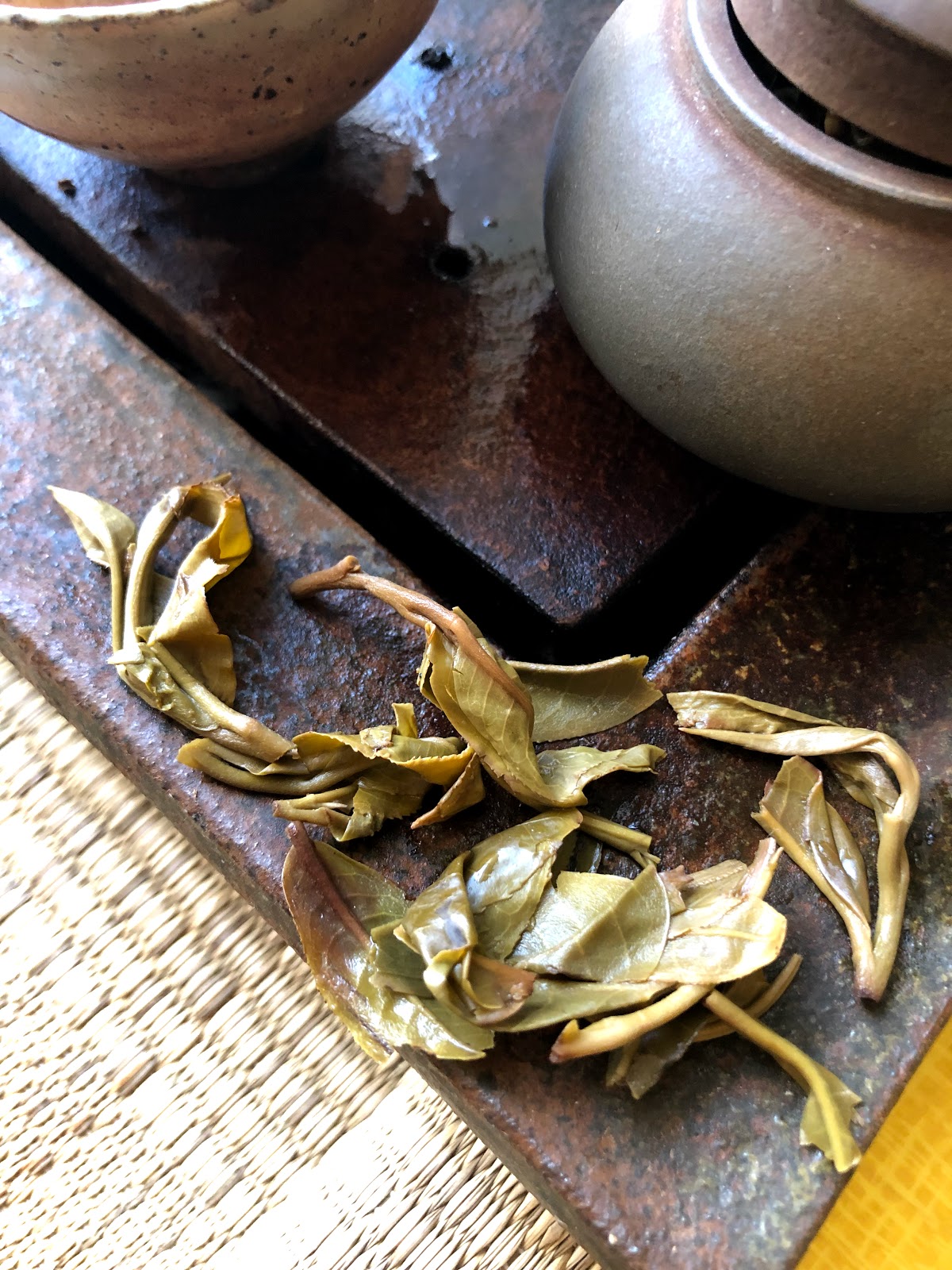
Let’s look at the leaves for some clues… The leaves are very tippy and small picked almost uniformly 2 leaves and a bud (the astonishing uniformity again suggests single origin and also suggests very early spring flush).  Maybe the quality/ date of the picking is part of the rarity in the vendor description?  Maybe it is a small leaf variety in an uncommon location outside off the typical Yibang and Jingmai (of which this teas taste does not resemble).  Or conversely, maybe it is an unusually bitter, unconventional, and powerful single origin find from one of these regions.  Typically, a small leaf variety is not this intensely bitter and usually much more sweet.  What is common with the smaller leaf variety is the intense Qi sensation which this tea has a lot of.  It’s a reason I am found of Yibang despite me not always being in love with its taste.

The value…. That’s another thing.  Is this crazy expensive tea worth it?  At $1.25/g you can surely find better Qi for cheaper… probably but the summation of qualities that this tea has with the very intense bitter with small leaves varietal, all 2 leaves and a bud… not sure.  I think for those of you who drink for the Qi and not for the taste, this is your gift and at least a sample is in order here.

Thanks for pressing this one Paul… Yes, I graciously accept.

Peace

Edit June 14, 2019:  I tried this one a week later using 1/3 less leaf as I usually do and I got a really different session.  The bitterness stayed in the rage closer to moderate than high.  The flavors didn't really resemble LaomanE at all but were more buttery and floral and almost no honeydew Mellon or coco/rubbery bitterness.  It was more mineral, floral, and slight buttery.  The tastes were much less exciting than a fully stuffed pot and didn't change much throughout the session.  Upper throat has a tight sensation that I notice more today.  Qi was again nice and powerful.  This is a Qi puerh for sure.  How do these tinny little leaves have so much power?  Many thanks to Paul for pressing this.  I'm going to wrap this one up soon and try it in a few months.

Double Peace

Tuesday, June 4, 2019

Evaluating Weeks Old Puerh Is A Good Thing!


It’s that time of year when our beloved puerh vendors have to decide when to release their newly pressed puerh.  One thing that I often read is that you shouldn’t evaluate a very freshly pressed puerh or maocha.  Some vendors even hold back their cakes for a few months before release.  Others tell customers that they shouldn’t base their decision on whether they like the puerh until a few months have passed.  I totally disagree with these statements.

Although I do understand that changes do take place pretty rapidly in this early month or two.  There is actually lots we can learn from very fresh maocha or newly pressed puerh cake.  In my experience of making green tea and compressed ddok cha in the mountains of Korea, very freshly made tea does have a different quality to it.  However, when you try enough very fresh tea you develop a taste for it and can easily determine quality.

If the puerh is of quality in these first few weeks, even 6 months later it will taste above the rest, regardless if some qualities change.  One of the best characteristics to look for in very young puerh is its energy, Qi, and the way it makes you feel.  This dimension doesn’t really change as much as the taste.  I find thickness of the tea liquor and a bit of the taste change the most during this early period. However, the change is somewhat predictable.  If you couldn’t determine quality from these early picked tea, then how could our vendors and producers select the best fresh maocha to press into cakes?

I don’t hold it against vendors who wish to release a more palpable tea especially as rubbery, smokey, and overly bitter qualities often dissipate over this time.  I see this very early stage as part of the lifespan of puerh.  If puerh is to be appreciated as it ages, then why are we not appreciating puerh infancy?

Peace

Friday, May 24, 2019

Puerh Drop 2019


Oh yes… did the puerh ever drop this year (not in price of course)…

It started with fireworks, rather unintentionally, really…

Weeks ago James of TeaDB kicked off a storm when hepresented (by complete accident) a dichotomy of budget vs premium Western puerhvendors.  Scott of Yunnan Sourcing rightfully defended his brand as being both premium and budget (and probably everywhere in between).  He also threw the gauntlet down with his own dichotomy, reframing the topic to be about Western vendors with high markups vs low mark ups.


It actually sounds kind of nasty but it is, in fact, Scott attempting to re-define or at least remind us all, about what Yunnan Sourcing is at its root and what it is not.  Did Scott say anything mean? Hateful?  I don’t think so at all but it certainly doesn’t follow a certain unsaid rules.  Sure, it’s a bit controversial to talk openly about how much you think your competition marks up their product… it’s something I wouldn’t do.  But there it is… Scott just says it the way he sees it, an open book.  Read all that info about each tea he presses- It pretty much includes everything that you would possibly want to know (except how much he marks up the raw material of course).  He likes to give us information and what we do with that is up to us. That’s why I like Scott and Yunnan Sourcing and will continue to support him and his vision.

So, those into puerh know who Scott is trying to differentiate himself and Yunnan Sourcing from, its main competition Paul of white2tea… we all know this.  And the fact I am still talking and thinking about this, and repeating what was said is, well, probably good for the Yunnan Sourcing brand (if you hear something enough times then people start to believe it).

Alright then, so Paul of white2tea, isn’t one to respond directly (nor is he one to just take it) instead he responds in his own roundabout way- some rather brilliant satirical, and sarcastic responses on his Instagram… I mean how do you respond to the accusation that your markup is higher when that information is confidential?  You aren’t going to open your books up for everyone to see your accounting… and besides he has no way of knowing Scotts mark ups either….  Anyway, this past week Paul has been dropping lots of sarcastic and profane commentary about marketing on his Instagram in lead up to this 2019 puerh release… hahaha

While this was happening… Yunnan Sourcing was first to release some pressed 2019 puerh, their 250g (dare I say) “premium” Yiwu line from some pretty famous areas such as Wa Long, Ding Jia Zhai, Xiang Chun Lin… all tested for pesticides and the like.  I love all of these areas that have become more famous over that last 5 years or so.  Plus look at those wrappers… they are pretty amazing… a bit playful, and inviting… I really like them.  Great work Scott.  I’m very temped to try these.

Then… Boom… white2tea dropped its Spring 2019 sheng puerh line up.  If You Are Reading This, Lucky Puppy, and Splendid are the only teas to make a re-appearece in 2019. Every year white2tea has a creative theme which comes from the names, descriptions, and wrapper art.  This year’s theme seems to be playful and loving, full of positive energy.  There is no controversial, obscene, political, or kitschy  messaging what so ever (Ok maybe 2019 Astro Kittens is a bit kitch).  Only I love it!

The other theme I noticed is the use of blurred words and images on the wrappers.  To me this is a deliberate response to the critique that white2tea is never clear on the origin and terroir of their tea and its use of blurry marketing.  It speaks to their lack of transparency.  It also speaks to the ambiguity and uncertainty surrounding their productions.

However, this year I think Paul of white2tea did a great job of explaining what the material is all about and what to expect from each puerh product.  He is actually a lot less ambiguous in his descriptions this year and clearly outlines the goals for each of his products way better than past years on most of his 2019 puerh cakes.  Paul also sent an email with a quick list of recommendations with links that best describe you. When you click on the description it takes you to the tea that is best suited for you.  Its like a personality test that matches you with a puerh.  I thought this was pretty fun and helpful (see photo). Great work. 

Paul is genius in the way he drops his product too.  He is the Taylor Swift of puerh tea and actually uses a very similar marketing technique of dropping his product (see here), by teasing sassy, sarcastic, and vulgar but by then actually going in the completely opposite direction and releasing love and positivity.  This creates a really shocking effect when what you expect is overturned.  This is the true creative genius and marketing that Paul brings to puerh in the Western world and this is why I like Paul and white2tea and will continue to support him and his vision.

Wait, where is David and Yingxi of the Essence of Tea in all this fuss?????

They are barely on social media at all, not on any of the tea blogs, no youtube channel, no showing off the new wrappers… no nothing… Where is David in all of this marketing posturing? I bet he’s meditating and staring at a blank wall and just chuckling to himself.  In fact the Essence of Tea rarely makes a fuss over marketing, their word, their product is their marketing… it’s that simple.  They are almost anti marketing but by keeping us in the dark they are creating their own kind of excitement.   And this is why I like David and Yingxi and the Essence of Tea and will continue to support them and their vision.

I tell you… when the Essence of Tea drop their 2019 puerh pre-sale it’s going to be a big deal, things will sell out, it will be perfect.

Thanks again to these vendors (and all of the others as well) that have chosen to make a career by putting their love into sourcing, pressing, marketing, branding, and most importantly, selling this wonderful thing called puerh…

I got to go and stare at a blank wall for a while…

Peace

Monday, May 20, 2019

2010 Rong Dong Da Bang Bing & How Close is Close?


This complimentary sample came from KL Wong of Teapals in an order I placed a few months back.  Mr. Wong tells me that Bang Bing is a mere 15 KM from the famous Bing Dao.   I know 15 Km sounds pretty close in proximity but if you have actually been to the tea mountains and understand a bit about terroir, it is really quite far.  There are lots of these puerh areas that are near more famous areas that try to ride off their popularity.  In a way this is harmless, but it is equally deceptive because most of these areas even ones only a few KM away have such different profiles.

KL also informs me that this cake is now sold out.  So I report here only for the purpose of recording my experience from a cake from Bang Bing, an area that I’ve only tired blended into Shuangjiang Mengku cakes  in the past… please sit down and join me at the tea table, pals…

The dry leaves smell of very clear high noted sugar notes, crisp wood and distant dry grasses.  The sweetness is pretty strong.

The first infusion starts off with vegetal tastes which are barely sweet and bitter.

The second infusion starts with a slightly bitter edge which has layers of vegetal tastes underneath.  The bitterness is notable and long as it recedes in the aftertaste a malty sweetness is paired with bitter.

The third infusion starts with a buttery sweetness then turns quickly to bitter there is a pop of fruit before a cooling wave heralds in malty sweet tones.  The tea liquor feels reasonably thick there is a bitterness found throughout.

The fourth infusion starts with a buttery malty sweetness with bitter underneath a soft cooling wave comes in and reveals interesting mix florals and fruits, creamy sweetness, the aftertaste is reasonably long here.  This infusions taste is very nicely balanced and quite delicious.  The mouth feeling is soft and sticky the throat is mildly stimulated.  The Qi sharpens the mind and concentration.  The body feels loose in the lower body and knees.

The fifth infusion is much the same as the fourth with a mainly sweet profile of malty, vegetal, bitter then after the distant coolness creamy sweetness, tropical fruit, malty sweetness and underlying bitterness over a soft sticky mouthfeeling.  This is a real nice fairly dry stored sweetness.

The sixth infusion tastes even sweeter with more of a sweet entry initially, a beautiful buttery thick sweetness which stays throughout.  There are some tropical fruits and creamy sweetnesses that appear in the long sweet aftertaste.  The bitterness has significantly reduced but is still underneath giving this tea much depth.  The saliva in the mouth pools a traps in the aftertastes even minutes later.

The seventh infusion has a light, juicy fruit mixed with malty sweet depth onset.  The liquid feels less thick in the mouth in this infusion but still stimulates the throat nicely.  The mouthfeel is grittier now.

The eighth infusion is thick, malty sweet, mild cooling and long sweetnesses throughout the profile.  There is a creaminess thoughout, some vegetalness.  The sweet aftertaste is trapped in the throat.  9th infusion is the same, but more pronounced sweetness.  This is a very nice experience, I’m having here.

10th is creamy sweet malty, it turns talc and slightly floral before transitioning into long sweet tastes.  The mouthfeel is really nice here, velvety coating.  The 11th has a pronounced pungency to it.  The taste is sweet throughout with just edges of astringency and bitter barely presenting now.  The sweetness is very apparent and very nice.  The layers of sweetness is enjoyable.

12th has a bit of a thinner profile now but has a long butterschotch sweetness throughout, a touch of coolness, nice tongue coating.  The 13th becomes a bit sandy in feeling and less substantial.  Just flash steeping it still.

The clock of the day runs out on my session so I put this guy into an overnight session and awake the next day to some major deliciousness- thick and sweet and still very nuanced and interesting…

Great tea, very sweet, layered sweet, saliva pushing flavor up throat action, lots of depth, pure, clean, nice dry storage, good concentration enhancing Qi, too bad its gone….

I noticed that KL Wong has recently added a few different puerh to his website.  From what I’ve tried, he’s worth paying attention to…

Peace

Friday, May 17, 2019

Comparing Storage: 2003 HK Henry Conscientious Prescription Taiwanese Dry Storage Vs Malaysian Humid Stored


I was sent this sample thanks to commenter Spatulab.  This Taiwanese dry stored version comes from Teas We Like and sells for the same $130.00 cake but has very different storage than the more humid Malaysian stored Essence of Tea version that I purchased and reviewed here.   The Malaysian cake went through an interested change since trying it about a month ago which I documented in an edit to that initial post.  You can check out that post for all the background about this famous puerh.  Lets taste and compare this dry stored version, shall we?

The dry leaves have a much sweeter creamy wood penetrating odour than the much more humid stored Malaysian storage offered at the Essence of Tea.

First infusion starts a touch creamy sweet with a vegetal taste initially there is a mild cooling suggestion then a slight creamy sweet dry wood finish.  Very clean, tight dry storage off the bat.

The second infusion starts with a slightly creamy dry wood onset, there is a vegetal base with mild cooling then longer pungent dry wood aftertaste.  The mouthfeel is mildly sandy and mildly astringent here.  There are light creamy woody sensations long on the breath.

The third infusion starts off with resinous pinewood, creamy sweetness underneath, vegetal taste deeper in the profile, then a pungency rings out with nice creamy sweetness balanced with woody pine notes.  The profile is clean and clear and crisp.  The qi is mildly relaxing here and mildly alerting.  I can feel some qi pooling in the head.  The mouthfeel is slightly sticky and barely astringent.

The fourth infusion starts off pine wood, almost vegetal, resin, there is a mild pungent coolness that opens up a little sweet creamy woody taste which attempts to stretch out on the breath.

The fifth is more piney and resinous throughout, a slight pungent taste comes through then slightly creamy sweetness.  The pine wood taste dominates all the way through.  The taste is clean, crisp, and long in the mouth.  Good clarity.  The mouthfeel has a tighter smoother feeling but not as gripping or deep feeling compared to the Malaysian stored.

The sixth infusion is very pine, resin, almost sour and astringent stimulating throat now a touch, pine dominates profile, some mild cooling and sweetness trying to push through pine taste.  The sweetness is more distinct and untouched in this Taiwanese dry stored version but also the resinous pine note is more dominating- it is really dominating.

Taiwanese dry storage seems much more pure and true to the original material but in its purity it looses some complexity than a more humid storage brings out.  The 2003 HK Henry Conscientious Prescription has pretty simple and clear profile, it isn’t super complex so this can be seen as a positive or negative here.  Or to put it another way the more humid Malaysian stored adds complex storage humid nuance to the original materials.

The seventh infusion starts off with an almost vegetal pine taste with an almost soapy creamy sweetness underneath.  The pine is less dominant in this infusion and the sweetness has almost a plumb and candy edge to it which is more distinct and long in the aftertaste here.  The sweet plum taste is quite nice.

The eighth infusion carries a pine incense taste now slight pungent returning arrives then a clear woody long plum sweetness.  The returning coolness and pungency is less in the dry stored version compared to the Malaysian but the sweetness in the aftertaste is now much more distinct, pure, and vibrant.  The mouth and throat feeling is different as well.  The dry stored is more stimulating the tongue and mouth with a tightness and mild stringency but is just mildly opening in the throat where the humid Malaysian stored has more throat feeling than mouthfeeling and a deeper throat feeling.  The qi is mildly relaxing and it pools in the head, slightly alerting the senses, and visual acuity.

The ninth infusion nice pine wood profile, creamy sweetness lingers underneath, clean pure, simple taste, sweetness comes out a bit more in the aftertaste.  Cooling pungency is mild here.  The Qi starts to make the head feel like its floating.  The qi of this Taiwanese dry stored is slightly less warming but seems to have more bodyfeeling in the head slightly.

The tenth infusion starts off with a touch off pine incense then to just pine wood then to a mild pungent then to wood over mild creamy sweetness.  Pretty woody here.  There are no earthy, foresty, soil tastes in this very clean dry stored version at all.  Simulating sandy and tight coating on the tongue mild but deeper throat opening.

The eleventh infusion the mouthfeel becomes stronger and gripping, almost drying, a distinct dry wood onset then there is a woody resin returning with mild pungent.  The sweetness is less here the pungent cooling is more with the stronger, tanic mouth and throat feeling.  The Qi is quite relaxing now.  The odour of the wet leaves smells of red Korean ginseng but it doesn’t show in its taste.

The twelfth infusion has more of a creamy sweet plum onset with wood that emerges slowly. The mild creamy sweet taste is still more apparent here.  The thirteenth is more woody and dominating but still the sweetness is mild but throughout and more obvious than in previous infusions.  Wood and creamy sweetness- simple tastes in these infusions but enjoyable ones.

14th is woody, creamy sweet, this tea is fading here if not the last few infusions.  Plum note is clear and the mouthfeeling is milder here.  Nice fruity wood. 15th is mellow fruity woody enjoyable thing with a touch of cool pungency.

15th infusion I push it with a 60 second infusion but get much the same maybe even a slight sour note in there as well.  Woody more pine and resin.  More cooling pungent.

16th I do a long infusion and it pushes out a lot of pine, more resin and some incense notes which mask any sweetness underneath.  The cooling pungent is more obvious with this push the sweetness shows up a minute later. Nice.

17th I do another minutes long steeping and get a very resinous pine taste with cooling pungent aftertaste with no sweetness found.  I enjoy the pine woodiness.

It’s put into an overnight infusion and comes out quite fruity plum after a few days.  The Malaysian stored comes out tasting just dirt in these days long steeping.

Overall, I feel that this drier stored Taiwanese version is better at preserving some of the teas original essence and is will be a better option for long term aging in people who are looking for a slowly evolving puerh with age.  It is closer to a Qing Bing type of storage and feeling and its stamina and flavor has not been pushed out by humidity.

However, I prefer the Malaysian stored version which is warming and harmonious to drink now.  Will it age more interestingly than the dry Taiwanese stored version?  I doubt it, but right now on these unseasonably cold Spring mornings I seem to be going to it instinctually and this dry stored version didn’t satisfy me in the same way.  Part of this preference is my history of drinking similarly more humid stored cakes like this weekly around the tea tables in Korean teahouses.  I still think it would be interesting to pick a dry stored one up to see how it will fair in 10 years.

Peace


Sunday, May 12, 2019

2013 Chen Xi Hao Gao Shan Zhai and Xishuangbanna Storge


I had my eyes on some Gao Shan Zhai from another vendor over the last year but still haven’t purchased any.  The Gao Shan Zhai region in Yiwu is known for some pretty delicious puerh being higher altitude relative to other regions in Yiwu and all.  This production ($114.49 for 250g cake or $0.46/g) is a collaboration between Zheng Si Long and Chen Xi Hao of which the wrapper bears its name.  It was kindly sent in a complimentary care package by Tiago (thanks again)...

Dry leaves smell of perfume florals, subtle fruit, and woody rainforest floor.

First infusion is a woody almost flat syrup taste there are almost floral notes in there as well but strong predominating dry wood tastes.  The mouthfeel is slight sandy and astringent, slightly bitter.

The second infusion has a flat dry wood, slight malty taste with slight brown sugar taste.  The mouthfeel is fairly stimulating slightly dry and astringent.  There is a very mild cooling then a long brown sugar and dry wood aftertaste which lingers on the breath.

The third has a more cohesive dry wood, slight malt, and brown sugar taste which plays out in the aftertaste.  The taste profile is pretty simple and obviously single origin material.  The mouthfeel is slight dry and slight astringent pretty simple as well but enjoyable enough.

The fourth has a distinct deep malty sweet, almost syrupy medical herbal taste.  The menthol returning is more pronounced and there is dry wood underneath everything.  The thickness of the liquor here increases its viscus feeling and it makes for a denser taste.  The Qi is mild and relaxing.

The fifth has more of this malty, herbal medicine taste with wood underneath.  The liquor remains medium thick now and the aftertaste is long carrying some of the initial tastes of wood, malt, and herbal medicine but in a mild wave of menthol and in a brown sugar sweetness.  The taste is long on the breath and now has a nuance of complexity and charm.

The sixth infusion becomes denser and more complex still with a dense layering of herbal medicine, woods, malty butterscotch but now there is a pronounced tropical fruit sweetness that lingers throughout it almost has a bubble gum sweet edge to it.  The Qi starts to mildly alert.  The mouthfeel is slightly oily but mainly mildly astringent- the dryness is gone.  This infusion the sweetness becomes quite apparent.

The seventh infusion is dense and malty sweetness, mild wood now and herbal medicine tastes.  It has a nice medium to thicker feeling and long menthol sweetness with slight tropical fruit and almost bubble gum sweetness.

The eighth is becoming heavy on the menthol/eucalyptus from start to finish.  There is more woody taste in the initial and sweeter taste in the aftertaste with a strong medicinal herbal quality throughout.

The ninth is very menthol, malty sweetness with topical sweetness under heavy camphor much the same as last infusion.  This infusion seems to be more licorice tasting.

The tenth is strongly menthol/eucalyptus in taste so much that it drowns out other aspects of the profile.

The eleventh is almost creamy menthol onset woodier in the aftertaste.  The mouthfeel is significantly astringent, almost but not really dry, slight pucker.  The Qi of this tea is mildly relaxing with a bit of head sensation of lightness of the brain.

The twelfth infusion is strong menthol/ eucalyptus through and through.  The tea is becoming more astringent to in these later infusions.

The 13th is much the same this infusion is a bit more sweet wood and menthol.  The profile changes very little from initial to aftertaste.

The 14th shows signs of sweet woods, herbal medicines, and an underlying tropical sweet taste under medical notes.  The taste is quite bold even now but is not as sweet as it is astringent and pungent menthol.  The pungent menthol is really something.

The 15th has an almost peachy sweet onset now, woody, slight licorice, almost herb, long cool sweet aftertaste.  Still lots going on here, much to enjoy.  16th is a touch bitter and astringent but similar tastes, more wood almost a sour grapefruit taste.  Faint tropical fruits.

The seventeenth is sweet peach, woody, almost herbal medicine like before shifting to a slight cooling and long sweet aftertaste.  This puerh has some great stamina with the taste complex and full late into the session.

The eighteenth and nineteenth give off sweet tastes, medicinal tastes, woody tastes, long sweetnesses.

I really stuffed the teapot with these leaves but this tea could go on for quite some time, I suspect.  I overnight steep it and a greeted the next morning with a very viscus and dense butterscotch/ caramel sweetness.  It’s so full that I decide to put it though another few day-long steepings.

This tea has what I consider “harmonious Qi” it doesn’t overtly feel relaxing or simulating and to someone with little experience almost feels like no qi but in the end this qi makes you feel good.  If you are tired, you will feel more alert and if your simulated it kind of makes you feel relaxed.   I think this puerh has this type of energy to it.  It can easily be overlooked by those who are less sensitive.

Tastewise, this tea is a winner.  It has much to enjoy as far as tastes go.  It’s a bit unique in how pungent it is.  This feature will do it well 10 years down the road.

I believe that the storage is clean moderately humid Xishuangbanna Storage.  I remember a time that Xishuangbanna storage was a dirty word in puerh circles.  It was synonymous with poor storage or forgotten tea.  It’s my understanding that Mr. Zheng of Zheng Si Long has been instrumental in elevating the profile of Xishuangbanna storage of which this cake seems to be a good example of.

*I ended up trying to replicate this type of greatness a few days later and was unsuccessful at pulling together a great session like my first experience above.  The second time didn’t have as much pungency, depth, or stamina, Qi seemed weaker too. Might have to pick up a cake to investigate further when I finally do an order of Zheng Si Long from Tea Encounter.

Peace

Saturday, May 11, 2019

Are We Just Buying the Puerh Wrapper?


Over the last few years, I’ve taken the time to look a bit at the marketing and branding behind Western puerh vendors here on the blog.  Since returning back to puerh buying, I noticed that marketing has become a driving force these days.  Of course, there is nothing wrong with that, in fact, I enjoy the marketing on display.  However, I have sometimes openly questioned whether we are buying the puerh or just buying into the marketing.

I recently read this article about how we rate a wine label influences how good we perceive and rate the wine.  It talks about the research by a Master’s student at the University of British Columbia.

The article is titled “Like the label? You'll probably like the wine, says UBC researcher”.  The subtitle proclaims, “Masters candidate Darcen Esau says people want wine that matches their personal identity”.

I got to thinking that you could easily replace the word “wine” with “puerh”.

His research look to answer these questions: "With so many options available, why do some labels appeal to some people but not others? And then taking it a step further, does that label actually impact the wine drinking experience?”

The research essentially had different parts to it such as an online survey and a taste testing.

For the taste testing, he employed a triangle design with 3 glasses of wine and 2 of the 3 were the same wine.  Esau also used two types of labels in his research: a contemporary design and a traditional design.  No single design was found to make the wine taste better.  However, if the person identified with a label they would perceive the wine as actually tasting better.

Do you think, as I do, that this result could easily be reproduced among puerh drinkers in the West?

Do we really like the puerh we are drinking or are we just unconsciously picking the Western puerh vendor and/or puerh wrapper that matches our personal identity?

Peace