Friday, February 25, 2011

Section 17. Well Water Is Not Appropriate For Tea


"The Classic of Tea says: "Mountain water is superior, river water is less good, and well water is the worst"

from Cha Sin Jeon- A Chronicle of the Spirit of Tea, a copy of Zhang Poyuan Chalu recorded by Cho Ui, translated in Korea Tea Classics

Those who do not have a copy of Korean Tea Classics do please follow along and participate by referencing a different English translation available here from The Leaf.

This tea classic will be covered one section a week which will go on for 24 weeks. Feel free to jump in with your commentary at anytime.

Peace

Monday, February 21, 2011

The Types of Tea and Their Chaqi: Darjeeling Second Flush

One read a tea blog somewhere that proclaimed that only tea from China, and Japan (and Korea) has cha qi. This statement could be further from the truth especially when looking at the tea produced in Darjeeling. Some would argue that this could be because the tea in Darjeeling is produced using the Chinese variety of tea plant, Camellia sinensis var. sinensis rather than the Assam variety, Camellia sinensis var. assamica. This again, is ridiculous. Recently there has been a cold snap on the island and one has been drinking a lot of second flush Darjeeling reflecting on these things...

Darjeeling tea is known for its warming properties. These warm thermal properties of second flush Darjeeling are due to a variety of factors. Most of the warmth develops as the green tea leaf is oxidized. Oxidization induces warm thermal energy. The once green, cool properties of the plucked leaf undergo a process where heat is generated as the leaf oxidizes. The result is a dry leaf that is dark often with a reddish tinge to them, a liquor that is red-brown, and wet leaves that are coppery brown. All of these colours contain the colour spectrum of a dark red. Red is the colour of summer. Early Summer, late spring is when these leaves are picked. As a result they contain in them the heat of summer. Red is the colour of the Heart, therefore this tea is especially good for preventing heart conditions (see here and here and here). Because these leaves grow slowly at such high altitudes often among the high misty mountain tops they generate more heat, more yang. These leaves also contain in them dark colours. Darker colours indicate depth, like the depth of space or that of a deep ocean. In this way the qi of Darjeeling second flush is warm and deep, qualities that are often sought to balance the cold depths of Winter, or simply when we feel cold.

The taste of Darjeeling Second Flush also is an indication of its qi. Hong cha is sometimes known for its rather bitter taste, especially when production dictates heavy oxidization. Bitter tastes are descending in nature and have a special relationship with heat in the body as it is often associated with the communicating transfer of heat from the upper (yang) parts of the body to the lower (yin) parts of the body and conversely from the lower parts of the body to the upper parts of the body. This is especially true with second flush as it contains both the colour red, warmth, and darker colours that represent depth. Bitter tastes also descend deep in the body.

However if it was a strong bitter taste, its properties would be too harsh and would simply have a draining effect on the body, thereby depleting our qi. This is not the case because there is balance between Taste and Smell. The deep bitter taste anchors the warm qi downward and the light smell of florals and fruits lift it up. There is good movement of energy, a communication between upper and lower imparting heat there.

The bitter descending taste is also moderated by a fruity, often muscatel, sweetness. Sweet tastes strengthen and ascend, remedying much of the harsher effects of the bitter taste while circulating the warm thermal energy.

Second flush Darjeeling is processed in a way that a large surface area of the leaf and the enzymes released in production are quickly exposed when steeped in hot water. The release of its energy is quick and often dramatic and powerful, usually resulting in fewer more powerful infusions.

The nature of Darjeeling second flush is such that Middle Way is therefore maintained as Yin (descending, deep, dark, more taste, and bitter) is masterfully balanced in the cup by Yang (ascending, light, red, floral odour, and sweetness). The balance and harmony of this tea along with its characteristic cha qi is why Darjeeling Second Flush is even prized by the teamasters of Asia, least those with an open mind.

Peace

Saturday, February 19, 2011

Section 16. Grades of Spring Water


"Tea is the spirit of water and water is the body of tea."

from Cha Sin Jeon- A Chronicle of the Spirit of Tea, a copy of Zhang Poyuan Chalu recorded by Cho Ui, translated in Korea Tea Classics

Those who do not have a copy of Korean Tea Classics do please follow along and participate by referencing a different English translation available here from The Leaf.

This tea classic will be covered one section a week which will go on for 24 weeks. Feel free to jump in with your commentary at anytime.

Peace

Thursday, February 17, 2011

2011 Victoria Tea Festival Overview


Making it through the quick moving line up and through the front doors, one was greeted by the tasteful bonsais of the Silk Road booth. Although the design was much more natural in feel, it was apparent from just the first glance that there were less exhibitors than last year (about 10-15 fewer?).

One navigated past the crowded exhibition hall without spotting any surprises upon first walk through. There were some great conversations had with the different exhibitors though. This year one spent most of the time chatting with the local Victoria dealers that one hadn't got to spend time with before, that was nice.

Expect some posts in the next month or two covering Victor of Tea Farm and his interesting tea growing operation and Libby of Tula Teas and her oolongs. One had a great conversation with the almost 90 year old Yunnan native and exhibitor about her 200 year old puerh tea brick at the May Ip Lam Gallery exhibit. Even met up with another puerh tea lover in Victoria, who would have thought?


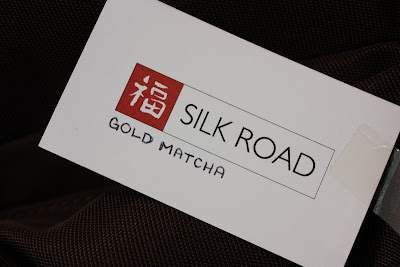
Out of the presentations, the Japanese Tea Ceremony by local tea group the Urasenke Nagomi Tea Circle was well done and even included a sampling of specially ordered matcha that Silk Road brought in exclusively for the event which contained flecks of gold. It was served a touch too watered down, a little too flashy, but none the less was enjoyable.

All in all, when around such great tea loving people, you can't help but enjoy yourself.

Peace

Tuesday, February 15, 2011

2010 Jagasilk Organic Dragonfly Matcha (Produced By Harimaen)


This matcha was purchased at the local stop, Jagasilk. It is the highest organic grade they carry, a step higher then the Organic Butterfly matcha consumed last month. Their webpage claims that Harimaen Estate, the garden they source their tea from, is the oldest and highest quality organic production in Uji. Certainly it is fresh- the label says it was stone ground on Dec 20th. Let's cut open the bag, boil the water, and prepare this tea in ceremony...


And so the bag is cut open and small particles react with air- one's nose takes in the scent of the powder. There are deep blackberry fruit notes with a savoury sweetness. Nutty notes are also picked up but are faint. The depth of the odour is noted. There are roasted bread smells as well as the scent of sesame seeds. There is a lot going on.


The mind is quieted. Movement upon movement, the tea is whisked up and thanks is given.

Taking the matcha in three sips first reveals an initial sweet burst that is followed by nutty, slightly roasted, sesame tastes which evolve in the mouth. The mouthfeel and throatfeel creep across mouth and throat respectively but with a smooth stickiness and slight grittiness that makes for somewhat of a layered sensation in the mouth.


The aftertaste that emerges is a creamy smooth marijuana taste with a somewhat soft 'green' taste. It develops into a malty- yeasty taste that is reminiscent of a good ale. Mellow but alerting qi.


Starts off sweet, finishes sultry. What a evening for a matcha like this.

Peace

Saturday, February 12, 2011

Section 15. Tea That Has Deteriorated Must Not Be Used


"If one drinks deteriorated tea, the stomach becomes cold, so much so that one's energy is depleted and bad effects accumulate."

from Cha Sin Jeon- A Chronicle of the Spirit of Tea, a copy of Zhang Poyuan Chalu recorded by Cho Ui, translated in Korea Tea Classics

Those who do not have a copy of Korean Tea Classics do please follow along and participate by referencing a different English translation available here from The Leaf.

This tea classic will be covered one section a week which will go on for 24 weeks. Feel free to jump in with your commentary at anytime.

Peace

Sunday, February 6, 2011

Sam Do Style Tea Bowl by Korean Master Chon Han Bong: A Look at the Rae Bin Sam Do Subtype


The Sam Do Style, or Three Island Style of tea bowl has a long history in Korea. The Rae Bin Sam Do style can be traced all the way back to the early 1400s and is one of Koreas classical styles. Like the Hwa Sam Do style and Ju Sam Do Style it has a very distinct look, or cannon, that is followed. Essentially they are trying to replicate the essence of a traditional bowl with only subtleties of each potter coming out in the final product. The idea is that the harmony of the elements, of nature, of the earth & fire is what is admired in the final product. The potter is below or under his product- the bowl his hands helped create. Of course, we cannot talk of this bowl without mention of Master Chon Han Bong- he is a brilliant potter and one of Korea's true masters.


This beautiful white slipped Rae Bin Sam Do style bowl is winter in feel while hinting at spring. So today, as winter rains fall and spring around the corner, it seems like the perfect day to examine such a wonderful piece.


The focal point of Rae Bin Sam Do style bowls is most definitely the calligraphy in the bowl's pool. The whole bowl seems to emanate around this centering feature like the island that this style of bowl was thought to come from. Here in the center we can also see the colour undernieth. It is the earth, the earth of the island. Its boundary is well defined by a white circle. From this calligraphy, from this white circle, the energy of the bowl is transmitted.


Squiggly lines emit from the center covered in a thin white that is blotchy, not completely covering the colours beneath. These squiggly lines represent the water, the waves that surround the island, the waves of peace that undulate in rhythmic motion that put us at ease when drinking tea from its innards.


The squiggles reach outward to the rim that is marked by notches, often a defining feature of the Sam Do Style. These notches are to thought to fill space with that which is beautiful but not pretentious. The notches that collar the inside rim on this bowl remind us to fill our lives with that which is beautiful but not to be braggarts, flamboyant, or pretentious but rather modest- happy with the simple things we fill our life with.


Of note on the inside rip is a finger print, a blotch, a human touch. Often blotches connect us to the human element of a tea bowl besides adding a measure of asymmetrical beauty. This blotch is especially beautiful and done quite tastefully.


The outside of the bowl is coated in a thicker application of white. Only when you flip the bowl over to admire its foot can you get a real feel for the contrast the white slip gives to the bowl. You also notice the ghostly layers white with thinner application in some areas and thicker in others where it coagulated then drizzled down the side. As the white nears the foot it thins into natural patterns with blotches of the base, green/blue brown colouring, showing through. These blotches add a relaxing element to the piece like watching a slow moving cloud in the sky.


The chop to is tactfully balanced with a small uncovered patch, revealing the clay below. It suggests modesty of the potter. The balance it creates with the chop is quite breathtaking especially with a such a thick layer of white defining its perimeter.


The division and contrast created by the distinct white boarder that cuts the foot in half is stark and is the focal point of the bowls bottom. Staring at its division reminds us of the division between Heaven and Earth. The sky, water, and island. The yin and the yang. The Dao.

Peace