Friday, June 25, 2010

Defining Two Distinct Types of Ddok Cha: Differentiation Based On Appearance, Production, Preparation & Taste Profile


Ddok cha (tok cha, ttok cha, dok cha), a rare and very traditional form of tea produced in Korea, has drawn the attention of the tea drinking community world-wide. Besides the information on this blog and a wonderful article by Steven Owyoung on Cha Dao, little has been written about this interesting tea. Of what has been written, there seems to be some confusion as to what constitutes a tea being ddok cha (see comment section of Cha Dao article).

Ddok cha, simply put, is Korean cake tea. Under this definition any tea from Korea that is pressed into a cake can be classified as ddok cha. Because of such a broad definition, you may be thinking that there must be an infinite number of different sizes and styles of ddok cha. Not really. In ones experience with this type of tea there seems to be two types of ddok cha. These two types can be classified by different appearance, production, preparation, and flavour profile.

The first type is the coin/ heavily pounded type. The coin type is about the size of a fairly densely packed silver dollar coin and many are often strung together, through the middle, like the way you would picture old Chinese coins. According to Brother Anthony of Taize, this type is sometimes referred to as "yop jon cha" or cash tea.

This coin type goes through the last steps of its production by being pounded with a large wooden mallet on large wood planks or pounded mortar and pestle style using large wood logs in a large stone bowl. When the tea is reduced to a gunky pulp it is placed into moulds, dried to form, and quite often strung together. A picture of traditional moulds can be found on the bottom picture of this post by Toki of The Mandarin's Tea. Click here for a detailed video outlining the production.

The coin type ddok cha is best enjoyed the traditional way, a way very similar to the way Lu Yu describes Chinese Tang Dynasty tea in his book The Classic of Tea (circa 760-780 AD). Click on these posts on Cha Dao and A Tea Addicts Journal of attempts to make Tang tea with ddok cha.

The traditional way of preparing coin ddok cha involves roasting, breaking, then boiling (or at the very least long steeps with just off boiling water). The roasting stage is quite important because if the tea is over roasted it will loose its essence or even taste burnt. On the other hand, if the tea is under roasted its full flavour can't be appreciated and the tea may be too bitter. It is ones understanding that some Koreans roast the whole coin and others break it up first and use unique teaware, a ceramic tea roaster, to roast the tea.

A Korean tea roaster looks much like a ceramic Korean tea warmer. Fitting with the style of southren wares it looks very rustic and natural and usually looks almost stonelike. It is hollowed out and has a place where a tea light can be placed. On top there is a hole, into which the conical metal or sometimes ceramic piece is placed over. The cone is placed right over the tealight. Tea is added into the hollowed out cone and is roasted there. Stirring is required to distribute the roast evenly across the broken tea pieces.

After the tea has been roasted to perfection, the tea is either broken into pieces (if it hadn't been previous broken) then it is added to either a kettle (sometimes a ceramic kettle) on very light boil or it is steeped in a tea pot using water that is just off boil. After boiling in a kettle, place a clean hemp cloth over a cup or serving pot and pour the tea through the hemp cloth so that the froth and teabits are filtered out.

Its taste is spicy, medicinal, and bitter when prepared in this traditional way. Due to its tighter compression, crushed composition, and more extreme preparation, aging coin type ddok cha tastes much better as it mellows with age.

The other type of ddok cha is the larger disk/ pressed type. Usually about 100 grams of tea are pressed into a disk shape that resembles a mini bing but can also take other forms such as bell shapes or ball shapes similar to tuo cha. The compression is not as tight as the coin type ddok cha. These cakes are wrapped in traditional Korean paper and are often tied together with hay or bamboo string in groups of 3s or 5s or wrapped in bamboo leaf similar to a tong of puerh.

Unlike coin type ddok cha, disk type ddok cha doesn't get pounded to a pulp. During the last steps of its production it is either pounded lightly or pressed between large wood planks. After the right amount of tea is measured out then it is often pressed by planks into form.

The disk type ddok cha is prepared in a Korean ceramic tea pot. It is wise to not use just off boiling water for young cakes as the tea can still be a bit bitter if prepared in this manner.

Fresh disk type ddok cha tastes somewhere between a Korean yellow tea and green tea. Due to its loose compression, it ages quicker than the coin type. Its full intact leaves allow for much less bitterness and more full flavoured profile. With age this tea gets much more mellow in taste, stronger in qi, and more floral in nature.

To avoid confusion on the topic of ddok cha in the future, one believes that ddok cha should be referred to using these subtypes- coin ddok cha or disk ddok cha.

Peace

Thursday, June 24, 2010

2009 Jookro Sae Jak Hwagae Valley Green Tea


One wrote this post up in the early fall of 2009 but never published it. After reading a nice post of the 2010 Jung Jak grade on Potery of Tea one decided to publish this as a reference.

Let's go back... and sit down on a sunny fall day with this green...

After sheding the four levels of packaging, the goods are revealed. The dry leaves are a beautiful vibrant green with a hue of blue running through them. They smell of evergreens and nuts under the soft, smooth, roasted notes- the scent of this tea is as delicate as its leaves. As the boiling water cools one meditates on these leaves and clears the mind.

The first infusion is prepared. There is fresh depth to this tea as well as a fair bit of green tea complexity. Things are light, watery, grassy with fishy, roasted notes.


The second infusion is light and tangy and stimulates the whole mouth with a silky feel. Roasted, fresh, sea-salted green notes are enjoyed.

In the third infusion the flavour is more roasted and fills the whole mouth. The chaqi is clean, alerting, and clear.

The fourth infusion dries the lips and the front of the tongue. Light, roasted notes are still present but tones of hay start to emerge.


The fifth feels quite round and complete in the mouth in flavour and feel. Lower notes like pine tree and dirt harmonize with lighter notes in this infusion.

The sixth has a nice full taste and feel as well but a certain blandness is becoming evident. The seventh, eighth, and ninth infusions are watery, thin, gritty and dry. Some fishy & buttery notes are picked out.


The wet leaves show a nice mix of buds and small leaves.

Peace

Wednesday, June 23, 2010

A Canadian Tea Garden

Almost a year ago a friend had mentioned that he had grown a few tea bushes on his land here on Vancouver Island. When asked about the growing conditions and care, he said that it grew fine with very little care.

Tea grown in Canada- sounds kinda crazy...

Actually its become a mission of once tea shop owner turned tea consultant, Brendan Waye. He initially scouted out land in the wine growing district of Cowichan Valley and is now looking to do some experimental planting just off Vancouver Island on nearby Salt Spring Island. Apparently, he hopes to plant a few different varieties of seeds and see what produces the best result.

It sounds preposterous, but considering Vancouver Island shares a similar climate as Washington, where an experimental tea garden currently exists, it doesn't seem that out of the question. Even Brett from Black Dragon Tea Bar in nearby Seattle has grown some backyard tea.

Local tea...

One quietly ponders the benefits of such things in meditation with tea.

Peace

Tuesday, June 22, 2010

Can This Phoenix Rise From The Ashes?: A Sampling of 2010 Red Dan Cong


This years tea harvest was hit hard by cold spring weather that influenced much of the tea production in Asia this spring. Perhaps the hardest hit was Phoenix Mountain, the home of Phoenix Dan Cong Oolong. It is predicted that only 1% of single bush high mountain Dan Cong will be available this year. Bad news for those who enjoy a regular Dan Cong.

This tea comes courtesy of Life In Teacup and is a true story of ingenuity and survival. Apparently, facing the complete destruction of their 2010 crop, a quick acting farmer banded together all the people and farmers of the surrounding area and mobilized them to pick the recently frost-bitten new growth tea. He knew that freezing triggers an oxidization reaction in tea and if he acted fast he could perhaps create a more oxidized variety of Dan Cong thereby recouping, at the very least, a small portion of his losses. Interesting story.

The kettle rumbles to a boil, the pots and cups are heated. The sample pack is cut and all the leaves dumped into the warm pot. When the dry leaves hit the warmed clay, a deep, rich, sweet odour fills the air surrounding the tea table. Sweet, strong, peachy apricot notes carry a deep candied maltiness. These dry leaves are filled with lots of yum.

The quick first flush carries the smell to the cup, then to the mouth. Malty, sugar cane sweetness with peach apricot flavours. Good aroma. The aftertaste is malty with fruity notes that step back from the sweet malt that is left behind. The mouthfeel is mainly develops on the tongue but encroaches on the rest of the mouth.

The second infusion becomes more dry and acidic. Fruity passion fruit tastes are caught up in a slightly medicinal mustiness. The aftertaste this time is malty and medicinal. The sensations of this tea can be felt full in the mouth and even traveling to the throat.

The third infusion is sweeter, lighter, and tangier. The wonderful smell of this tea falls off fast, by the third infusion there is a fraction of what was. Soft mandarin orange notes are noticed under lessened medicinal tastes. The mouthfeel is full and dry. The aftertaste remains malty and medicinal in nature.

The fourth infusion is thinner and grittier with malty medicinal notes hogging the flavour profile. The fruity, lighter notes are buried in this infusion. A liquorice aftertaste remains that doesn't stick around as long. The mouthfeel covers the mouth but doesn't seem as full or satisfying as before as the throatfeel has all but disappeared.

The chaqi is light, airy and fairly active- dispersing throughout ones body and mind.

The fifth infusion is tangy, malty, and has a subtle touch of orange. The aftertaste is more faint but carries more lighter notes. The mouthfeel has retreated to the front of the mouth.

The sixth infusion carries lighter malty notes- lighter than last infusion. Nothing stands out in particular. There is a soft and dry medicinal aftertaste that with extended time turns into malted peach.


This tea is taken to seventh, eighth, and ninth infusions but there is mainly just light malty notes left with fading mouthfeel and aftertaste.

Peace
Edit: It turns out that hours later, at the end of the day, one noticed that the aftertaste of this tea was still lingering in ones mouth! This was particularly strange (although it has happened before) because two meals were consumed between when one finished the session to when the lingering aftertaste was noticed. It was about the time one realized that oral hygiene had been skipped ;)
Double Peace

Sunday, June 20, 2010

Cha Chan Bad Chim (Korean Tea Coasters) Part III: The Story of An Old Poor Man And His Unique Spin On Wood Coasters


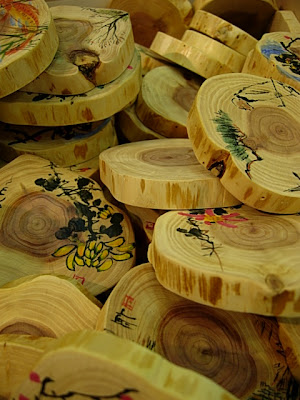
An old man wearing old clothes came into the tea shop. The rundown man carried a corrugated cardboard box and accompanied an old lady following shortly behind. The box was filled with wood coasters. These coasters aren't the typical wood variety. The bark has been peeled away and the fragrance of pine has been infused into the coaster- the smell was unreal- it captured the feeling of the mountain forest. On each coaster was a hand painted image of a traditional, natural Korean scene.


Perhaps too distracting or complicated for the Korean tea setup, the old man, a true starving artist, walked out of the tea shop after a few cups of tea and a few tea snacks without making a sale.


Smiling with the old lady not far behind, he made his way down the old street to try his luck at the tea shop next door.

Peace

Saturday, June 19, 2010

Cha Chan Bad Chim (Korean Tea Coasters) Part II: The Beauty Of Wood Coasters


The majority of tea coasters in Korea are made of wood. They come from a transverse cut of the trunk or large branches of a tree. Often the bark is left on the edges. Korean wood coasters are modest, simple, and natural, as such, they capture the essence of the Korean way of tea.

One of the reasons why wood coasters are so popular in Korea is because they are made of readily available substance and anyone can make them. Because they are simple and economical they carry with them a certain modesty.


Although they are common, no two wood tea coasters are the same. Also because no tree is perfectly symmetrical, they reflect natural asymmetry. In each, there is much natural beauty. Wood coasters, unlike metal or ceramic coasters, add more of a natural feel to a tea space. They are especially useful in situations where teacups would be placed on surfaces other than wood- such as on a fake wood or laminate covered table, and to a lesser extent, a stone surface.


Wood energy is the same energy of tea- tea leaves come from wood branches. In this way the energy of wood in a tea space acts to harmonize and/or fortify the energetics of tea.


Just as ceramic coasters are always changing with use, wood coasters are also always in a state of change. Wood tea coasters absorb the tea that spills over it. Over time and with use, the look and feel of wood tea coasters change as the energy of the tea is captured within it.

Peace

Tuesday, June 8, 2010

Cha Chan Bad Chim (Korean Tea Coasters) Part I: White Ceramic Coasters By Park Sung Il


Some teawares such as cups, pots, and bowls are almost an obsession amongst people who seriously drink tea. This is understandable because out of all the teaware cups, pots, and bowls directly affect the flavour, taste, feel, and qi of the tea the most. But today lets look at an often overlooked piece of teaware- the tea coaster.

One reason for the tea coaster's lack of attention is the fact that not all tea cultures use them, in fact, most in Asia don't. Japanese teaware mainly focuses on matcha and the ceremony surrounding it and coasters are not necessary in the gong fu setup of China where cups are usually set right on the tea table or a tea tray. In Japan and in China, when they do use them, they often prefer metal coasters. Out of all the teawares that could be made of metal, the tea coaster is, from a Feng Shui perspective, the best place for metal in the arrangement of teaware. It acts to balance all the elements on the table by anchoring (or controlling) any excessive energies that might be present. From this view, having metal under the tea cup makes perfect sense.


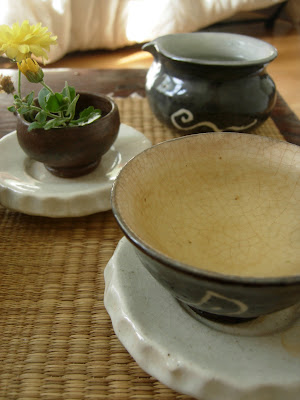
In Korea, because of the way teaware is arranged, the coaster is commonly used. Koreans rarely use metal coasters or any metal in their arrangement of teawares. You do see beautiful ceramic ones in use though. These pieces by artist Park Sung Il are real beauties...

These modest pieces are a good example of the natural beauty of Korean wares.

Firstly, they are functional. They are of the appropriate size which hold most Korean cups which tend to be larger that Chinese teacups but smaller than Japanese teacups. The top surface is slightly slanted towards the center so as to not allow the spilt tea to drip off the coaster. It also has four cute little legs which prevent a hot tea cup from transferring heat to whatever is underneath the coaster as well as giving it stability.


The shape of these coasters, although very simple, are quite beautiful. The shape has a quality about it that feels as thought it has just blossomed or formed. It gives the tea coasters the feeling of a cloud in the sky or the outside pedals of a blossoming flower. But it does so in a such a subtle way as not to draw attention away from the cup that sits atop, and the tea that rests in that cup. In this way these tea coasters teach one modesty when drinking tea.


The white colour of these pieces convey a sense of peace, purity, and simplicity. The colour white, although not a metal, vibrates with the frequency of metal- in some ways imitating its affect on the energy of the set up. Due to the nature of buncheong style teaware, these white coasters haven't retained their pure white look. They have darker cracks that are only brought out through usage. This is what gives them such natural beauty.


This beauty also teaches one a deep lesson. Although the purity of white is beautiful in its own, it can only stay pure if unused or if no tea touches its surface. If unused its even more beautiful state of infinitely small intricate pattern of cracks will never be revealed. Only though a subtle mistake, some sort of slightly careless action, or imperfect action can its true beauty be revealed.


The look of these coasters is not stable but always in a state of change. Like the wave of time or an aging peurh cake, in time and through more use the look of these coasters will change even more.

Peace