Thursday, July 10, 2008

Beautiful Korean Teaware


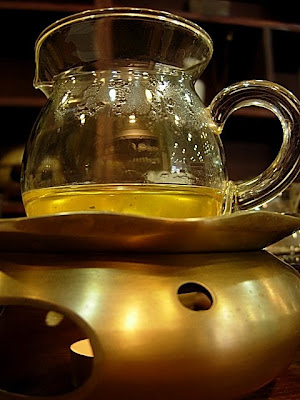
Today, in the busy, crystal clear blur of all goings on in a day, one received tea in this beautiful vessel. The warmth of the golden liquid, penetrated the thin paper walls of this incomprehensibly inexpensive, commonly seen everywhere in Korea cup. Its dry, papery-rough lip welcomed one's incoming lips. The bustle of the day paused as one took the tea in deeply.


What a wonderful tea vessel indeed.

Peace

Tuesday, July 8, 2008

A Tea Tasting From the Foot of the Cauldron


While making tea the traditional Korean way one really gets an opportunity to see how tea morphs from fresh leaf to final product. With this, a great respect for tea and all the love, sweat, and energy that goes into it is fostered.


Particularly, the taste of tea really evolves during the drying process. During this step in the production of tea, tea and those who make tea are subjected to long bouts of slow heating over an aluminum cauldron. This is the most tedious, laborious, backbreaking, and time consuming step when making Korean tea.


These long periods of mixing the tea over intense heat are broken by short breaks were the tea is brewed. The tea is taken directly from the hot cauldron or drying rack, and at the foot of the gas fired cauldron it is mindfully brewed. During these breaks all tea labourers, their clothes soaked in sweat, become tea connoisseurs.

We talk of the quality of the batch, how much drying is still required, and how we should best complete the tea's production. Most importantly, we just enjoy such refreshing delicacies, tastes that one only experiences at the foot of the cauldron. The tea hydrates us and gives us energy to push on making tea late into the night, the fresh qi of new tea flowing throughout our bodies. It quenches our thirst, replenishes our body, and refreshes our mind.


It is most interesting to see how the flavour of the same tea changes between tastings. When the tea is at the early stages of production it looks greener, but tastes more bitter, fresh, and the mouthfeel is more gritty. As tea spends a longer time over the heat of the cauldron it excretes a yellow powder, apparently the chemical constitutes of caffeine and other chemicals, and develops a sweeter, creamier, and smoother mouthfeel.


We work late into the night, completely exhausted, our faces flushed red from the heat of the cauldron and drenched in sweat. When the final tasting is given, we all marvel at what this simple leaf has become.


Peace

Sunday, July 6, 2008

A Lesson From Shofuku-ji Temple In Fukuoka, Japan


One was beaming with excitement and full of expectation walking up to the gate of Shofuku-ji Temple. Founded in 1195 it was one of the first Zen temples in Japan. Eisai had brought back tea seeds and Zen after returning from deep study under Zen master Xuan Huaichang on Tiantai Mountain in China.

He then founded the Rinzai School of Zen and his tea seeds were planted near Kyoto, in present day Uji. Eisai wrote the famous classic Japanese Tea book, “How To Stay Healthy by Drinking Tea” and was partly responsible for turning the Samurai class onto the philosophies of Zen and tea.


As one approached the thatched-topped brick wall surrounding the front temple grounds and walked through the front gate one's mind was at ease. Then one was immediately confronted by a large monolithic stele that reached toward the bright blue sky above. It stood there noble but natural, in the shade of an old tree. On this old stele had the inscription of the great Zen Tea Master Eisai. Although one could not read the engraved classical Chinese characters, one's mind was at peace.

After marveling at the sight of the engraved calligraphy, one looked around. It was empty. The whole temple grounds were empty. The complete stillness was broken by the chants, not of praying monks, but of pre-school children that shared a chain-link fence with the temple grounds. They laughed, ran, and played, full of innocence and joy. One watched them for a while before approaching the only building which was locked by thick, jail-like, wood bars that ran vertically from the top of the door frame to the bottom. This building, the main hall, was also surrounded by wood fencing. One glared past all of this and caught a shadowy glimpse of three Sakyamuni Buddha statues, but, in all truth, one couldn't even really see the Buddha.


One then proceeded to the rear of the grounds in search of someone or something more to this temple. Something more than its empty peace and stillness. Nothing. Wait, up on the tiled rooftop of an adjacent hall, it was a large crow, its jet black feathers contrasted by the large piece of persimmon fruit that hung from its beak. One watched the crow eat the juicy persimmon marveling at its swift, stately movements as it happily and slowly finished off this snack. The crow seemed to savor this seasonal delicacy.

Then coming from the hall one spotted a middle aged monk. One bowed, then waved him over. He smiled and came over.

One inquired, “When does the temple open?”

The happy monk replied, “It's open.”

In this moment, one experienced a profound awakening. The sound of children playing, a crow eating, stillness, and nothingness- this was the true meaning of Zen.

Sometimes when we drink tea we carry the burden of some preconceived notion of what this or that tea should taste like or we look for something, something special within our cups, when, actually, what we are truly looking for is always there, waiting to be discovered.


Peace

Thursday, July 3, 2008

A Sampling of Two Taiwanese 2008 Spring Oolongs and One 2007 Winter Oolong


It is quite uncommon to run across any Taiwanese tea in Korea. The market is primarily full of green teas mostly Korean in Origin and more recently puerh from China. But today at a tea shop in the presence of friends, we laughed, kicked back, voiced tea preferences, and enjoyed an irregular treat.


The first is from Lei Mountain by the producer of the same name. It had a floral aroma typical of spring oolongs, no flower in particular just the sum of a garden full of different spring blossoms.


The taste was mild, bitter-sweet, with a slight woodiness. The notes of flowers softly smothered the mouth targeting the back of ones mouth like an aftertaste of lingering candy. The freshness of this tea in the back of the throat made it shine. It's happy energy could be felt.


The second tea was an Ah Lei Mountain oolong. The smell of the liquor was a deeper, huskier, mustier, and muted floral. This tea doesn't taste as it smells.


It was a heavier oolong with subtle sweet, bright high notes. It left dry astringency at the back of the throat where the Lei Mountain tea left floral footprints.

After relishing in the spring oolongs, an Ah Lie Mountain 2007 winter harvest oolong from the same maker was brewed up.

This tea had more bitter elements to it that came on fast over the front of the tongue. A oak flavour is felt on the tongue and left on the breath.


This tea had the least floral scent out of the three, perhaps a characteristic common of winter oolongs? This tea was most like a Korean green. One was comforted by this similarity albeit vague.

In the end it was nice to be able to compare Taiwanese teas of similar (mid range) quality from different regions and harvesting seasons. In this way one can begin to form opinions about a certain kind of tea. But, more importantly, it was nice to talk, share, and just be with like-minded tea friends and just enjoy tea for what it is- tea.

Peace

Wednesday, July 2, 2008

A Closer Look At Three Different Kim Kyoung Soo Pots and One Bowl of Flowers

05.8.11.


The lid of this pot was sutured with gold after it was damaged. Often damage or ware and tear of a pot can bring out its natural beauty. This is an excellent example of this.

07.2.24


The shape of this pot is particularly beautiful. It is cleverly, gracefully, and so evenly proportioned. The shape seems especially right when pouring tea from it.

07.3.10


This pot displays how the base can ground the pot. The top of this pot seems ill proportioned as its upper seems to share less space, yet the base and three legs pull one's attention down, grounding one's mind.

Peace

Tuesday, July 1, 2008

2008 Nok Ya Won Wild Hadong Ddok Cha


This traditional Korean style tea has a long history that goes back to the 7th century during the rule of the Shilla Dynasty in Korea.


This tea was produced in eight steps. The first step involves the hand picking of this tea, in the clean and serene Jiri Mountain valley at a wild tea plantation just outside Hadong on the 10th of May, 2008. Secondly, the tea is dried in a large, gas-fired aluminum cauldron for 20 minutes. This acts to partially stop its oxidization. Next, the tea is removed from the cauldron and is placed on a rough, fibrous rush mat where it is violently rolled by hand. At this step the leaves break a little giving way to a reaction between tea and air. Then the tea is shade dried where it is exposed to the open air of the mountain valley for 48 hours. Next, the tea is separated and weighed into 100 gram piles. Then the leaves are steamed to soften them. When the leaves are supple they are pressed into cakes. Finally, they are left to dry in a warm room for 3-5 days.

If this tea tastes anything like last years, it will undoubtedly be an interesting session. The proprietor and producer of this tea, Mr. Kim, suggests traditional Korean style gong fu brewing, 2 grams of tea for intervals of 30-40 seconds or 3 grams of tea for 10-20 seconds. He claims that this tea will acquire its best taste in 3-5 years.

The tasting notes are as follows...


What? No notes? Why?

Well, due to peaking interest (see this link to Toki's adventures in Korea) one has decided to offer thanks to some of the other blogers out there whose blogs one regularly takes great pleasure in reading and learning from.


Three 100g cakes were broken in to threes (that's nine 33 g samples), packaged in the traditional Korean way in rice paper, and then mailed away.
One apologizes in advance to those who were missed, they will be first on the list next time one sends goodies out.

One looks forward to reading the notes on your blogs of this rare Korean tea.

Peace