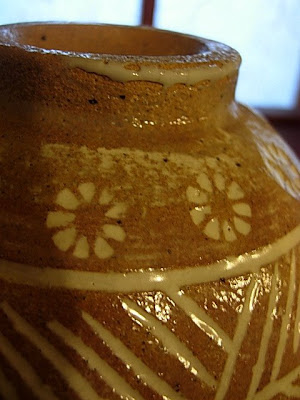
Showing posts with label sam do style. Show all posts

Tuesday, March 12, 2013

Another Sam Do Style Tea Bowl By Korean Master Chon Han Bong


Chon Han Bong (Cheon Han Bong) is one of Korea's best potters. Especially magnificent are his Sam Do Style teabowls. One had the opportunity to drink many bowls of matcha (Kor: malcha) from his Sam Do bowls and the experience is always memorable. It was an unexpected treat when Greg Demmons brought one of Chon Han Bong's Sam Do Style bowls over to drink matcha from. After our tea meeting he left this bowl behind for me to inspect with a closer eye...


The eyes are drawn to the streaky, thin, gye yal (brush mark) which skirts across the outside wall of the bowl. The eyes see what the fingers feel- senses are in harmony as one holds the bowl in cupped hands. The gye yal offers the fingers soft bumpy ridges with which the fingers embrace. The sharp gye yal fades invisibly into the upper and lower side wall, its border is ambiguous and hard to define leaving the mind in an expansive state. The side wall of the bowl above and below the gye yal are only defined by the subtle sensation below ones fingers. Near the rim it feels of soft grainy sand under the glaze. Near the foot it feels of slightly courser grainy sand under the glaze. The colour of the outer sidewall also dramatically changes as the bowl is rotated counterclockwise in ones hands. One side is pink-reddish and slowly the more greyish-blue side is revealed as the bowl is rotated. These colours offer a wonderful contrast, warmth and cold, sunrise and sunset, yin and yang.


At the bottom of this bowl is a simple "haes moo ri" style foot that is characteristic of Chon Han Bong's Sam Do teabowls. The simple style and execution of the unpretentious and smooth cut foot is exactly opposite what is found on the rest of this bowl. This technique of a simple foot is done for a few different reasons. Firstly, it allows for the focus of the bowl to be elsewhere. Secondly, it offers an element of contrast. Thirdly, it reminds us of the unpretentious and simple life.


Conversely three marks of beautifully imperfect beauty grace the outside wall of this bowl. Two blotchy fingerprints are found near the foot and connect us with the potter. These fingerprints give the bowl a feeling of being in the present while connecting us with the past. These marks on the bowl are just as unique as the fingerprints themselves. These prints break and muddle the continuity of the gye yal of the side wall. Like a monk breaking though his koan it jolts us into a relationship of what this bowl is. There is a beautiful patch of thicker white glaze on the edge of the foot and another smaller slightly thicker greyish white blob on the sidewall near the foot. These blobs of glaze give the bowl more life, more uniqueness, more strength. If you look closely you will also see a faint gye yal fade into the rim of the bowl. It certainly encourages you to look inside...


When gazing inside the bowl your focus is immediately drawn to the characteristic Sam Do Style stamped flowers in the shallow of the tea bowl. These flowers are especially interesting and contain three elements which make them especially beautiful. First, the flowers seem to be haphazardly scattered and often overlap. This element conjures the image of the potter acting in a carefree fashion, and gives the bowl a free feeling. The flowers also fade in and out and do not always offer a complete imprint. This feature also has the same effect as above. The flowers are also covered by the five stack marking that occur in the wood kiln- also a very free feeling effect that brings into touch with the potter.

Other interesting aspects of this exceptional bowl include the seemingly random blotches of ghostly white. These both offer contrast while bridging and harmonizing the colours of the patterns and marking and the base colour.


The small divots that encircle just above the flower stamps act to give the bowl movement. More importantly they influence the whisking action of the matcha creating micro turbulence and in the end a better bowl of tea.


If you look close enough at the characteristic Sam Do style white diagonal white dashes you can even see mico cracks in the glaze. Also of note is how the double lined upper border of the inner sidewall fades from two lines into one. It does so so harmoniously and so subtly that an untrained eye would easy miss it, lost in the complex patterning of the Sam Do Style.

This bowl is an overall beautiful visual and tackle experience...

Did I mention that it makes good tea.

Peace

Sunday, February 6, 2011

Sam Do Style Tea Bowl by Korean Master Chon Han Bong: A Look at the Rae Bin Sam Do Subtype


The Sam Do Style, or Three Island Style of tea bowl has a long history in Korea. The Rae Bin Sam Do style can be traced all the way back to the early 1400s and is one of Koreas classical styles. Like the Hwa Sam Do style and Ju Sam Do Style it has a very distinct look, or cannon, that is followed. Essentially they are trying to replicate the essence of a traditional bowl with only subtleties of each potter coming out in the final product. The idea is that the harmony of the elements, of nature, of the earth & fire is what is admired in the final product. The potter is below or under his product- the bowl his hands helped create. Of course, we cannot talk of this bowl without mention of Master Chon Han Bong- he is a brilliant potter and one of Korea's true masters.


This beautiful white slipped Rae Bin Sam Do style bowl is winter in feel while hinting at spring. So today, as winter rains fall and spring around the corner, it seems like the perfect day to examine such a wonderful piece.


The focal point of Rae Bin Sam Do style bowls is most definitely the calligraphy in the bowl's pool. The whole bowl seems to emanate around this centering feature like the island that this style of bowl was thought to come from. Here in the center we can also see the colour undernieth. It is the earth, the earth of the island. Its boundary is well defined by a white circle. From this calligraphy, from this white circle, the energy of the bowl is transmitted.


Squiggly lines emit from the center covered in a thin white that is blotchy, not completely covering the colours beneath. These squiggly lines represent the water, the waves that surround the island, the waves of peace that undulate in rhythmic motion that put us at ease when drinking tea from its innards.


The squiggles reach outward to the rim that is marked by notches, often a defining feature of the Sam Do Style. These notches are to thought to fill space with that which is beautiful but not pretentious. The notches that collar the inside rim on this bowl remind us to fill our lives with that which is beautiful but not to be braggarts, flamboyant, or pretentious but rather modest- happy with the simple things we fill our life with.


Of note on the inside rip is a finger print, a blotch, a human touch. Often blotches connect us to the human element of a tea bowl besides adding a measure of asymmetrical beauty. This blotch is especially beautiful and done quite tastefully.


The outside of the bowl is coated in a thicker application of white. Only when you flip the bowl over to admire its foot can you get a real feel for the contrast the white slip gives to the bowl. You also notice the ghostly layers white with thinner application in some areas and thicker in others where it coagulated then drizzled down the side. As the white nears the foot it thins into natural patterns with blotches of the base, green/blue brown colouring, showing through. These blotches add a relaxing element to the piece like watching a slow moving cloud in the sky.


The chop to is tactfully balanced with a small uncovered patch, revealing the clay below. It suggests modesty of the potter. The balance it creates with the chop is quite breathtaking especially with a such a thick layer of white defining its perimeter.


The division and contrast created by the distinct white boarder that cuts the foot in half is stark and is the focal point of the bowls bottom. Staring at its division reminds us of the division between Heaven and Earth. The sky, water, and island. The yin and the yang. The Dao.

Peace

Thursday, July 22, 2010

A Sam Do Style Teapot by Japanese Ceramicist Tosiichi Suzuki


Tidy shape, clean form, nice pot.
There is something slightly unbalanced about the ring of flowers on the top which the stubby handle and bulbous bottom seem to partially remedy.

Peace

Wednesday, July 21, 2010

A Sam Do Style Tea Bowl by Japanese Ceramicist Tosiichi Suzuki


There was a large art festival just down the block last weekend. One was anticipating conversation with one of the artists there, Tosiichi Suzuki. He is a ceramics professor at Yokohama College of Art and Design and specializes in 'Sam Do' (Jap. mi si ma) style. He had a few pieces on display.

This tea bowl is a very clean example of 'Sam Do' style. Although beautiful, this bowl is a bit too 'clean' with very little wabi sabi to value. Japanese potters have always had these problem when trying to recreate classic Korean styles. It has much to do with the mentality of Japanese compared to the mentality of Koreans. It is definitely a social thing and not an ability/ skill thing as there are many mind-bending potters in Japan.

Tosiichi Suzuki discussed his firing technique- 900-950 Degrees gas fired for 10 hours, oxidization firing from 1230 and stopped at 1250. The very clean, almost sterile, feel of this bowl is mainly due to the fact that it is gas fired as opposed to wood fired. Wood firing breathes so much life into the pieces.

The shape, foot, and feel of this bowl seem too perfect as they kick up the sun's rays creating a white heavenly glow.


The flowered lip is the focal point of the bowl. The small stamped flowers fade in and out of the oxidized rim, no two are the same- each one is admired.


Heavenly bowl.

Peace

Tuesday, April 21, 2009

Sam Do Tea Bowl Style- A Look At The Ju Sam Do Subtype


This style of tea drinking bowl can be traced back to June 6th, 1565 where it is described in written records by the Japanese. The name ‘Sam Do’ or ‘Three Islands’ refers to the three islands in the south of Korea where the Japanese first stumbled across this style. It most likely erroneously alludes to two islands and part of the peninsula which was mistaken as being completely surrounded by water.

These bowls are marked with white. Most, but not all, have short slashes of white just inside and/or outside the lip of the bowl. These dashes give the bowls a feeling of movement and depth. At the bottom of these bowls there is a rather short simple, even cut ‘Haes Moo Ri’ style foot. These pieces are often heavily glazed.

There are many subclasses of ‘Sam Do’ bowls the most popular and probably most spectacular being the ‘Hwa Sam Do’. ‘Hwa’ means flower so these bowls are ‘Flowered Three Island’ Bowls. They carry this name because there are white flowers that are stamped onto the bowl using a stone or wood carved stamp. Quite often there are thousands of these little white flowers that cover the inside and sometimes the outside of these bowls creating a wonderful blossoming effect.

These bowls, like many others from this early time, were coveted by the Japanese. Today, however this style is not in vogue, and is quite a rarer sight.


This bowl is a different subtype of the sam do style- 'Ju Sam Do'. All 'Ju Sam Do' bowls, from a far distance , look completely identical. Only upon close inspection can you notice the subtleties that divide amateur 'Ju Sam Do' bowls from the 'Ju Sam Do' bowls of masters.

This wonderful example of the ‘Ju Sam Do’ style is by buncheong master Kim Jeong Oak. This piece looks quite respectable in shape and form. When cupped in the palms of the hands this bowl feels wild and uncut as flesh senses the criss-crossing white divots.


The flowers are not overdone in this piece and linger near the bottom. They serve to balance and give elegance to the many white slashes that hover above. The cloudy glaze around the foot of this bowl hints at its genius, a last attempt at turning simple and wild into soft stable sophisticated beauty. You can feel the movement and balance in this bowl from top to bottom, from rough to refined.

Doesn’t our restless mind also follow this progression after taking time in our busy days to drink tea?

Surely drinking matcha from this bowl would bring about such an affect.

Peace