Showing posts with label 2015. Show all posts

Monday, November 30, 2020

Revisit: 2015 Biyun Lishan Gongcha

This was a pretty straightforward and very enjoyable puerh when I  tried it blind in the summer.  I’m sampling it again a day after re-visiting the 2013 Biyun Hao Mahei and 2 days after 2015 Biyun Hao Yibi Tedagushu with hopes of a nice comparison coming next post. 


Dry leaves have a faint sweet cereal odour.  Lots of subtle honey sweetness with expansive and long fluffy candy sweetness in the aftertaste.  Very pure and elegant with soft full light chalky fluffy aftertaste with a light oily lubricating feeling.  Very elegant in the body as well with some Heart thumping and focused relaxation.  A big stoner Qi develops with this one over long elegant long breath honey and candy sweetnesses.  The downside to this puerh is weaker stamina but it is actually quite common for puerh that is this highnoted and subtle.  The infusions in the later infusions turn to woody and somewhat astringent slight bitter.  

Overall I really like this elegant and Qi heavy puerh.  I knew what to expect this time and felt the energy of this puerh really put me in a good spot today!  I think this session turned out better than the first blind tasting.  The very long elegant finish is something spellbinding!

Peace

Saturday, November 28, 2020

2015 Biyun Hao Yibi Tedagushu: Lovely!


I remember when Teas We Like offered the now sold out BiyunHao Vertical Tasting of Yibi.  I was definitely curious.  I remember Marco being fond of the processing and care and overall experience of this Yiwu area which Biyun Hao has a long history.  But I also would have just preferred to simply know what the best Yibi is.  This 2015 Biyan Hao Tedagushu ($255.00 for 360g or $0.71/g cake) was a limited release and sold out fast.  It was billed by Teas We Like as their favorite of all the available Biyun Hao Yibi Gushu productions.

Dry leaves have a woody, almost licorice, and candy odour.

First infusion has a buttery woody creamy almost licorice sweet approach.  The mouthfeel is soft and full fluffy feeling.  The throat opens to an upper-mid depth which causes a bit of salivation in the mouth.  There is a long lingering licorice almost mushroom wood aftertaste.  This is a nice smooth puerh.  The Qi is a very reassuring calm with a bit of Chest sensations.

The second infusion is a creamy sweet woody kind of caramel licorice in a nice oily broth.  The oil leaves and the tongue and what is left a soft chalky sand with saliva pooling in the upper-mid throat.  The aftertaste of almost candy but mainly woody mushroom that is mainly sweet and oily.  The sweet candy lingers on the breath.  The Qi is immediately apparent in the head even a heavy head sensation is left there with deep breaths in the belly and open chest feeling.  There is a fresh coolness in the inhales and exhales along with candy in the upper-mid throat.

The third infusion has a richer woody sweet onset with a slight sandy mouthcoating with an oily broth.  There are notes of licorice and even metallic notes in the initial taste.  You can sense some almost unnoticeable incense tastes as the upper-mid throat is stimulated and an almost woody, mushroom, caramel sweetness is left behind.  The Qi is pretty strong in the mind and makes me feel like I am a bit heavy and hazy here.  Nice mild but quite noticeable body feeling of heavy shoulders and head, open diaphragm and chest.


The fourth infusion has a rich woody almost caramel sweetness the taste is real pure and clear and comes in a somewhat oily broth and as it recedes leaves a fine slight sandy mouthcoating and lips dryness.  The throat is stimulated a bit deeper in the mid throat here where a woody, mushroom, licorice and faint candy really linger.  The sweet woody mushroom long aftertaste is real nice.  So is the Qi that is both strong but relaxing on the body.  It leaves me feeling great with a nice opening body sensation in the Abdomen and Heart with slight heavy shoulder and head.

The 5th has an almost pear sweeter candy almost caramel initial splash of taste in a mildly oily broth.  There is a sweet candy that overarches the whole profile and is really nice.  The sweetness hangs out in the mid-throat and is long on the breath.  The taste is nice like a mushroom woody a predominately sweet taste.  The mouthfeeling is a sandy, lip drying, feeling that is revealed when the oily broth recedes.  The Qi is nice and happy and deeply refreshing in the mind with opening and heavy mild sensations in the body.

The 6th has a smooth creamy sweet almost caramel with mushroom and woody complexity to the sweet that is overarching and long.  The tastes really are quite long and stretch deep into the breath.  The taste is really yummy, expansive and long.  Very gushu but also very East Yiwu.  The Qi is really nice with a deep feeling good strong mind feeling with a very harmonious, soothing, strong bodyfeeling of heavy shoulders and limbs with opening chest and Lungs.

The 7th has a woody mushroom onset with a candy like taste that comes out and expands in the throat.  The liquor here is not really oily anymore so it just coats the mouth in a sandy, lip drying coating and simulates the upper-mid throat a tiny bit enough for a long candy like and mushroom-wood taste.  Again the taste profile is really clear and pure with the same tastes coming out in different measures.  The Qi is happy and soothing in the mind and obvious but harmonious in the body.

The 8th infusion has a more fruity pear taste upfront with woody-mushroom in the distance- the tastes go long in the profile and make themselves known in different areas like the mouth, throat, breath- a sign of a nice single estate gushu taste for me.  The Qi is deeply penetrating but harmonious and relaxing.  Long almost caramel mushroom woody sweetness is left on the breath.

The 9th has a nice woody mushroom subtle sweetness over a full fine sandy dry lips mouthfeeling.  There is a soft cool almost mushroomy caramel sweetness.  Long candy finish.  The taste is starting to weaken although it maintains its breadth.  Almost fruity finish on the breath now.  Nice relaxing uplifting Qi.  Good harmonizing bodyfeeling.

The 10th infusion has a bit of dry woody astringency now with more of a subtle sweetness.  The woody taste is dominant now with the sweetness reduced and mainly on the breath with a bit of fresh coolness.  The mouthfeeling is drier even into a dry upper throat.  Nice Qi.

The 11th has a woody dry initial taste with a subtle sweetness.  The oiliness is gone in the liquor leaving lots of sandy dryness as a mouthcoating with no polarity to level it out.  The throat is a bit dry here too with a subtle candy breath taste.

12th is much more watery and woody and fruity.  There is a distinct mild dryness about the mouthfeeling and throatfeeling with edges of candy in the aftertaste.  Nice relaxing Qi with a bit of heavy shoulders body feeling left.

13th has a watery muted fruitiness over a dry mouth, lips, and throat.

I mug steep the rest out…


These long mug steeps push out a chalky, woody, almost savory mushroom, slight dirt taste with very faint coolness on the breath with ghostly almost unrecognizable candy sweetness.  Solid tastes are left in these long infusions.

This is a nice gushu puerh with very clear single origin taste (of woody mushroom, sweet candy finish, some caramel and occasional pear), mouthfeeling (full sandy almost drying lips and mid deep throat simulation with an oily liquor in the first half of the session), and qi (nice bodyfeeling of open chest and abdomen with very happy and harmonious qi feeling.  Great Qi and bodyfeeling!  It is strange that the taste, mouthfeeling, and Qi reminds me of the 2020 EoT TianMenShan!  They might possibly be similar in production, tree age, and location.  The Tianmenshan is definitely stronger and less smooth gushu and has a more interesting but kind of similar flavour.  This lovely Yibi is nearly twice as cheap per gram though.


Peace

Friday, July 31, 2020

Marco’s Blind Tasting “Delta” (2015 Biyun Hao Lishan Gongcha)


This was the very first of Marco’s blind samples that I tired.  It is decently hot here in the summers and I felt like a drier stored, maybe younger Gushu type of tea this morning that would give me a bit of energy and focus.  This one looked like it could be just that…

Dry leaves are moderate compressed leaves smell of a very faint floral and grains and almost licorice type aroma.  After rise the wet leaves smell of mild candy and licorice and hay.  The dry leaf looks dry stored and somewhere between young and semi-aged.

First infusion has a honey sweet onset with a vacuous grains base with a faint slow emerging lingering candy on the breath over a soft mouthfeeling.  The candy breath is very long and smooth and mingles with a slight cooling on the breath.  A sticky honey taste is found on the tongue.

The second infusion has a grains candy sweet onset that slowly stretches into a long and smooth candy finish on the breath.  The long and very smooth sweet aftertaste is very very nice and is the feature of this puerh.  There is some honey taste that returns in the mouth and throat minutes later.  This is obvious single estate, simple and quite elegant.  The mouthfeel is quite soft and the throatfeeling is deep but faint.  This is a nice puerh.  Even 10 minutes later this is a long elegant distinct honey and candy bubble gum.

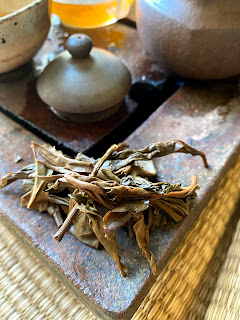
The third infusion has a more forest woody grains candy onset.  There is a bit of a rubbery blank almost licorice mid taste then a long candy breath taste with minutes long returning honey.  The long pure candy and honey sweetness is what makes this puerh quite elegant and beautiful.  The Qi is very mild and quieting in the body and mild.  There is a mild mind slowness and brow softness to the qi. (third infusion pictured).

The fourth infusion has a honey licorice grains woody onset with a rubbery woody mid-taste which leads into a long pure candy taste on the breath.  The returning honey on the breath comes minutes later then the distinct pure and strong candy is left on the breath riding out for minutes there.  There is almost no astringency (which just very mildly appeared in this fourth infusion) and no bitterness in this single estate puerh.  The mouthfeeling is quite soft and slightly sticky now.  The throatfeel is vacuous but mid-deep.  There is honey on the tongue afterward and candy on the breath.  The Qi is very comfortable in the body and mind.  This has the taste and feeling of Lincang/Mengku puerh to me.  The sweet profile, slight licorice, slight astringency, honey taste.  The strong candy and slight woody finish remind me of something more Yiwu, maybe Autumnal Yiwu or Spring Lincang… probably Lincang spring puerh.

The fifth infusion has a deeper woods, honey, grains and licorice onset.  There is more of a pronounced coolness in the throat a faint astringency.  The sweetness is a layered honey taste on the more substantial tongue coating.  I can feel a bit of tingling on the face and cheeks.  A mild and comforting Qi emanates from this puerh.  This infusion really tastes like Northern puerh.  Deep honeys come out of a strong stickier mouthfeeling and more substantial astringency in the throat.  There is a mild camphor taste in the throat.  This infusion has a bit of power to it has the astringency and tongue presence is felt.  You can feel some of that astringency in an empty stomach.

The sixth infusion has a woody, mushroom, licorice sweetness to it initially in a full feeling sticky and somewhat astringent mouthcoating.  The moderate astringency simulates the upper throat.  There is a long honey taste that lingers in the aftertaste and some candy is found in the breath.  This last few infusions have a bit more power to them which is a shift from the very elegant 1-4th infusions to a more tangible and powerful mid-session.  The Qi is starting to have a mild stoning effect on the mild.

The seventh infusion has an almost soapy, mushroom, woody, less licorice taste.  There is a bit of mineral and stone tastes mid-profile and is a faint long candy finish.  The astringency is less here and the candy aftertaste is more.  There is less honey and more candy in this infusion.

The eighth infusion has a soapy woody mushroom faint licorice initial taste with a long candy breath.  The mouthfeeling is a touch astringent and makes the tongue sticky.  There is a slight bland paper taste with candy in the aftertaste.  The qi has a mild-moderate heaviness to it and feels very mildly stoned in the body.  This is a common Mengku Qi sensation.

The ninth infusion has a flat woody almost mushroom onset with a nice candy finish.  The profile is thinning out here but the astringency is keeping things real and the aftertaste of candy long in the throat. 

The tenth has a mushroom and almond like sweetness to it.  The mouthfeel is a sticky almost drying but more astringent feeling.  There is still long candy in the breath with a faint woody taste and a stoned Qi sensation.  There is a slight heart racing and alerting feeling now too.

The 11th infusion has a blank wood onset with faint suggestions of licorice and chicory.  The candy aftertaste is dropping out leaving mainly woody taste over a slightly drying astringent sticky mouthfeel.

12th infusion is a licorice bland paper and woody onset with some candy and still a bit of camphor appearing in the breath.  Heavy brow Qi feeling.  Despite the initial and mid flavor profile dropping out there is still a long candy finish even minutes later.  Sticky astringent mouthfeeling.

13th has a paper tasting bland onset with a faint candy finish in an active and astringent mouthfeeling.  The 14th is much the same and I put this into a mug infusion… With a bit of astringency this puerh is not a great candidate to pushing hard here at the end so I end my session still on flash steepings then to a mug…

The long grandpa mug is a bit fruity almost but still quite bitter/astringent with a pucker astringent mouthfeeling and a bit of candy at the end…

The stamina of this one is a bit poor but the progression of flavor, mouthfeeling, and Qi over the shorter session is somewhat dynamic and changing.  It is elegant for the first 4 infusions with a beautiful very long and accentuated candy and honey sweetness.  This tea is all about the long elegant aftertastes here which is quite beautiful.  The honey and candy take turns at revealing themselves in the aftertaste for a long time which is the highlight of this puerh and makes it of nice quality.  The mid profile becomes more astringent but also mushroom and woody and licorice typical of the Mengku/Lincang producing areas with a familiar Mengku stoned qi sensation. In the end of session you still get the candy finish on some level and the Qi takes a turn to become more stimulating.  In the end I left quite energized from this session!

Guess: A pretty dry stored high quality Menkgu/lincang single estate like gushu approx. 3-7 years old.

Answer: 2015 Biyun Yao Lishan Gongcha from Teas We Like
Peace

Sunday, September 22, 2019

2019 Zheng Si Long Wa Long vs 2015 Zheng Si Long Wa Long


The 2015 Zheng Si Long Wa Long ($161.63 for 400g cake or$0.40/g) is one of my favorite of the Zheng Si Long I’ve sampled over the last year or so.  I was excited to try the 2019 Zheng Si Long Wa Long complimentary sample (the 400g cake goes for $129.30or $0.32/g).

Dry leaves are a deep dark foresty rubbery deep forest like underlying sweetness.

First infusion has a woody watery onset with underlying icing sugar sweetness. The mouthfeel has a tight mild astringency to it.  The throat almost seems open for things to come.  There are faint ghostly lingering fruits and florals in the far distance.

The second has a creamy sweet woody onset.  The creamy sweetness has a milky richness to it and turns into a stone like sweetness.  A fruity taste expands in the mouth in the aftertaste.  The mouthfeel is silky and has a faint astringency to it.  The throat has a nice opening where creamy and fruity tastes feel like ghosts in the throat.  The aroma coming from the throat is nice floral, creamy sweet and almost but not quite fruit.

The third infusion has a woody tart that traverses quickly to sweetness that is a bit plum fruity, almost sour, and a bit creamy.  The sweetness pops in the mouth nicely then the aftertaste expands into a floral sweetness.  The mouthfeel is faintly astringent and almost velvety.  The throat opens to a mid-depth.  The Qi starts to feel relaxing in the head.

The fourth infusion starts off sour and slight bitter creamy fruity taste like a plum that is not ripe enough to eat.  There are mild layered woods underneath and a floral quality as well. There are lots of different taste dimensions in here.  The mouthfeel is velvety and almost astringent and the throat feel opens to a nice mid-level from the faint astringency.  There is a mild lingering cotton candy taste minutes later on the breath.

The fifth starts with an increasing tart and bitter nuance.  The mouthfeel is mainly tart, puckering astringency.  It pushes out floral and creamy sweetness and in the aftertaste a faint cotton candy taste.  The astringency pushes the flavours deep into the throat.  I would say floral wildflower and almost honey distinctly lingers there.

The sixth has a plum and green apple fruit onset that is somewhat bitter sour and bitter.  The fruit tastes kind of expand into sour notes.  The qi is somewhat relaxing with a heavy head feeling.

The seventh is a bitter, astringent moderately fruity green apple and plum taste under the stronger tastes.  A strong floral sensibility expands in the aftertaste.  The tastes are interesting and nuanced but cloaked in bitter astringency.  The long sweet floral expansive aftertaste is enjoyable.  Back to back infusions cause the mouthfeel to become pucker.

The eighth infusion starts with a sweet splash with bitter and sour underneath.  There is a sweet creaminess which expands into a floral nuance.  The taste is full and nuanced in the mouth.  The Qi is stuffy in the head, mildly warming, and mildly relaxing.

The ninth infusion starts with an astringent pucker- you have to really space out the infusions to mitigate this, but let’s be honest, a tea like this is for aging.  The sweet almost tropical fruity onset and creamy sweet finish is made complex by a deep floral layering and deeper throat feeling.

The tenth infusion starts creamy sweet tropical splash of quick flavor before astringency and bitter overtake.  The foresty, floral taste layered with creamy and almost candy sweetness juxtaposed with bitter astringency gives this puerh lots of taste depth.  The mouth is very puckered up but not at all throat choking.  The head starts to feel spacy and floating.

The eleventh is a mellow tasting almost sweet fruit but more floral with bitter and astringency underneath. The mouthfeel is a flat tartness.  The sweet floral taste is most obvious here.

The 12th starts woody, astringent, and bitter with a faint butter floral underneath.  The floral almost creamy sweetness shares space with a dry astringent wood.  The Qi is mellow and a bit warming.

The 13th has a fruity sweet starfruit onset with a sour and moderate bitter finish.  The taste has very little floral here and is mainly a flat fruit sweetness.  The mouthfeeling is slightly slippery.

The 14th becomes a bit more woody fruit moderate sourness and bitterness and a subtle candy nuance in the aftertaste.  There is a sour fruity sweet note on the tongue and in the throat the floral taste is less now.  Qi is a moderate/mild heavy headed feeling and relaxing thing. 

The 15th has a chalky almost creamy mild fruit taste with sour and bitter tastes much less now. The mouthfeeling is slippery.  The 16th is a bit more bitter and sour but there is mainly just this mild fruity sour taste with a mouthfeel that is becoming increasingly sandy.

I decide to put this one into a long overnight infusion next to the 2015 Zheng Si Long Wa Long that I conveniently drank the day before…

A bitter very floral taste is left in the broth the next day.  There is an underlying melon fruit sweetness to it.

Left are the 2015 wet leaves and right are the 2019 wet leaves.

This is quite a distant comparison because the 2015 Wa Long underwent 4 years of dry Xishuangbanna storage.  So really it’s at a different stage of aging compared to the ultra young, pressed just a few months ago, 2019.  Also, it should be noted, that I quite like the 2015 Zheng Si Long Wa Long and purchased 3 cakes last year.  It was the intense Qi sensation (the warmth, the alertness, and the chest sensation and Heart racing) that made this one a worthwhile purchase for me.  This 2019 Zheng Si Long Wa Long has a more heady type of Qi, relaxing, more moderate-mild, and no stronger body sensation.

The interesting thing about this young 2019 Wa Long is the astringent bitterness and reasonably layered complexity of taste and deeper throat sensation (although this sensation isn’t consistent throughout the infusions).  I image the 2015 Wa Long also had this type of astringent bitterness and stronger throat sensation when it was this young but it has aged out at bit into something quite nice.  This is likely the reason that it didn’t sell out early- when it was young, it was probably a bit unpalatable, like this one.  The 2015 Zheng Si Long Wa Long is basically for aging into something enjoyable, much like the 2015. 

Peace

Tuesday, September 3, 2019

2015 Yunnan Sourcing Mu Shu Cha and A Bit On the Mother Tree Puerh


What exactly is Mu Shu Cha (aka Mother Tree Tea)???  Well, it’s a bit of a puerh oddity that seems to be only produced in the Mengku producing area.   They are some old large leaf varietal that is often referred to as “Primordial”.  It is my understanding that they are called “mother trees” because they are they ancient varietal which gave birth through selection the common puerh varietal.  They also seem to only be found at reasonably high altitudes.  They kind of have their own separate flavor, mouthfeeling, and Qi profile.  I kind of think of them somewhere between a wild tea/ Yesheng and puerh.  During my recent sampling of the Yunnan Sourcing Brand I thought to pick up some recommended Mu Shu Cha to see if it sparks my interest in a deeper exploration of this unique type of puerh….

I actually have quite a long history of sampling and drinking Mu Shu Cha.  I remember sampling the Shuangjiang Mengku Mu Shu Cha releases when they first came out in the Mid-2000s.  I believe 2005 is their first production and I’ve never even heard of Mu Shu Cha productions that pre-date these Shuangjiang Mengku.  It’s a bit of a different profile and I never really fell in love with its very unique character.  A sweet taste and euphoric Qi is what I remember most from these.  This is kind of like wild tea/ Yesheng and shouldn’t be judged next to more standard puerh varietals, Mu Shu Cha has a different stereotypical profile than other puerh.  I had never tried aged or semi-aged Mu Shu Cha.  This sample will be 4 years of age in completely Dry Kunming storage at Yunnan Sourcing’s warehouse. Although I have tried the Yunnan Sourcing 2011 and 2017 version of Mu Shu Cha in the past, this sample (a 400g cake goes for $192.00 or $0.48/g) was to test the waters as to whether I want to explore more Mu Shu Cha for purchase…

Dry leaves smell of intense strawberry, raspberry, and airy sugary sweetnesses.

The first infusion has a slightly bitter onset with a flat grainy taste that follows there is a low lying fruity nuance underneath a cereal taste.  The mouthfeel is slippery and there is almost a metallic finish in the mouth.  There is an almost non-existent mouthwash aftertaste in the mouth along with edges of dry dirt and grains.

The second infusion has a grainy almost raspberry dry dirt and wood nuance to it.  It’s an unusual single note taste that has more of a grain and berries taste in the finish.  The taste is real muddled in the initial taste then becomes this interesting grainy fruity strawberry taste in the aftertaste.  The Qi is migrating to the mind and it becomes at ease and relaxed a bit euphoric even.

The third becomes more fruity sweet strawberry.  That sweet note is there initially with mild bitter, dry wood and dry dirt muddle and a more clear barley grain taste.  It then becomes clear and vibrant and almost pungent in the aftertaste.  The mouthfeel is slippery and almost sandy and the throat feeling feels empty.

The fourth has a slightly bitter and more cherry fruit taste initially.  The bitter cherry taste is strong and vibrant.  There is a slight sour astringency developing.  The mouthfeel is slightly gripping now and the throat is stimulated.  There is a hollow fruity nuance in the aftertaste.  The Qi is dizzying now and starting to build on being euphoric.

The fifth infusion starts a bit buttery bitter and vegetal there is a distinct fruity cherry note with some muddled vegetal, rubbery, dry dirt like base.  There is some bitter cherry and almost beetroot sweetness in the aftertaste.

The sixth infusion starts with a moderate bitter fruity onset with a muddled beetroot base.  The mouthfeel is slippery/sandy with an open/ vacuous throatfeeling.  The sweet cherry-strawberry almost vegetable taste is then found in the aftertaste over a muddled, beetroot base taste.  The Qi is spacing me out my mind floats away.  Profound clam is found within.

The seventh infusion starts with a thick syrupy sweet cherry sweetness. There is a quick lingering candy sweetness in the aftertaste.  This infusion is very thick and distinctly sweet with any of the base tastes all but disappearing under heavy sweet fruity syrup.  Very nice infusion.  The mouthfeel is slippery and almost sandy the throat opens mid-way in a vacuous manner.  Qi has a nice euphoria going on.

The eighth infusion starts off brilliantly syrup thick dense sweet fruit note.  The note kind of trails off into a fait candy like taste with a very faint base of slight sour and biter and muddle beetroot tastes.

Ninth infusion has this thick syrupy fruity taste that transitions into a long candy like taste.  The mouthfeeling here is slippery and the throat opens mid-way to a sweet candy faint coolness.  These infusions are super delicious with a grounded dense syrupy sweetness which transitions to a distinct candy on the breath.  The base tastes are non-existent here but the sweet tastes are thick and full.

10th starts a touch bitter then syrupy dense and thick fruity cherry syrup sweetness which transitions slowly into a candy like sweetness.  The mouthfeel is sticky and slippery and reasonably full giving the sweet tastes a completeness.  The Qi continues to be heavy in the mind, slight euphoria.

11th is much the same as the last handful infusions a super enjoyable thick dense syrupy fruity sweetness than transitions to candy and faint pungency in the throat.  Big head qi.  Slippery full mouthfeeling.

12th has a velvety almost syrupy fruity cherry sweetness that trails into a candy like sweet aftertaste.  The repetition here indicates that there is a really stable streak of infusions with optimal taste.  The Qi continues to relax with mild euphoria.

13th has that same dense strong syrup sweetness that turns to candy but in this infusion the candy taste is coming quicker and lasting longer.

14th is much the same syrupy sweet dense deliciousness there is a touch more bitter in there now which overshadows the sweet candy finish.  I feel very relaxed just sitting here drinking tea and staring out the window.

15th infusion is much the same. The tastes is so dense, and obvious, and unchanged infusion to infusion that this post is really sounding redundant.  The Qi is making me feel sleepy in this relaxing feeling.

16th is much the same.  The syrupy sweetness is real delicious and thick but monotone deliciousness for sure.  The mouthfeel also remains stable after many infusions.  The Qi becomes very sleepy and tranquil feeling.

17th is holding stable.  I’m totally impressed with how long and stable the taste and mouthfeel is here.  It tastes solid.

18th, 19th, 20th the taste is stable and thick syrup fruity sweetness with suggestions of candy in aftertaste.  I’m totally impressed with the stamina of flavor for this one.

I run out of daytime to drink this and it is put into an overnight infusion…

Stamina of taste, thick unwavering juicy sweetness that converts to candy on the breath is impressive.  Movement of Qi in the mind throughout the session is also notable.  Its starts relaxing then moves to a touch of mild euphoria then to a sleepy feeling.

I ordered this Mu Shu Cha to see if I want to sample more extensively to look for the best option.  I really like Yunnan Sourcing’s Kunming dry storage and what it has done to this cake and will likely do to the Mu Shu Cha series.  I’m just not too sure if I really am in love with the general profile of the Mu Shu Cha…

I wonder if you have ever tried any Mu Shu Cha?  How did you like its profile?

Peace

Friday, September 14, 2018

2015 Zheng Si Long Wa Long & Productive Qi


When you say “Wa Long” my mind thinks immediately of intensely sweet Yiwu material with basically no bitterness and miles of deliciousness…. Mmmmmm… I wonder if this Wa Long can satisfy my presumption about this growing area?  This Wa Long goes for $156.24 for 400g cake or $0.39/g.

The dry leaves smell of creamy intensely sweet woody Yiwu-ness.  The odour has a fruity cherry character to it as well as a candy like sweet smell…

First delivers an intensely creamy icing sugary sweet fluffy cotton candy intense sweet deliciousness.  There is a long cool faint menthol that hangs out mildly in the background as not to disturb the intensity of the sweetness.  This is intensely and beautifully sweet stuff.

The second infusion at least half of the sweetness has vaporized in its volatility but still there is enough of that to go around.  The very distant wood note, like a rainforest, lingers throughout.  The mouthfeel is light and stimulates the edges of the tongue, it has a tingling feeling to it not at all vacuous.

The third develops some dragon fruit and pear taste as a layer to its intense sweetness.  Very Faint woodiness is almost overlooked completely over draping, very distinct Yiwu sweetness. The Qi is big in the head very weighty and muddling, happy and energizing.  In the body it can be felt in the heart.

The fourth infusion has a fruitier than sweet onset- pear, plum, distant tropical.  There is a slight almost sour/bitter wood taste underneath.  The mouthfeel is thin but slight sticky on the tongue.  It’s more on the tongue than the throat.  The aftertaste is a continuation of sweet fruits.

The fifth almost has a pungent menthol initial taste which swells in the mouth and tongue.  There is a subtle woody, rainforest taste throughout.  It has a sweet bready yeasty finish indicating a few years of more humid storage.

The sixth infusion has a woody, plum, and slightly sour taste to it.  The tongue develops a chalky bitterness to it, which is mild.  The aftertaste is bready, fruity, woody and has a yam note in there as well.  Nice mild menthol finish, more fruitiness trails off.

The seventh has a woody plum and tropical edge taste presenting initially.  The intensity of the first few infusions can’t be found any more but a faint trace in the aftertaste.  What remains are classic Yiwu woody, plumb, foresty tastes.  Slight bitter and sour but very faint.  A sweet bread finish in the mouth.

The eighth has more of a malty woody plumy fruitiness.  The tastes of this tea have some depth to them in the stimulating but mild tongue coating.  The throat only opens mildly to welcome these flavours in.  The Qi is heady, alerting, cloudy.  In the body it races the heart slightly and you can still feel it in the stomach.  It makes for a very productive day…. This is that Qi that makes you want to get stuff done.  It gives you a sort of clarity and focus but also a nice surge of energy especially mental energy.

Ninth is nicely woody, plumb, almost soapy sweetness with a ghostly edge of that intense sweetness almost gone now as it lingers with fruits in the aftertaste.

Tenth has a nice deep mellow fruity woody Yiwu thing going on.  The fruit flavor is complex enough in the mouth.  Slight menthol lingers.  A good Yiwu profile, yummy!

Eleventh and twelfth is steeped with a good 15 seconds longer than flash and much more tropical fruits are pushed out the wood is mellow in the background now. Tropical fruity with a menthol background.

13th & 14th are pushed longer and a woody dryness with fruity edges so very Yiwu.

This tea has such a wonderfully productive Qi to it.  Its effects leaves the mind in a profoundly focused state.  I imagine I could have done a few more steeps out of this one easy but instead I was way way too busy getting stuff done!

Peace


Tuesday, September 11, 2018

2015 Zheng Si Long Yi Shan Mo


And back to my onslaught of Zheng Si Long samples.  I hope you have been enjoying my current deep plunge into Tea Encounter's puerh catalogue...

This is a new tea area for me although it’s entirely possible I would have tried something like this before… It seems like the Yi Shan Mo area is pretty far off the beaten path.  This is one of two 2015 Zhang Si Long at Tea Encounter this one sells for $156.24 for 400g cake or $0.39 /g.

The dry leaf delivers deep rich pungent dried apricot odours in a heavy whiff of sweetness.

The first infusion has a watery floral, icing sugar- like opening, faint wood, then cooling retuning finish, ending on a melon taste on the tongue.

The second infusion starts on a caramel note transitioning to a slightly pungent dry woody taste.  The cool menthol is noticeable.  The mouthfeel is elegant and flows to the edges of the mouth and tongue.  The mouthfeel is nice and the quaint throat sensation is deep where menthol flows.  Slight melon aftertaste.

The third infusion starts off as a dry woody, fruit melon taste then dry wood fades and the melon swells then menthol arrives.  The mouthfeeling and throatfeeling is very gentle but nice.  There is a long melon and floral sweetness that lingers minutes later.

The fourth starts with significantly pungent, dry woody notes which give way to melon then menthol.  There is a sweet-sour, almost mango-like, taste in there prominent as well.  Long melon and floral note lingers along with wood.

The fifth infusion is much the same as the fourth but much more pronounced.  The mouthfeel becomes thicker and stickier in the mouth.  With no bitterness around, there is almost a cloying melon sweetness while the woody taste is really becoming more pronounced.

The sixth is continuing to build slowly into a slightly syrupy woody melon fruit taste with a long camphor wood cooling finish.  The mouth and throat feel slowly build in the mouth and become a sticky, almost dry.  The finish is long melon and wood.  The aftertaste is quite nice.

The seventh infusion is more menthol and pungent now.  That has to be the dominant falvour.  The pungent taste is throughout, it’s long.  Initial it shares space with woody and slight sweetness.  In the aftertaste with melon, sweetness, slight honey, and floral.

The eighth infusion has an interesting soapy floral taste as the dominant taste now.  Tastes like Thrills gum.  A sticky almost grapy taste in the mouth is there as well.

The ninth shares this interesting taste.  There is woods and florals and sweet melon fruits in there as well.  It has suggestions of a faint cotton candy sweetness under the fruit sweetness.  A nice sticky mouth coating.  The Qi of this tea is very mellow.  It strolls throughout the body without much fuss.

The tenth has a woody melon initial taste with distinct menthol underpinning.  A long floral melon stays along in the aftertaste.  The eleventh has more powerful creamy cotton candy sweetness in there compared to previous infusions.  This taste seems to be the dominant one now.

The twelfth has a more pronounced fruity sweetness thing going on with the cotton candy floss underneath.  Layers of light nuanced sweetness. Faint wood. No bitterness.

The 13th and 14th have ten seconds over flash infusions and offer a dense thicker broth of fruits and thicker florals, a long creamy sweetness, light menthol.  The mouthfeel is nice but not standoffish.  This tea has great stamina of flavor and gives off a lot of depth when pushed a bit more.

I push it a bit harder to 30-90 seconds and it gives off thick fruity creamy menthol wood tastes.  Nice.  I feel a bit bad at stopping this session at 18 infusions because I think it has a lot more to offer- great stamina.  It’s getting late in the afternoon and I have no other choice, least I’ll be up too late.  I put it through a few more days of overnight steeping and the result is very thick fruity tastes.

This puerh has the Yiwu fruity and woody with more of a boarder tea melon almost green tea like taste at times.  The flavours are very nice, this is a flavor tea to me with a certain thickness to it.  This Yi Shan Mo is a slow moving puerh with lots of stamina.  The Qi sensation is very mild in both the body and mind.

Peace