Saturday, November 8, 2008

Song Ha's Golden Touch


These golden painted cups, teapots, and serving pots seem a bit out of place in one's tea room and even on this blog. They are such regal pieces. They would seem right at home in a large pompous tea room mysteriously darkened by low hanging eves. Surrounded by silk-framed coligraphy and a gold or silver kettle, how wonderfully would the dancing flame of a candle light flicker off these pieces?

Peace

Tuesday, October 28, 2008

Sample # 2 From Thomas at Tuo Cha Tea


The smell of buttery dry leaves and faint characteristic puerh fill the air. These dry leaves are a mixture of hairy tips mixed with stems and dark brownish whole leaves.


These leaves conjure up a liquor that is a hazy orangey-yellow. The first sip introduces one to a nice balance between soft spicy floral notes, subtle fruity notes, a caramel sweetness, and light bitter and astringency. This flavour is complex, searching for it one looses oneself on the tongue.

This tea appropriately stimulates the tongue and throat as it makes its way into the stomach leaving a cool, fresh, sweet, subtly spicy aftertaste behind. The aftertaste is full and especially nice.


As this tea cycles through infusion after infusion, one ascertains that the fruity taste is akin to melon or maybe peach.

This tea's energy is unforgiving. It hits the guts and stomach excessively hard even when small amounts of tea are used. The energy of this tea pools in the throat and in the lower abdomen. Every time this tea was consumed it left ones throat feeling as if it was constricted by an invisible boa. Phlegm seemed to stagnate there for the remainder of the day.

Consequently, this tea has lots of stamina and can be brewed for several days. In fact, although still a bit harsh, it is best enjoyed on the second day. This tea is made for aging as strong energies require mellowing.


Thanks again Thomas.
Peace

Monday, October 27, 2008

Chung Jung Ho Tea Bowl Style


This bowl is a Chung Jung Ho or Big Edo style tea bowl. This style of bowl differs from the Jung Ho (Edo) style in only its size and shape. Big Edo tea bowls are noticeably larger than Edo bowls, forgoing a bit of their soft gracefulness for sturdy grandioseness. When cupping the Big Edo bowl in one's hands it relays a sense of empowerment.

The other difference is its shape. The side body of Big Edo style tea bowls display a steeper incline than Edo style bowls. This effect makes this bowl less subtle than Edo style bowls. Consequently, when one drinks from a Big Edo bowl the tea embraces the mouth less gracefully and slightly more forcefully due to this difference.

This bowl pictured is a wonderful Big Edo style piece by ceramic master Jung Jum Gyo.

Peace

Friday, October 24, 2008

Shin Hyun Churl's Ten Cup Tea Pot


This pot is a beautiful giant. It displays many of the signatures of a typical Shin Hyun Churl work only in epic proportions. Viewing the glazing on the large side body is almost like looking at a beautiful work of art hung on the wall. One almost feels as though one is staring at a work of art within a work of art. Never had one seen a tea pot so big yet so beautiful before. Removing the heavy lid is like lifting a small teapot in and of itself. Wrapping ones whole hand around its large stable handle feels like pouring a pitcher of ale. The sight and feel of it left one with the impression that this pot wasn't made for use but more to just enjoy for its artistic value. This piece oozes with atheistic beauty, but all beauty aside, how could one ever leave a teapot thirsting for tea?

Peace

Thursday, October 23, 2008

Kind Simplicity: A Tasting Of 2008 Red Box Ddok Cha


One received this tea as a gift from a friend who received it from another as a gift. He knew absolutely nothing about this tea except that it was traditional style ddok cha. He said that it probably came from the Jiri mountain area but even that was just mere speculation. The only thing that one knows for sure is that it came with kindness in a red box.


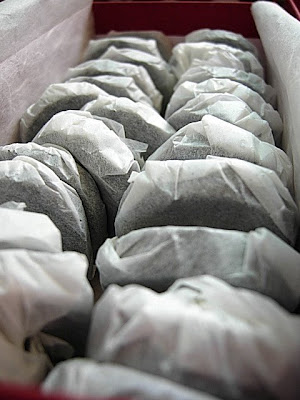
Opening the red box and removing the thin white rice paper which veils its contents below reveals a strong smell of slightly medicinal spicy cinnamon and two long quaint rows of tiny coin-shaped ddok cha cakes all individually rapped in rice paper. The scent of anything resembling tea is lost in the spicy blanket of odours. One takes up a single coin, unwraps it, breaks it into smaller chunks, and drops it into the bottom of the tea pot. Soon near boiling water embraces these pieces and the resulting infusion is poured into a serving pot then from a serving pot into small ceramic cups.


This tea fills ones mouth with a simple, very watery, flat, sweet, clear cinnamon taste. This tea is probably the very opposite of complex and doesn't hardly change at all from infusion to infusion other than conjuring a bit more astringency. The faint aftertaste mirrors the initial taste- a testament to its simplicity.


When two cakes are added as opposed to just one this tea is much more enjoyable as a bit more astringency pushes this tea to a more complete, yet incomprehensibly simple, feeling and taste in one's mouth.


One basks in and gives thanks to this tea's uncut, transparency.

Peace