Saturday, September 19, 2009

Yunnan Sourcing Mystery Sample 'Beta' ( 2009 You Le Zhi Chun)


Early in the morning one arises to this sample. Mountain water is drawn. The kettle filled. When it rumbles just right water is thrown on the table coating everything with a membrane of boiling water. The steaming effect created, the rising heat from the ceramic table, signals that it's time for tea.

The pack is opened by eager fingers and an even more elated nose dives into the opened foil. One huffs tea like the downtrodden down the block huff gas. Very sweet, light, maybe a touch flowery. The scent leaves the eyes curious as to what it looks like.
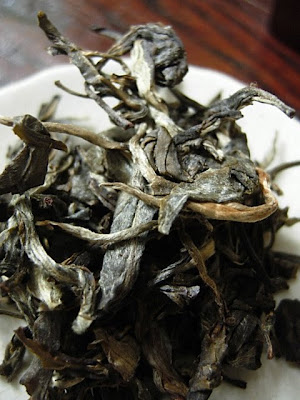
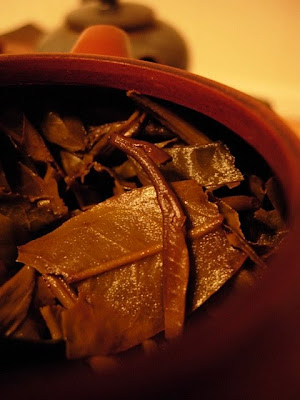
The leaves are very loose and wiry with many hairy white leaves in the mix with the brown. Beautiful. One reverently lays them in yixing and a hot rise christens them, releasing their fresh youthful energy.

The clear, crisp light yellow liquor that results from these tippy early spring leaves is worthy of praise in and of itself. So one lavishes it upon this tea.

More hot water puts them at ease. Light, sweet, fresh, flowery, ... the taste of this tea is true to the scent of the dry leaves. There is also a sneaky undertone of tobacco. The tea imparts a sticky sensation on the lips and front and sides of the tongue. The affect of the qi is noticeable within seconds of consumption. Nice, warming as if in the bright light of the sun this cloudy morning.

Multiple infusions commence, the creamy, candy-like sweetness is upfront and immediately apparent as it moves all the way to ones breath before slowing fading. Saliva pools in the middle of the tongue, a refuge from the tingling lips, tip and sides of the tongue. A slight soft bitterness fills in the end.

The chaqi radiates forth as the session creeps on. This teas energy is empowering and feels as though it shines through the pores of ones skin.

This tea doesn't evolve much in the mouth, nor does it seem to have enormous depth to its flavour- a testament to its spring-tippy constitution. It's flavour remains consistent over many infusions with a meandering tobacco and flowery tones coming out more as tea cools slightly.

In the end, things become chalky and cloudy
mimicking the afternoon sky outside.
Cloud or no cloud,
it is truly sunny inside.

Peace

Note: Please follow this link to the tea tasting discussion on the Half-Dipper.

Wednesday, September 16, 2009

Yunnan Sourcing Mystery Sample 'Alpha' ( Later Found To Be 'YiWu Gua Feng Zhai')


This is one of five mystery samples from Yunnan Sourcing. Its foil pack is marked with the code 'Alpha' to maintain an air of fun.

This pack is torn open and immediately the nature of this mysterious sample is revealed. The brownish leaves, some of which are lighter and fuzzy, have a certain creamy depth to their light sweet odour.

These scents distract the mind as one prepares these leaves in yixing.
The first sip transmits a sweet, creamy, light, airy spring taste. It is truly light in taste, colour, and feel. Its mouthfeel, silky smooth, covers the whole mouth.

As the leaves in the pot are exposed to more water, the mouthfeel fills up a bit more. There is also a flash, a tease, of forested depth in the mouth before quickly vanishing under creamy sweetness. A tat of dry is left on the breath.

This soft, mellow puerh remains stable throughout, unimpaired by the session which soon stretches along. Its qi is so soft and light that it seems to almost relax and sedate so one decides to drink it into the evening.

Even after many infusions this tea holds its own, it becomes somewhat bitter loosing some of its purity, but hardly so. There is a spicy, sometimes flowery depth to its sweet full feeling liquor that one enjoys until calling it a night.
Peace
Note: Please follow this link to the tea tasting discussion on the Half-Dipper.

Tuesday, September 15, 2009

Predictions of Yunnan Sourcing Tea Tastings

Thanks Scott & Hobbes for making this happen. One is truly grateful to sample these delicious teas...

Alpha = Wu Liang
Beta = You Le
Delta = Ban Zhang
Gamma = Bu Lang
Epsilon = (damn, damn, damn good) WiWu

Detailed tasting notes and comments on the Half-Dipper to follow over the next week.

Peace

Saturday, September 5, 2009

An Exemplary Buncheong Style Tea Bowl by Renowned Artist Min Young Ki


Min Young Ki's work is mind blowing. It has been featured in such famous international art galleries as the Royal Ontario Museum in Canada, the Smithsonian Museum in the USA, and the Royal de Mariemont in Belgium just to name a few.

This bowl sits in an old traditional Korean house- a natural place to savour its beauty.

The form is so natural that it fails to capture ones attention as it modestly takes a back seat to magnificent color and texture. Because one doesn't notice its form, one really notices its form.


Inside the shallow of this bowl, reddish brown colour connects this piece to its material- the clay. As ones vision climbs from the bowls shallow up the side wall, the earthy reddish colour fades to a natural blue hued grey. Bursting pebbles penetrate blue in a spectacular contrast of colour leaving behind light orange blotches outlined in red-orange. This effect is also seen on the outside wall of the bowl. Placing this bowl in both hands and rotating it gracefully as per ceremonial etiquette, creates a wonderful panorama of flowers blossoming before the eyes.

There is continuity between the colour and pattern of the inside and outside of this bowl. There is contrast in the texture. The inside shallow is heavily glossed, the outside bottom is uncut and rough, exposing the rugged clay beneath. The sensory receptors of the fingers and hands truly appreciate this contrast, which sharply divide top from bottom.


The roughness of this uncovered clay reaches its zenith in this bowls foot, as does its beauty. Particularly, the center, reveals a low angled mountain of natural rugged symmetry, a mini Fuji.

Peace

Friday, September 4, 2009

2009 Makaibari Green Delight Organic, 2nd flush, Darjeeling Green Tea


This sample is the last of three from Makaibari (Thanks again to Mr. Lochan for sending the samples). Another creative experiment from Makaibari, this one is a green tea and its leaves look quite interesting. They emit lighter, fresher, less bogged down scent that has less deep tones than the Imperial and less muscatel tones than the Standard. Light, airy but still very Makaibari.

These leaves are guided into a pot, warm water is poured onto these leaves, pause.

The liquid that streams out into the serving pot is not the healthy brownish delight that one would expect from Darjeeling nor is it a vibrant green as the name suggests. It is what it is. It is a cloudy yellow.

It streams from pot, to cup, to mouth. From it comes juicy light pear with sneaky caramel undertones that finish into a pondy-vegital faint raisin spice that drys the tongue and lingers on the breath.

Another infusion invites a dryness into these pondy-vegital depths. The juicy pear is still there as is the semblances of earthy raisin.

When more and more water is passed through these leaves, the mouthfeel rounds out and feels complete and full. The pear tones become more bland and less juicy becoming more enmeshed with dryness and subtle muscatel.

In the end the pear flavour thins into vegital sweetness under a blanket of consummate dryness.

The qi that is left behind is the kicky, darting hong cha variety, perhaps only a touch lighter than that of a black tea.

This tea's torn leaves, yellowish colour, and light kicking/darting chaqi suggest that this tea underwent more oxidization than most green tea during production. This is more of a 'black' green tea, similar to some other Southeastern Asian green teas.

It is enjoyable enough, interesting enough, Makaibari enough.

It is what it is.

Peace

Thursday, September 3, 2009

Two Lustrous 'Chun Mok' Style Tea Jars By Shin Hyun Churl


Staring deeply into Shin Hyun Churl's tea jars is like gazing into the cosmos.

Into the nature of all things.

Peace

Wednesday, September 2, 2009

2009 Makaibari Imperial Organic 2nd Flush Darjeeling


This is a very oriental inspired black tea from Makaibari. It is a nice diversion from traditional Darjeeling black.

Its small, tightly wound dry leaves smell of faint sweetness and tangy wood-raisin depth.

It's time to make tea. The tea matters, the water matters, the intent matters.

When this tea hits your lips its slick smooth character is immediately obvious, this is as smooth as Darjeeling teas get. Its creamy oxidized taste has a full mouthfeel with mild subtle dryness. The fruity sweetness that ones mind has come to expect with Darjeeling blacks, hasn't materialized. This allows more attention to be given to creamy oxidized notes. This is not to say that this tea is not sweet. The sweetness is more embodied in the aftertaste more than in initial impression.


As the next infusion comes along, a juicy demerara sugar sweetness is often overlooked by the blanketing smooth, bland, oxidized profile of this tea. Some very faint fruitiness can be sensed in all of it too, but, like the sweetness, it is a bit hard to uncover under the overbearing smoothness of this tea.

In later infusions, the sweetness on the breath develops a raisin flavour which seems to become more apparent in later infusions. When brewed with longer infusions the oxidized flavour is more apparent throughout and slippery smooth dryness prevails throughout.

Peace