Tuesday, November 25, 2008

2008 Jookro Jiri Mountain Yellow Tea


Jookro is an old tea company with a good reputation for producing good tea. Although they produce a lot of tea, it is all produced by hand from bushes that grow wild in the valleys of Jiri mountain.

Let's warm our hands upon the hot air of the brazier and sit down for Jookro's yellow tea...


The dry leaves are small and fairly uniform dark brown. They smell fresh, sunny, almost minty, behind roasted but not smoky tones.


These leaves are placed in a pot, the same pot one has used for years now. The boiling water from the brazier is added and the liquid of tea is born.

As we sip in silence the flavor of this tea speaks to us. It has a sweet, full bodied citrus taste with a juicy mouthfeel and subtle long nutty aftertaste. It's like biting into a sweet lime with sweet and sour in perfect balance, walking together hand in hand. It's taste is also deliciously chocolately, the bitter dark chocolate one is quite fond of.


The liqour is a bright, happy orangy yellow leaning more towards yellow than most oxidized tea from Korea. It also almost lacks a real roasted taste, although it is detectable in later infusions it tastes so different than most others. It contains a different kind of 'yellow tea roast' maybe due to special processing one is not aware of.

The chaqi in this tea is warming and sunny, it is mostly felt in the upper torso, the heart, and in the lungs. This teas energy is the uplifting type as its energy ascends.

The mouthfeel of this tea is less pronounced it lacks any throatiness as it doesn't seem to travel past the back of the throat, but what is in the throat feels quite natural. Astringency comes quite late with this quality tea, only later infusions dry the roof of the mouth.

With later infusions also comes the typical nutty-roasted taste that seems to characterize Korean yellow teas. What's really nice about this tea is that the flavour really evolves through infusions and the stamina of the leaves allows it to go though many, a tell tale sign of a good tea.


And as we finish our last sips from the liquor of spend leaves, in silence we give thanks.

Peace

Edit: Here is a picture of the box that one intended to include in the inital post.


Friday, November 21, 2008

Shin Hyun Churl's Thatched Roof Tea Jars


Shin Hyun Chrul is quite famous for his tea jars. These two tea jars are called 'cho ga jib ho'. This name refers to a traditional Korean thatched roof commoners home or 'chogojib'. These 'chogojib' houses were the most basic of Korean houses with a simple layout and a roof that looked like the cap of a mushroom that was entirely plaited by the straw of rice.

The shape of these tea jars resemble the shape of these traditional houses. These 'cho go jib ho' also remind us of the modesty we must cultivate while drinking tea, an idea that comes from Korea's deep Confucius roots. An idea that permeates many aspects of Korea's current tea culture today.

Peace

Wednesday, November 19, 2008

Mystery Sample #3 From Thomas at Tuo Cha Tea (later found to be a Yu Lan Xiang from www.longfeng.cz)


Outside cold winds blow at what few leaves still manage to cling to dry branches.
Inside one awakes at the crack of dawn to prepare tea.

One sits down with a few lonely sprigs from a blossoming Camellia sinensis to keep one company. The Camellia blossoms, in their silence, tell one that winter will soon be here.

One carefully chooses the charcoal for the brazier. This charcoal, now glowing, brings water to a boil. The water is drawn and plummets from the pyo chew bak (pumpkin like gourd) into a pot full of dry leaves that are a mix twisted dark blackish leaves accompanied by some smaller lighter green leaves.

The rinse is short and brings with it a peppery-cinnamon floral scent that rides plumes of rising steam.

The first infusion brings a soft, flowery, milky taste as the flavourings of Dan Cong fills one's mouth. The mouthfeel is smooth and just dry enough to be stimulating. Its aftertaste mirrors the initial taste and lingers in the mouth.

In the second infusion a milky citrus plays about on the tongue. This tea caries a fruity-flowery flavour, a very good flavour.

The chaqi is nice, muted, bright, cloudy. Like the bright morning sun rising into the sky of a cloudy day. The energy descends before unnoticeably traveling outward to the limbs.

As the cycle of gong fu cha plays itself out like life, flowery, milky, and fruity tones remain pretty constant with some tones of 'melon' and 'soapiness' stopping by from time to time. Gradually, exhausted, these tones weaken and wain. Leaving a mouthfeel as though one's tongue and mouth is covered in thin cilia or moss. One relishes this feeling.

With minutes between infusions and hours later, this tea's essence stays on ones breath for hours as a reminder of a good tea.

Thanks again Thomas,

Peace

Note: One believes that this sample is perhaps the Single Bush Ba Xian Dan Cong... what do you think Thomas?

Sunday, November 16, 2008

Kim Kyoung Soo's Natural Rock Tea Jars


These jars truly encompass the naturalness of Korean tea culture. In fact, they look so natural they could easily be confused for actual rocks. They eliminate the tackiness of a tearoom filled with jars and instead fill it with the clay of the earth, in the form of earth. What tearoom wouldn't benefit from such a peaceful addition?

Peace

Thursday, November 13, 2008

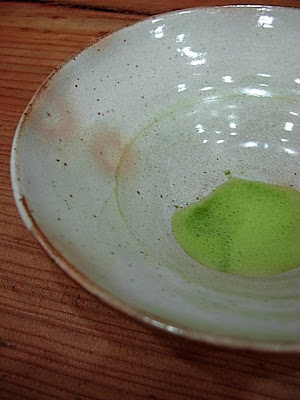
A Flowering Buncheong Tea Bowl by Kim Jeong Pill


This tea bowl style is typical of Kim Jeong Pill. It is covered with coin sized blotches that resemble flowering blossoms. These blotches are not painted on, they are the results of rocks erupting in the kiln just as flowers blossom in the heat of the summer. The bright green matcha like the dense vegetation after monsoon rain only acts to draw out lifeless blossoms.

As flowers bloom in cool Autumn fields, one drinks tea and ponders these things.

Peace

Tuesday, November 11, 2008

Erabo Style Tea Bowls


Erabo style is defined by its clay. Erabo clay is flecked with stones and thick sand. These raw materials leave the bowl with an uncut roughness. On good Erabo bowls one can sense their beauty through all of their roughness. Erabo bowls are particularly appealing to the sense of touch as grit and pebbled surfaces emit the wild solitary feeling of the mountain.

These are grounding bowls. Erabo bowls teach us to find the good in everything. Touching a good Erabo bowl is like touching the diamond in the rough and knowing the diamond is the rough.

These two Erabo bowls by Jung Jum Gyo are two such brilliant pieces.

Peace