Showing posts with label mystery sample. Show all posts

Sunday, June 6, 2010

An Old Mystery Yancha Sample from Aarron Fisher And Cleansing Reactions Towards Tea


Besides the millions of years before man first rustled the leaves of the ancient forest in Yunnan, the first few thousand years that tea was drunk are also pre-historical... In those ancient days beyond memory, tea was a healer- just as it is today.
Aaron Fisher's The Way Of The Tea

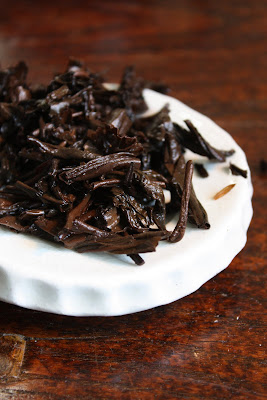
The generic packaging is opened and the smell of musty, malty, deep, black cherry and chocolate odour escapes. These smells trail off into bitter, tangy, depth. The warmed pot is stuffed with these fair sized, slightly red-brown tinted dark leaves.

Hot water is added to the pot for the first infusion- an yellow-browny-orange soup pours from the pot. The initial taste is very medicinal- musty dried fruit then turns sour and sweet before finishing dry. This tea has lots of flavour in its depth. The mouthfeel is dry and tight.

The second infusion is similar to the first but layers are peeled back. It starts medicinal, like liquorice or fennel and bitter herbs then blends into a subtle, tangy fruit taste. The arrival of these fruit flavours marks the arrival of slight sweetness. It finishes dry and full in the mouth with the medicinal characters staying on the breath and in the nose for quite sometime afterwards.
The qi of this tea is sunny and warm with qi pooling in the middle jiao, not attacking but harmonizing it. Ones head becomes stuffy, nose starts to run. It is as though one has an allergic reaction to this old tea. It could be that this tea has some sort of impurities in it that it may have absorbed in storage. But most likely this tea is clean and its strong qi is bring about a cleansing reaction. So one continues with this session, nose running, head becoming heavy.
The third infusion is a touch lighter and fresher than the two previous. It is still dominated by heavy medicinal flavours and a dry finish. The mouthfeel is mainly in the front of the mouth but also traverses deep in the throat. The feeling in the throat stays even minutes after the tea is consumed.
The fourth infusion is highlighted by light fresh fruit tones which transition into light chicory dryness. The mouthfeel is wonderful and alive. The qi of this tea is strong, ones physical duress seems to be lifting and with it a clear mind.
The next few infusions are filled with light fruit tones- a continuation of that complete mouthfeel and a dry finish.

Roasted notes seem to be the attraction of the seventh infusion. Pear flavours are pulled out of the ambiguous fruit taste.
The last handful of infusions gradually become flat, bitter, and dry. The fruity depth that this tea once had is all but gone leaving the taste of pear behind for ones taste buds to pick on. When this tea completely flattens the session is over and the wet leaves of this tea are admired.


Staring quietly at the long red tinged leaves with the sound of cool spring rains on the street outside, one feels as though a weight has been lifted.

Peace

Monday, May 24, 2010

A Mystery Puerh Sample From Aaron Fisher


The connection that we can achieve and maintain through tea, is an understanding that there really is no difference between the various aspects of the Universe, in the sense that they are all facets of the same totality, the "Tao"... Qi is the movement of this totality. For us, we use our bodies and minds as objects of focus, becoming aware of the present moment as it is experienced, lived. The feeling of Qi connects us to the energy as it flows through us, moving in and out like the breath that connects us to each other, to the world.

Aaron Fisher's The Way Of Tea


Aaron Fisher sent a few samples along with his latest book, The Way of Tea. Let's draw some water, put it to boil, and sit down cross-legged with this tea.

These auburn-redbrown leaves smell of age. Deep, light, musty shu puerh scent. They have a certain deep freshness about them, the smell of forest, a very mineral odour.

The first infusion presents mellow mineral earthy tones that ground ones mind. These earthy notes linger on the breath with some sweetness. The mouthfeel is full but not sharp and harsh. Ones body slowly heats like a wood stove that is patiently burning.

The second infusion is more mellow earthiness, this one is dirtier than the first. The mouthfeel is thick, viscous velvet. The chaqi comes on strong and pushes one into a sweat.

The third infusion is lighter and plumby with a woody fruit finish. The mineral fruit stays on the breath with leafy green freshness that lingers somewhere in the mouth. The feel smoothens out and becomes more silky. Excessive salivation is encouraged despite a subtle dry quality that emerges.


The fourth and fifth smooth out even more as the mouthfeel really fills out. Woody, leafy, smooth- it stays in the mouth for a long time, plumb notes mingle with slick wood notes. The qi is deep and warms the lower jiao as it steams upward, traversing the spine.

The sixth and seventh are fruitier as this characteristic starts to slowly dominate the infusion.

This tea is enjoyed through many infusions over a period of a few days. It remains durable throughout- sharing some aspect of the flavour profile described above. In some of these late sessions gritty brown sugar notes come out and play with the plumb flavour.


The wet leaves are examined and show evidence of a blend of at least two different teas. There are dark shrivelled shu leaves that seem to be mixed with lighter aged shang leaves.

Peace

Sunday, April 11, 2010

Trafficking Tea In B.C.: A Suspicious Puerh Sample From A Friend


One is walking down the hall when out of the blue a friend approaches. She slips a small carefully paper wrapped and taped package into ones hand and says "this is it". Then hurried, she walks away. Passers by give one suspect glances.

Here in British Columbia most little packages handed off in this way are usually filled with marijuana- not tea. To each addict, their own...

Later this friend said that this sample is from a king bing that is about 4-5 years old- producer and region unknown. It came from an anniversary cake that was purchased by her aunt in Hong Kong to commemorate the birth of her nephew- a common practice in Hong Kong. It turns out that she managed to get a good chunk of the cake last time the family got together.

The dry leaves are pungent, sour with a lingering mellow sweetness to them. The whole sample is dumped into the pot. Rinsed and the first drinkable pot steeped up.

The first infusion is buttery and spicy with under defined tobacco tones. This tea is very smooth with very little bitter left in it. The aftertaste is a touch malty- a sign of its age. The mouthfeel is mainly on the front of the tongue. This tea is smooth.
The second infusion reiterates sweet, smooth malty tobacco. The mouthfeel still mainly waits in the front of the mouth. The liquid is a clear bright yellow with peachy tones.

More smooth sweetness follows the third infusion. This tea is quite slick- nothing offends. It's smooth character creates an air of kind simplicity.
In the fourth infusion the leaves are pushed with a slightly longer infusion time. The tea now shows some light bitter tastes but is not that much more complicated. Subtle metallic tones emerge with the other tastes under such pressure.
The chaqi exerts a cumulative affect on the mind and body. It builds up slowly to mid-session, around the fifth infusion- where it clears ones mind. The fifth infusion brings more of the same.
During the sixth, seventh and eighth infusions the flavour weakens a bit. Faint sweet notes start, leaving dry metallic notes behind in the mouth. This tea still retains a soft feel.
The tea is left overnight and a few more infusions are enjoyed the next morning.

In the morning the tea is velvet, creamy, malty, and sweet. One tries to squeeze the last out of these leaves like a pothead puffing a joint down to their fingertips.
Peace

Wednesday, November 19, 2008

Mystery Sample #3 From Thomas at Tuo Cha Tea (later found to be a Yu Lan Xiang from www.longfeng.cz)


Outside cold winds blow at what few leaves still manage to cling to dry branches.
Inside one awakes at the crack of dawn to prepare tea.

One sits down with a few lonely sprigs from a blossoming Camellia sinensis to keep one company. The Camellia blossoms, in their silence, tell one that winter will soon be here.

One carefully chooses the charcoal for the brazier. This charcoal, now glowing, brings water to a boil. The water is drawn and plummets from the pyo chew bak (pumpkin like gourd) into a pot full of dry leaves that are a mix twisted dark blackish leaves accompanied by some smaller lighter green leaves.

The rinse is short and brings with it a peppery-cinnamon floral scent that rides plumes of rising steam.

The first infusion brings a soft, flowery, milky taste as the flavourings of Dan Cong fills one's mouth. The mouthfeel is smooth and just dry enough to be stimulating. Its aftertaste mirrors the initial taste and lingers in the mouth.

In the second infusion a milky citrus plays about on the tongue. This tea caries a fruity-flowery flavour, a very good flavour.

The chaqi is nice, muted, bright, cloudy. Like the bright morning sun rising into the sky of a cloudy day. The energy descends before unnoticeably traveling outward to the limbs.

As the cycle of gong fu cha plays itself out like life, flowery, milky, and fruity tones remain pretty constant with some tones of 'melon' and 'soapiness' stopping by from time to time. Gradually, exhausted, these tones weaken and wain. Leaving a mouthfeel as though one's tongue and mouth is covered in thin cilia or moss. One relishes this feeling.

With minutes between infusions and hours later, this tea's essence stays on ones breath for hours as a reminder of a good tea.

Thanks again Thomas,

Peace

Note: One believes that this sample is perhaps the Single Bush Ba Xian Dan Cong... what do you think Thomas?

Tuesday, October 28, 2008

Sample # 2 From Thomas at Tuo Cha Tea


The smell of buttery dry leaves and faint characteristic puerh fill the air. These dry leaves are a mixture of hairy tips mixed with stems and dark brownish whole leaves.


These leaves conjure up a liquor that is a hazy orangey-yellow. The first sip introduces one to a nice balance between soft spicy floral notes, subtle fruity notes, a caramel sweetness, and light bitter and astringency. This flavour is complex, searching for it one looses oneself on the tongue.

This tea appropriately stimulates the tongue and throat as it makes its way into the stomach leaving a cool, fresh, sweet, subtly spicy aftertaste behind. The aftertaste is full and especially nice.


As this tea cycles through infusion after infusion, one ascertains that the fruity taste is akin to melon or maybe peach.

This tea's energy is unforgiving. It hits the guts and stomach excessively hard even when small amounts of tea are used. The energy of this tea pools in the throat and in the lower abdomen. Every time this tea was consumed it left ones throat feeling as if it was constricted by an invisible boa. Phlegm seemed to stagnate there for the remainder of the day.

Consequently, this tea has lots of stamina and can be brewed for several days. In fact, although still a bit harsh, it is best enjoyed on the second day. This tea is made for aging as strong energies require mellowing.


Thanks again Thomas.
Peace

Thursday, September 25, 2008

Sample # 1 From Thomas at Tuo Cha Tea (Later found to be a 2007 Xi Zhi Hoa Pu Zheng Yuan Cha )


As you may or may not know, this sample is a complete mystery. Thomas sent four samples that were numbered with a corresponding sheet which told their names. Korean Customs must have gotten a little curious and went through, ravaged the package, thereby misplacing this important paper inside. So one cannot know for sure what sheng puerh bing this tea came from.

The dry leaf is a mix of blacks, orangey reds, mixed with some light white green leaf. The smell of the dry leaves are soft with no particular nuance standing out.

The first infusions of this tea bring about a quick sweet coolness covered by strong dry astringency, tasting of true earthiness- mud and dirt, it carries with it an aftertaste of sour rubber. Somewhere between the sweetness and the rubber is the taste of fruit, maybe plum or raisin, that only reveals itself for a short time before being cloaked in rubber and dirt. The qi of this tea is initially felt in the stomach and creeps out from there.

In later infusions this tea develops a smoothness in the mouth, the rubbery, earthy flavour becomes more subdued and the subtle fruity profile stands out. There is a spiciness that travels up the nose, in the mouth the nuances of flavour are many.

These flavours are excessively enjoyable among the back drop of a mouthfeel that seems to reach its balancing point as dryness seems to slightly dominate a cool smoothness.

The chaqi of this sheng is stimulating but quite relaxing. Its affects are similar to the calming alertness and absolute peace that come along with the consumption of fine matcha. Although its affect is much like a matcha, its feeling is warm and cozy, a feeling often felt in autumnal puerh. After the third infusion one just feels at peace. One really prizes such chaqi in puerh. As the sessions progressed throughout the week this chaqi was still evident.

The flavour and mouthfeel of this tea also really hold on for days after. Thanks Thomas for a tea that seemed to transform from tolerable in early infusions (possibly due to overstuffing the put) to one that was completely enjoyable in all aspects. Do you have any guesses as to which puerh this could be?
Peace

Edit: It was later found out that this sample was a 2007 Xi Zhi Hoa Pu Zheng Yuan Cha (2007 Xizihao “Pu Zhan”) sold by Hou De Fine Teas. Find other reviews by Thomas at Tuo Cha Tea and Hobbes at The Half-Dipper.
Double Peace

Wednesday, September 17, 2008

Stretching Tea: A Detailed Sampling of Mystery Puerh, The Marathon Tasting


This is a continuation of the post Stretching Tea: A Detailed Sampling of Mystery Puerh, The Initial Tasting. One decided to take this sample as far as it can go by using a brewing technique outlined by Toki on his blog.

The day after brewing eleven infusions from the leaves of this sample. It was time to sample the cold brew that was sitting in the pot for about twenty hours. Perhaps due to the fact that one didn't do so many initial steepings this tea turned out quite red in colour. Its taste a bit bitter with very strong metallic and mushroom still in the aftertaste. The mouthfeel very dry but pleasant and was felt in layers in the mouth.

The hot few second infusion was very yellow like the colour of a young puerh. The flavour was soft and muted, so light with metallic, wood, and very little mushroom. The mouthfeel was faint. The chaqi was calming, relaxing, and balancing.

Then the pot was filled with boiling water and left to infuse until it was revisited the next day.
The tea was brewed in this manner for days. Each day yielded something slightly and sometimes unnoticably different than the day before. As the days went by the taste became more metallic especially in the cold brew, and the mushroomy profile ran out. The hot infusions were always quite a bit softer and less flavourful then the cold. The energy of this tea also considerable weakened until becoming undetectable. The feeling of the tea in the mouth was the most pleasant experience of dragging out this tea. Its complexities in the mouth, toungue, and throat were always welcome.

The tea seemed to peek at around the fourth day. Where the tastes of mushroom, metal, earth, and wood tasted right together and the mouthfeel of smooth, dry, and astringenic was the deepest.

The resulting infusions slowly degraded until on the eighth day the long session was stopped. Really one should have probably pulled the plug on the fifth day.

Anyways this longer session was beneficial for many reasons. Firstly, this technique yielded better results than just leaving the leaves in the pot overnight and adding fresh water the next day, the technique one had previously used for brewing tea for up to 3 days. Secondly, it harvested a relationship of patience between the tea and drinker. This patient mind is not only useful when drinking tea but also in the broader context of our lives. Thirdly, brewing tea this way allowed one to savor the cold brew immediately after one awoke in the mornings. While preparing the coals in the brazier and waiting for the kettle lid to shake, the water coming to a boil inside, one could meditatively enjoy the cold brew. Forthly, it allowed for a more celebrated way for the tea to exhaust itself. In Korea many people enjoy their teas until they are completely spent, their sessions push even green teas into the double digits. One feels this is the most appropriate way of exhausting good puerh leaves.

Many thanks Toki for suppling the leaf for this experience.

Peace

Tuesday, September 16, 2008

Stretching Tea: A Detailed Sampling of Mystery Puerh, The Initial Tasting (Later found to be a 2005 999 limited edition from Menghai)


Toki sent this sample, one doesn't exactly know what it was. It came in a foil bag and was the only sample that he sent that was unlabeled. One thought to brew it over a span of a few weeks as recommended by Toki. The notes below are a rather detailed account of one's experience with this tea.

The smell of the dry leaves were subtle, complex, and overly appealing. The deep, dry puerh smell is almost metallic. The sample was left in the open air to breathe for a few days before steeping.

The tea was rinsed, prepared, and readied to be experienced.

The first infusions left a soft metallic, mushroom, fruit flavour that seemed to change in the mouth. The mouthfeel is phenomenal, it strokes the tongue, making it purr on contact, the liquid softens the tongue, drying the tongue. The aftertaste is deep mushroom at the back of the throat. The qi of the first pot is nice, happy, it radiates from the mouth and throat spreading into the shoulders and neck. The tea's energy asserts a calming top down effect as it creeps from the base of the skull down the spine.

The second infusion was less metallic, the mushroom taste strikes first leaving one struggling to name this fruity taste that sneaks into the aftertaste, the flavours are light and not overpowering. The mouthfeel seems softer in the throat, dryer in the mouth, if only one could walk allong one's tongue right now, what a happy place to be! The chaqi has now really taken hold. The mind is calm as if sitting for hours in mediation, calm euphoria, ones world slows down, energy radiates forth, one's head feels slightly lighter than one's body which feels almost as light. This tea is really taking one for a ride!

The third infusion tasted similar to the second yet there was more earthiness to the aftertaste. The feeling in the mouth continued to be pleasant and dry.

A rumbling stomach reminded one that they should take a break to eat. Homemade sugared peanuts were used to quell the swirling unbalanced energy of one's stomach reacting to an early morning's hunger. Even the nuts seemed to taste much better, basking in the aftertaste of the tea still on one's breath.

One resumed the session with still half a pot left to drink. The sweetness in the mouth after the sugared nuts masked the taste of sweet notes in the brew resulting in a woodiness, with camphor with a slight metallic tang.

As I drew more water the earthy mushroom aftertaste lingers and pleases one deeply.
The chaqi from the tea in one's body caused it to reach a breaking point at the start of the third session. It warmed under the cool breeze of a late summer morning almost to the point of sweating then retreated bringing a cool freshness to ones body and mind.

The forth infusion seemed to mellow out but not nearly as much as one's mind had. The taste contained sweeter notes that came out more reminiscent of plum, minty freshness is so slight, still mushroom like aftertaste. The mouthfeel is watery but drying, the tongue welcomes this dichotomy. The tea's energy is pushing one's body to feeling quite cool.

The fifth and sixth infusion pushed out more tangy, minty, metallic tastes. Overall there is a composition of tastes in this tea that are composed like a chief preparing a feast, each flavour playing a part in its whole. The qi causes one's body to become hot almost to the point of sweating before receding once more.

The seventh and eighth infusions it becomes apparent that the cool, earthy, metallic tastes are more prominent and evolve in ones mouth along with undertones of mushroom. The mouthfeel is changing only slightly, almost unnoticeable from infusion to infusion. The qi is slowing things down both physically and mentally. One's heart slows as one slips deeper into meditation with this tea.

A friend interrupted and asked if one had anything for an upset stomach. One sat them down for tea and we drank together.

Through the ninth, tenth, and eleventh infusions the mushroom taste recedes even more as the metallic tang seems to now dominate with undertones of wood, maybe camphor. The mouthfeel had become more smooth, silkier.

One's friend's stomach problem was balanced by the calm qi of this tea. There was no more uncomfort or pain. And although this tea session could have lasted many more infusions, after three hours of drinking tea it was time to bring it to a close and take advantage of this wonderful day. One prepared the tea for a session tomorrow, floating from the tea one went for a walk with a good friend.

Peace

Monday, September 8, 2008

Sample # 4 from Thomas at Tuo Cha Tea (Later found to be a 2007 Darjeeling Thurbo Oriental White First Flush)


Thomas generously sent four mystery samples. This sample is labeled #4. The dry leaves are partially crushed and exhibited both curled, hairy white buds, and smaller darker green unfurrowed leaves. This tea appeared to be a white tea.


It was prepared mindfully. The first infusion brings with it very lightsweet high notes, fresh, silky mouthfeel, and a quiet flavour of mint and fruit.


The second infusion caries a strong grape flavour, it tastes very sweet, almost artificial. Much like the purple grape bubble gum cubes that one can fetch in a pack at the corner store. This tea is candy. Its mouthfeel remains silky with just enough astringency to make it feel just right.
The third infusion is much of the same as the second. One is quite surprised that this tea lacks almost completely that green vegitalness that is found in almost very green tea, then again, this is most likely a white tea. The tea becomes thicker in the mouth, the flavour, grapier than ever.
The fourth infusion has tones of a deeper, mustier quality that is barely detected under its sweet candy body.


After the forth infusion one was interrupted and unfortunately couldn't get back to this tea (don't you hate it when that happens). This mystery tea could have probably taken a few more steepings, but, either way, it was enjoyed. Thank you Thomas for supplying one with such a flavourful delight.

Peace

Edit: One just did some snooping at Tuo Cha Tea and found this tea. It's a Darjeeling Thurbo Oriental White First Flush, one is sure that it is the one sampled above.

There was some discussion about the steeping parameters on Thomas' original post, but one was quite pleased with the result when using lot of leaf, water that was reduced to a low temperature (appox 80C), and short 30 sec to 40 sec infusions.


Peace Again (there's no such thing as too much peace :)