So far the blind samples that Marco has sent me seem to be
very very different from each other. The
“Delta” was quite elegant with a nice energy to it, the “Gamma” was very
delicious, powerful, out of body experience, and the “Alpha” seem to be a very
dry/sealed stored factory production.
This blind sample labeled “Zeta” would turn out to be an interesting
comparison to “Gamma”…
The stone compressed younger/ drier looking dry leaves smell
of strong smoke after snipping the sealed package…
First infusion has a very sweet almost vegetal and mineral
but fruity smoky onset and steeps out surprisingly darker than I thought. It has a flat creamy sweet finish, almost
floral. This first steeping reminds me
of Bulang area. It has some nice
complexity right of the bat and is nuanced and sweet. There is a lingering sweet creamy
aftertaste. It has a lubricating oily
feel to it. I can feel the Qi in the
head even in this first cup. Could be a
younger semiaged very dry Malaysian stored Bulang?
The second infusion has a sweet root beer, creamy sweet
milky and very milk chocolate taste. The
mouthfeeling is very oily and lubricating and paired with the creamy velvety sweetness
of milky sweet chocolate and root beer taste it results in a smooth, oily,
rich, decadent feeling. There is a spicy
warm pungency in the throat and a sweet plumb and kind of floral
aftertaste. There is a certain elegance
and smoothness to this initial taste.
The smoke is more of a faint backdrop in this second infusion. This Bulang is very smooth and has an obvious
layered complexity to it.
The third infusion has a sweet root beer/ sarsaparilla onset
taste with some smoke. It tastes more
herbaceous and less milky chocolate. The
taste is more roots and sweet, not TCM medicine, something more complex and
light and sweet but yet still mild-moderate smoke. This is more of an herbaceous Bulang at its
core but has some nice smoke-milky-chocolate Bulang taste too. There is an oily feeling in the mouth and
throat with root beer finish. Mouthfeeling
is sticky/oily and throatfeeling is opening mid-deep. The Qi is a calming but smooth type of
alertness- a focusing alertness.
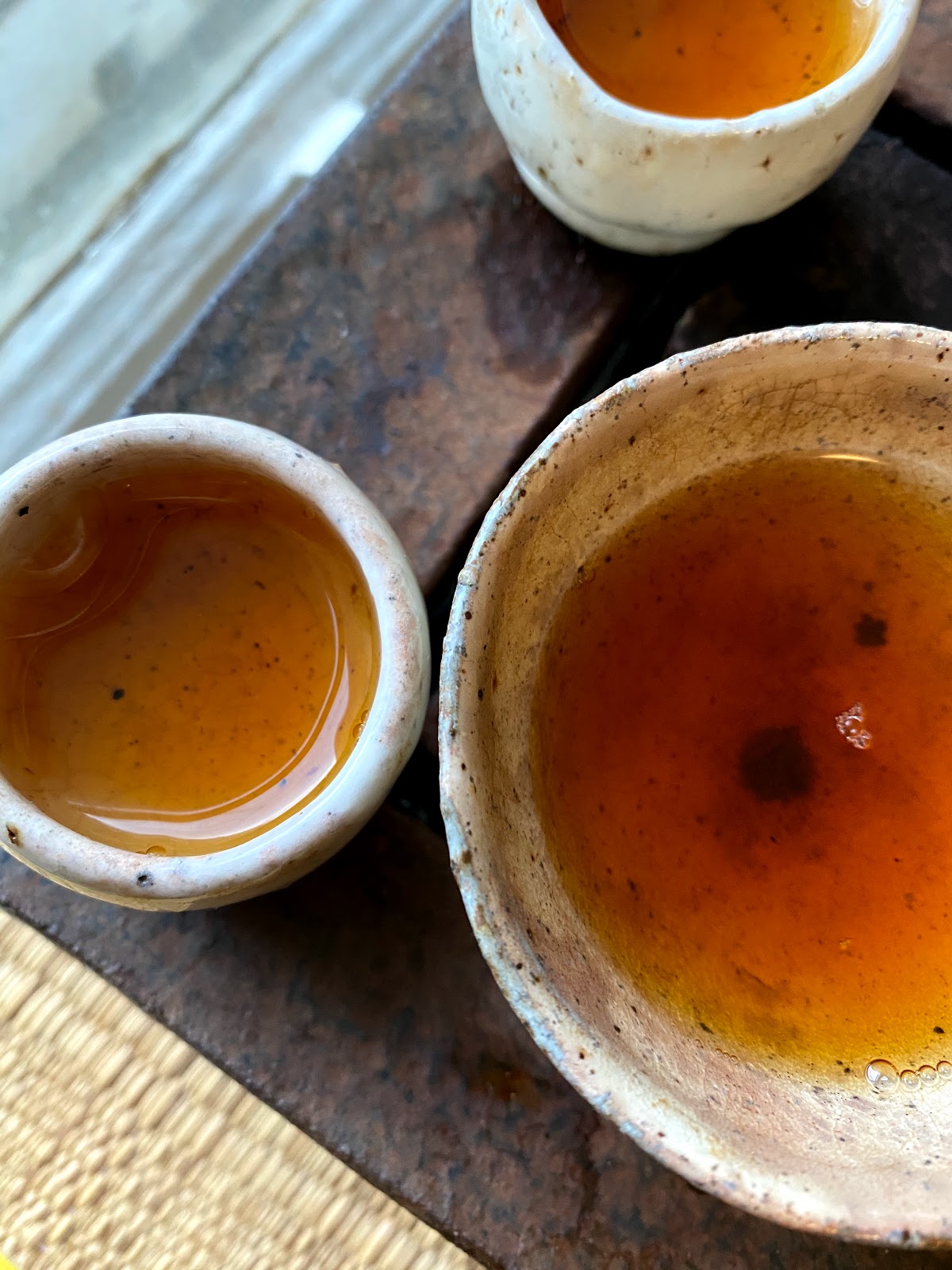
The fourth infusion has a forest, milky, less root beer,
more creamy sweet subtle smokiness.
There is a rich velvety feel and taste to this Bulang which I find
really interesting and unique. Although
it is mild-moderate smokiness the rich smooth oily and creamy tastes are very
elegant. The pungency is a warmer spicy
pungency, dried orange peel, and there is even a warmth building in the
body. It kind of tastes like Christmas
cake or spiced bread- the taste is spicy and herbaceous layered on oily
sweetness. The effect is very enjoyable.
The fifth infusion I drink the cooled cup and it gives off a
smooth creamy root beer oily smooth taste with a touch of smoke. The smoke is really background and not char
but an elegant smoke that layers with the creamy root beer sweetness- liked a
nice smoked creamy root beer… that sounds delicious doesn’t it? Because it is… This is really tasty with a nice focusing
energy to it.
The sixth infusion has a forest creamy milky taste with a
smooth finish of creamy sweet root beer.
There is not really much bitter in this Bulang- a feature that adds to
its smoothness. The mouthfeel is
becoming less oily and more soft/sticky.
The throat still opens deeply with a warm spicy pungency. The Qi has a
strong deep focusing energy to it and I yawn and stretch my body while my mind
feels relaxed and a bit sharp.
The seventh infusion has a creamy less thick root beer
taste. The depth of the root taste is
somewhat complex but the interplay between, milk, creamy, chocolate, spices,
herbs, ect is gone now. It’s now mainly
a one dimensional taste. The
mouthfeeling and throatfeeling are much less oily and more soft/sticky. Qi is really relaxing now.
The eighth infusion has a forest, almost creamy, not really
root beer not that smoky taste. I would
say it’s more kind of forest and faintly bitter. The mouthfeeling is a more soft tight
feeling. The throat is less
opening. The Qi is more a relaxed focusing
now.
The ninth infusion is a root tasting kind of forest even
slightly fruity tasting with a faint bitter almost but not really coco taste
underneath. There is more of a flat
aftertaste of coco. The mouthfeeling
becomes a bit sandy. There is a bit of
complexity here but on a more shallow level as this puerh is thinning out here.
The tenth infusion comes out more watered down root beer
faint chocolate. It still really tastes
good but is fading considerably. The
mouthfeeling is a sandy/chalky/soft sensation.
This mouthfeeling and taste is quite enjoyable even here.
11th has a more almost dirt coco taste to
it. There is just a faint background
smoke in there with a kind of mild root beer aftertaste over a sticky tongue.
12th I add 15 seconds to strengthen it up a bit…
and it comes out a bit stronger but a nice chocolate flat milky creamy onset
with more of a root beer finish. I
really like this Bulang. It has a really smooth taste, mouthfeeling, and Qi for
a Bulang… a strong velvety Bulang. Humm…
not sure if it is even Bulang but that’s kind of how I decided to evaluate it.
13th I add 20 seconds… and it starts a bit watery
smoke initially with a flat forest taste almost creamy milk taste with barely
detectable root beer finish. The
mouthfeeling is slight sticky and tight.
14th I add 30 seconds to the flash steep and get
nice foresty tastes, slight creamy. In a
stick sticky dry mouthfeeling and slight throat stimulation. This Bulang has very good stamina for a
Bulang and because it doesn’t have too much bitter or smoke or astringency you
can really push out the flavours at the end here. I also really like the deep mood influencing
feeling of wellbeing that this Bulang induces.
It’s a deeper reaching Qi experience rather than a typical intense
Bulang experience. This is also very
nice. Just like the “Gamma” I wonder if
it could be Ban Zhang or even other area..???
15th is a 40 second steeping beyond flash and it
gives off a bit of dirt coco faint smoke taste and slight bitter foresty kind
of taste. The bitterness is stronger
with this 40 second steeping and give more of a griping mouth and throat
feeling with faint coolness but not much returning taste.
16th I go back to 20 second steeps…there is a
smooth fruitiness left in the cup with a faint pungent that pushes out a creamy
sweetness. This is still very flavourful
despite its simplicity here. The complexity
at the end of the session here is the diversity between steepings.
17th infusion I steep it 30 seconds…and it is a
bit pondy/woody bitter almost fruity and creamy sweet. Not complex at this point but still quite
enjoyable.
18th is 40 seconds longer than flash and gives
off a mildly smoky creamy sweet simple taste with a slight almost fruity edge. It
has a bit of a creamy sweet but kind of woody bland finish.
The stamina is at least partially due to the long big but tight
rolled leaf that is apparent in viewing the wet leaf…

Overall, this is a very decedent, refined, smooth, and
somewhat elegant Bulang in taste, feel, and Qi.
There is just a subtle reminder of Bulang toughness in its background
smoke, its strong deep plunging Qi, and when pushed too hard some standard
Bulang bitterness that is still accessible.
It has excellent stamina for a Bulang and feels comfortable in the body
and mind. This makes me think that this
is not even a Bulang but I have no other region that comes to mind. This is kind of a mix of the bitter and creamy
sweet Bulang profile, the herbaceous woody medicinal Bulang profile, and the
fruity, floral, less bitter Bulang. I
would say that the first infusions are more herbaceous and the later are more
bitter creamy sweet with a bit of the fruity less bitter tossed into the first
half of the session! In this way this
Bulang is quite balanced and complex instead of the profile of most Bulang
which is often very strong and polar.
The Qi really left me in a great spot.
This is a great classy Bulang, if a Bulang at all. To many things point this to being something not Bulang, but what? Ban Zhang- don't think so. I don't know.
Guess: This is a semi aged 10-14 years very dry Malaysian or
possibly dry Taiwanese storage Bulang?