Showing posts with label Kim Jeong Pill. Show all posts

Thursday, November 13, 2008

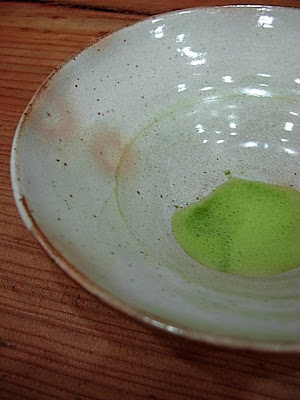
A Flowering Buncheong Tea Bowl by Kim Jeong Pill


This tea bowl style is typical of Kim Jeong Pill. It is covered with coin sized blotches that resemble flowering blossoms. These blotches are not painted on, they are the results of rocks erupting in the kiln just as flowers blossom in the heat of the summer. The bright green matcha like the dense vegetation after monsoon rain only acts to draw out lifeless blossoms.

As flowers bloom in cool Autumn fields, one drinks tea and ponders these things.

Peace

Friday, September 19, 2008

Education In the Art of Edo Style


Please read the post A Test In the Art of Edo Style to understand the following...

You readers are a smart bunch! Tea Bowl #1 is of lesser monetary value made buy a much younger and inexperienced, all though extremely popular, artist. Bowl #1 was made by the hands and kiln of Kim Kyoung Soo. So lets look at this Edo Tea Bowl...


The shape of this bowl is a little on the hardy side. It looks a little too bulky for a graceful, soft, and gentle Edo bowl. The main body of the bowl is also quite thick. The high firing of thin ceramics is difficult to do without overheating and cracking the bowl in the kiln. So buncheong style bowls that have thin walls are generally valued higher then those with thin walls. Although these shape characteristics detract from the Edo style, they are also what make this bowl alluring. Edo style aside, this bowl feels sturdy and grounding. One can see how it could be treasured and used under certain circumstances to evoke this feeling.


The clay of this bowl is of lesser quality. For some reason beyond my knowledge the clay used for this tea bowl doesn't share the clay of a quality Edo bowl. Perhaps the clay is expensive, or is difficult to find or obtain, or maybe it was just a creative decision by Kim Kyoung Soo to use a different clay. Either way the clay used is on the duller side where as the muted pinkish-orange is the most sought after. The best place to view the clay of a tea bowl is on the unglazed foot. Here a greyish hue can be seen from this bowl.


The glaze of this bowl is thick and glossy not quite ideal for the muted calm of an Edo bowl. This thick style of applying the glaze is somewhat of a characteristic of Kim Kyoung Soo and can be seen on his other bowls pictured here, and here. So again, one wonders if it was done deliberately.


The foot of this bowl doesn't resonate the look or feel of the blooming Mae Hwa. Firstly, the globing technique doesn't engulf the exposed clay and make it come alive. Secondly, there is something about the shape of the collared-like foot that, once again, exudes a certain huskiness to it.


Either way, given a certain mood, this bowl could really enhance your experience with tea and even be chosen over the other two.


Tea Bowl #2 was made by the hands of artist Chan Han Bong, a ceramic master and mentor of Kim Jeong Pill. This bowl is beautiful in its shape, colour, and glaze. The shape seems in proportion, and conveys a sense of grace and balance. This bowl feels quite right in one's hands. More than any of the three, this bowl conveys a sense of safety and security. The colour of this bowl is soft, muted, and at peace with the rest of the bowl. The glazing is of excellent quality on this bowl. The glaze lightly coats this piece allowing cracks to share its air with the tea. The soft white glaze looks like the soft clouds of early morning, that pulls and bases the colour of the clay, the colour of a soft sun rise. As one peers inside the tea bowl one can see soft white slowly converging upon the shallow of this bowl. What a wonderful effect. The foot of this bowl is also quite beautiful as air holes creep their way down toward the foot. The unglazed clay beneath the glaze resembles the branches of the Mae Hwa and the white blobs the full white blossoms. What a wonderful tea bowl.


Tea Bowl #3 by Jung Jum Gyo was chosen as the favorite of the three by all those who left a comment on the blog. Consequently, it is also one's favorite and also the most expensive of the three, more than doubling Chan Han Bong's Tea Bowl in price. So, what makes this tea bowl so special?


The shape of this bowl is wonderful, it exudes a feeling a grace, maybe even shyness. Its shape looks and feels elegant, but not showy. The walls of this bowl are also thinner than the other two, validating the feeling of gracefulness. The outside body of this tea bowl displays three rings that jut out slightly from the bowl. These three rings are quite valued on tea bowls and give the hand that cradles the bowl maximum contact with the bowl and a sense of unimposing security. Creating a bowl that contain these three rings while still conveying a sense of subtly and naturalness in form is no easy task. Jung Jum Gyo did a great job pleasuring the hands on this bowl.


This bowl's colour seems to radiate such natural pinky-orange softness, the most beautiful of the three. It's thin glaze can barely contain the peaceful glow of this bowl. The small cracks in this bowl supply the bowl with ample air as well as beauty. On the foot of this bowl, the glazing seems to portray 'the skin of the Mae Hwa'. The size of the foot seems a bit smaller than it should, but it makes up for it in its form. The shape of this foot is an excellent example of what a good Edo foot should look like. Unlike the foot of Chan Han Bong's bowl, the outside collar of this foot first juts in before jutting out. The collar is small and retains a sense of grace without looking clumsy and jolting like the foot of Kim Kyoung Soo's Edo bowl. This bowl simply has too many beautiful features to not be chosen as the most beautiful of the three!


Thanks again for your comments. You guys passed the test with flying (but subtle pinkish-orange) colours!


Peace

Tuesday, July 22, 2008

Education In the Art of Gimhae Style


Bowl Number One by Jung Jum Gyo is the pricey piece. It displays many characteristics of an excellent chawan.

Firstly, the way in which the glaze sits on the bowl is absolutely beautiful. It is an excellent example of the method of applying glaze in drizzled little blobs wherein the clay underneath can peek through. This technique looks simple but is actually quite hard to master. One can best see this artistic element near the foot of the chawan where bloby glaze just barely covers the clay beneath.

Secondly, the cracking of the glaze inside the bowl is quite beautiful in this piece. The shallow of the bowl contains many fine dark cracks but as one's eyes move up the inside wall to the lip of the bowl the cracks slowly and gradually fade away before disappearing. This technique is also difficult to master in such a balanced, natural way.

Thirdly, the foot of this bowl conveys a sense of natural beauty, or 'wabi sabi' as Toki put it. The light glaze naturally blends, blotches, and fuses with the exposed clay in a way that is elegantly natural, far from jarring. It's four pieces supporting the bowl are extraordinarily thin. The swirling center appears pursed and cracked. This technique requires a skillful combination of intuitive glazing as well as appropriate firing. This piece was likely pushed to its limit under high heat in the kiln. If the heat in the kiln was too hot the four thin pieces would crack, if too low the cracked and pursed look could not be created. So, as you can see, this technique is also quite hard to master.

Fourthly, this piece conveys an overall naturalness to it that is especially prized by the Japanese and Koreans. The pale whiteish-pink colour, the form of the bowl, it's etchings, the way the glaze sits on the bowl, the elements of the foot all reflect a peaceful naturalness.

Bowl Number Two is also a excellent piece by Kim Kyoung Soo. The cracking of the glaze is particularly wonderful in this piece, if not a little overdone. Its glaze is also thickly applied and shiny, a characteristic of Kim Kyoung Soo's style. It's etching pattern is also quite intricate perhaps the best of the three and the colour subtle and natural with pink softly laying with creamy white. Such a beautiful piece.

Bowl Number Three by Kim Jeong Pill is a very interesting piece. It is probably the most eye catching and flamboyant of the three, the dark effect seen in the clay creating a stark contrast with the light glaze. The shallow of the bowl contains a beautiful swirl that also plays with the fine swirling brushed on technique found on the inside walls of the bowl. The beautiful circular pink flowering technique that is found on this piece characterizes most of Kim Jeong Pill's works.

Its foot is perhaps the most interesting feature of this bowl. The foot is glazed in such a way that the edges and bottom of the four pieces supporting the bowl are unglazed but slowly transition to ghostly white glaze accumulating in a swirling button. Its four pieces that support the bowl are all of different size and shape but yet appropriately support the bowl and create a sense of motion and change, exactly what this bowl is trying to convey. Although this bowl is stunning, it lacks the elements and feeling, subtlety and naturalness, found in traditional gimhae style bowls.

Thanks again for your wonderful commentary on these beautiful pieces. One hopes to do this again soon.

Peace

Sunday, June 1, 2008

2008 Nok Ya Won Ujeon Handong Green Tea

Mr. Kim from Nok Ya Won gave one an invitation to the serene Jiri Mountains that surround the quaint city of Handong. In these mountains one picked, heat treated, rolled, and dried the wild tea that cover the scenic mountains. This tea is close to ones heart because it came from one. It is the labour of love.

So the tasting of this tea was shared with family not seen in a long time, outdoors amongst the new green spring growth of a Canadian garden. The following notes come from these sessions.
The newly opened foil packing reveals a wonderful odour that overpowers the ambient fragrance of newly potted perennials and freshly spread potting soil. The scent is rich, sweet, full, with evergreen and grape primed in ones mind. The complex odour of tea makes way for the dry leaves which are carefully coxed out of the foil pack with a polished stainless steel J.A. Hanckles tea spoon. The leaves reveal a deep black-green with light green highlights and a soft white coating- a nice looking dry leaf. These leaves tumble from the spoon into the shallows of the teapot.

The water that was left cooling in the cooling bowl is now slowly and mindfully poured onto the leaves. The sound of water echoing from the tea pot as water carefully fills the pot alerts ones mind to the reaction taking place when making tea, the reaction between tea, humanity, and water. The lukewarm water is left on the leaves for a short time before all of the newly concocted liquor is poured just as mindfully back into the cooling bowl before immediately being courteously poured into awaiting cups.

As cups touch patient lips, tea pours forth, the true nature of tea unfurrows in the mouth, down the throat, and throughout ones body and soul. This tea initially displays a light, sweet, roasted nut taste with undertones of wood, this is a very nutty tea a peanut buttery tea. The first infusion is soft, gentle and watery on the tongue. As the tea fills the mouth it triggers some sweet taste receptors. Then as it makes its way down the throat and into the stomach a slight silky astringency covers ones mouth.


We drink casually and enjoy the morning calm, the puffy cotton ball clouds, and the bright blue sky above. Later infusions allow for stronger elements of the tea to emerge, the mouthfeel is the most pronounced as the silky astringency in the first infusions turn into a fond dry tightness felt on the upper sides of the tongue. Tones of grape and sharp creamery butter are faintly identified in the brew that is overpoweringly nutty. The rough natural character of this wild tea can be felt in the later infusions. Perhaps in this way it mirrors and captures the hard work that went into producing this tea.

With a nutty aftertaste on our breath, we go through pot after pot of this tea enjoying the company of each other and of the robins that sing joyfully chirping and dancing about on the grass, and the pair of doves that coo while nesting in the evergreen in the corner of the yard. This tea holds its own through many infusions. And so we drink into mid morning, discussing the stamina and delicious profile of this tea. Someone mentions that the subtle elements of grape and butter are lost in the last infusions to the sweet nutty taste that characterizes this tea. Someone also mentions that this tea is quite different than last years tea of the same maker (see post), much better.


As everyone slowly begins to leave, one contently cleans the cups with the hot water of the kettle and puts the Kim Jeong Pill buncheong tea set back on the serving tray. One reflects on the calming and alerting chaqi- the perfect green for meditation or just enjoying the stillness of morning just as we did. The energy that went into producing and preparing this tea shows in its final product, smiles on all those who shared in this tea.

Peace

Saturday, March 15, 2008

'Hok Sae Mo Eh So Hwan' Traditional Style of Tea Drinking Bowls


Tea loves to dwell in beautiful places.

This post will start into motion an ongoing attempt at highlighting some of these places.

Tea drinking bowls (Kor: cha sa bal; Jap: chawan) are the most grandiose and celebrated of these places. Housing the thick green froth of mal cha (Jap: matcha), the energies of man, water, air, and powered tea converge here. It is both a creation vessel and consumption vessel- its point of conception and its last stand.

Brief descriptions of these different styles of tea drinking bowls by Korean ceramic artists will be featured throughout this blog. Enjoy.


'Hok' means black. 'Sae Mo' refers to the white base. These tea bowls are just that- black colour applied to a white base before being fired in the kiln. During the firing process the black reddens giving these pieces a rust tone that shares space with black globs in areas where the paint was thickly applied. Besides white and black- reds, oranges, browns, and greys can be seen.
Rustic imperfection is a strong attribute of this style. A lot of examples include obvious or exaggerated asymmetry where the shape of the bowl looks warped. A heptagonal base is also a characteristic of this style.

Rusty. Rustic. Old. Imperfect. The 'Hok Sae Mo Eh So Hwan' style is wabi sabi.


The tea drinking bowl photographed is by Kim Jeong Pill. The top black area has a slippery-soft but slightly textured feel while the white base feels smooth but a bit sandy and gritty. This bowl is more symmetrical than most of this style, with a distinct lip that feels natural resting in ones mouth. One of the most wonderful features of this bowl is the colour change that takes place with the white glaze in the bowl. When hot water is added to pre-heat the bowl the white glaze reveals white-grey spots like fresh spring rain hitting old winter snowbanks before freezing within. Only through use can the true nature of this piece be realized.

Peace

Thursday, February 28, 2008

Containing the Qi: The Living Mool Hang A Ree


'Mool Hang A Ree' is Korean for 'water storage container'.


Water patiently rests in them before being boiled to make tea. Like a mother nurturing a child, so too does a Mool Hang A Ree nurture water. If the water is hard and stubborn the earthen clay that makes up a Mool Hang A Ree is said to soften and soothe the water cradled within. The water is at home cuddling close to the Mool Hang A Ree, absorbing its minerals and natural deposits. The water sprung forth from the earth, was removed, now it returns. How soothing is it for a child to be reunited into its mother's arms?


HEY... How'd that picture get in there!!! The works pictured are by Korean potter Kim Jeong Pill (excluding the last one of course).

Peace.