Showing posts with label edo style. Show all posts

Wednesday, November 26, 2008

An Edo Style Tea Bowl By Kim Jeong Oak


This bowl by Kim Jeong Oak is an eye-catcher. The cracks of this bowl are beautiful. Upon closer inspection there are smaller cracks within the boundaries marked by larger cracks that give way to even more smaller delicate fractures. Even the blobs of white glaze found on the foot are not exempt from these graceful fractures.

In the subtle pinkish-orange glow of the bowl's shallow, these cracks give way to black air holes. One's mind gives way to awe.

Peace

Friday, September 19, 2008

Education In the Art of Edo Style


Please read the post A Test In the Art of Edo Style to understand the following...

You readers are a smart bunch! Tea Bowl #1 is of lesser monetary value made buy a much younger and inexperienced, all though extremely popular, artist. Bowl #1 was made by the hands and kiln of Kim Kyoung Soo. So lets look at this Edo Tea Bowl...


The shape of this bowl is a little on the hardy side. It looks a little too bulky for a graceful, soft, and gentle Edo bowl. The main body of the bowl is also quite thick. The high firing of thin ceramics is difficult to do without overheating and cracking the bowl in the kiln. So buncheong style bowls that have thin walls are generally valued higher then those with thin walls. Although these shape characteristics detract from the Edo style, they are also what make this bowl alluring. Edo style aside, this bowl feels sturdy and grounding. One can see how it could be treasured and used under certain circumstances to evoke this feeling.


The clay of this bowl is of lesser quality. For some reason beyond my knowledge the clay used for this tea bowl doesn't share the clay of a quality Edo bowl. Perhaps the clay is expensive, or is difficult to find or obtain, or maybe it was just a creative decision by Kim Kyoung Soo to use a different clay. Either way the clay used is on the duller side where as the muted pinkish-orange is the most sought after. The best place to view the clay of a tea bowl is on the unglazed foot. Here a greyish hue can be seen from this bowl.


The glaze of this bowl is thick and glossy not quite ideal for the muted calm of an Edo bowl. This thick style of applying the glaze is somewhat of a characteristic of Kim Kyoung Soo and can be seen on his other bowls pictured here, and here. So again, one wonders if it was done deliberately.


The foot of this bowl doesn't resonate the look or feel of the blooming Mae Hwa. Firstly, the globing technique doesn't engulf the exposed clay and make it come alive. Secondly, there is something about the shape of the collared-like foot that, once again, exudes a certain huskiness to it.


Either way, given a certain mood, this bowl could really enhance your experience with tea and even be chosen over the other two.


Tea Bowl #2 was made by the hands of artist Chan Han Bong, a ceramic master and mentor of Kim Jeong Pill. This bowl is beautiful in its shape, colour, and glaze. The shape seems in proportion, and conveys a sense of grace and balance. This bowl feels quite right in one's hands. More than any of the three, this bowl conveys a sense of safety and security. The colour of this bowl is soft, muted, and at peace with the rest of the bowl. The glazing is of excellent quality on this bowl. The glaze lightly coats this piece allowing cracks to share its air with the tea. The soft white glaze looks like the soft clouds of early morning, that pulls and bases the colour of the clay, the colour of a soft sun rise. As one peers inside the tea bowl one can see soft white slowly converging upon the shallow of this bowl. What a wonderful effect. The foot of this bowl is also quite beautiful as air holes creep their way down toward the foot. The unglazed clay beneath the glaze resembles the branches of the Mae Hwa and the white blobs the full white blossoms. What a wonderful tea bowl.


Tea Bowl #3 by Jung Jum Gyo was chosen as the favorite of the three by all those who left a comment on the blog. Consequently, it is also one's favorite and also the most expensive of the three, more than doubling Chan Han Bong's Tea Bowl in price. So, what makes this tea bowl so special?


The shape of this bowl is wonderful, it exudes a feeling a grace, maybe even shyness. Its shape looks and feels elegant, but not showy. The walls of this bowl are also thinner than the other two, validating the feeling of gracefulness. The outside body of this tea bowl displays three rings that jut out slightly from the bowl. These three rings are quite valued on tea bowls and give the hand that cradles the bowl maximum contact with the bowl and a sense of unimposing security. Creating a bowl that contain these three rings while still conveying a sense of subtly and naturalness in form is no easy task. Jung Jum Gyo did a great job pleasuring the hands on this bowl.


This bowl's colour seems to radiate such natural pinky-orange softness, the most beautiful of the three. It's thin glaze can barely contain the peaceful glow of this bowl. The small cracks in this bowl supply the bowl with ample air as well as beauty. On the foot of this bowl, the glazing seems to portray 'the skin of the Mae Hwa'. The size of the foot seems a bit smaller than it should, but it makes up for it in its form. The shape of this foot is an excellent example of what a good Edo foot should look like. Unlike the foot of Chan Han Bong's bowl, the outside collar of this foot first juts in before jutting out. The collar is small and retains a sense of grace without looking clumsy and jolting like the foot of Kim Kyoung Soo's Edo bowl. This bowl simply has too many beautiful features to not be chosen as the most beautiful of the three!


Thanks again for your comments. You guys passed the test with flying (but subtle pinkish-orange) colours!


Peace

Friday, September 12, 2008

A Test In the Art of Edo Style


If there is a buncheong tea bowl style that is most stereotypical of Korea, the Edo (Ido or Jung Ho) style is it. It is unknown when exactly this Korean tea bowl style first emerged although people speculate that it must have appeared around the late 1500s or early 1600s. Some of the most expensive bowls in the world are Edo bowls from the 1600s.

The Edo style tea bowl is distinguished by its distinct shape. This shape allows for hands to easily and gracefully cup the sides of the bowl. Its rim and main body are such to allow the tea inside to gently and ever so softly depart from the shallows of the bowl embracing the tongue and mouth like a warm hug from a loving friend.

The Edo style is also characterized by its Edo clay. Good Edo clay should resonate a pinkish-orange glow like that of a loquat fruit. This clay is only found in the southern kilns of Korea. Like watching the sun rise slowly on a slightly overcast morning, its affect is profound yet subtle.

The glazing style of Edo tea bowls also define its style. The body of the bowl should be thinly glazed so as to allow for many small cracks. These cracks in the glaze allow the Edo clay beneath to breathe, thereby influencing the taste of the tea. The many delicate cracks help remove the harsh edges from the sometimes overwhelmingly bitter powdered tea., softening it.

The foot of a Edo bowl is undoubtedly unique. It displays a technique referred to as 'the skin of the Mae Hwa'. The Mae Hwa is a flowering tree with wondrous white flowers, it is the first to blossom in the Spring in Korea (click on this link to see a post featuring the falling Mae Hwa). This technique leaves thick white blobs of glaze barely covering exposed clay around the foot. It should look as though the foot is covered in flowering branches of Mae Hwa in the early spring.

Overall, the Edo style tea bowl, perhaps more than any other style of tea bowl, exudes naturalness, safety, and calm. For these reasons this style is highly prized by the Japanese, a perfect fit in the tranquility of a Japanese tea hut.

Just like the post on Gimhae style, these three bowls pictured are by three different living artists. Each bowl contains its own beauty, a part of the artist who made them. Two of these bowls were made by ceramic masters and are worth a ridiculous amount of money, the other by a younger, less experienced, but extremely popular artist is worth much less.

So again, just like with the post on Gimhae style, one thought to test your ability to discern valuable Edo tea bowls.

Instead of guessing which bowls are the expensive ones, today you will guess as to which bowl is the least valuable. Can you guess as to which bowl is made by the young artist? Why do you think its the least expensive of the three?

And just as before, Which is your favorite out of the three? Why do you like that one?

One will post a reply in a week or so. It was so interesting to read your responses on Gimhae style, so please, let it rip. Remember, it's just for fun!

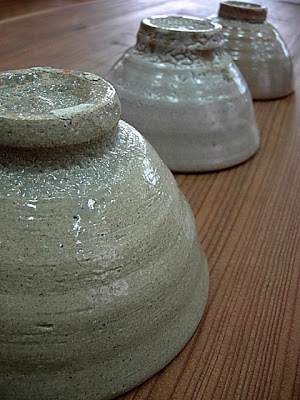
The three bowls pictured together are from left to right: #1, #2, #3

#1


#2

#3


Peace

Monday, June 23, 2008

Sel Young Jin's Wild Edo Style

Edo refers to both the style and clay used for this tea bowl. Edo clay, found only in the southern kilns of South Korea, is distinguished by its distinct goldy yellowish-orange colour, the colour of a loquat fruit. The texture of this clay is typically more fine and smooth, than coarse and rough. A traditional edo style bowl is bound to use these characteristics in its final product. This bowl is not your traditional edo style bowl.


Grittier, granular, coarser clay that typifies Sel Young Jin's tea bowls is found in this piece. Thick white glaze coats this bowl. In places where it does not, stones, and sandy loquat clay peer out from the white gloss helplessly enveloping it.

This tea bowl's shape is an exaggerated extension of yang. The addition of bright green matcha helps to balance this bowls energy. The matcha re-energizes the edo clay and pulls it out from the suffocating grip of oozing white blobs.


The feel of this bowl on the lips and fingers is wonderful- smooth, thick gloss, with sporadic gaps of stark pleading roughness. When it is brought to ones lips the heavy weight of this hardy bowl is felt. Tea creeps down the thick walls of this bowl and into the mouth. It seems impossible to coax out the last bit of tea from the deep, low laying, flat shallow of the bowl.


The oversized foot (Kor: joop, Jap: kodai) acts to balance this burly bowl. Its unusually large size and one inch depth appropriately grounds this the bowl.


One dare not call you a sissy when drinking matcha from this colossal bowl!

Peace