Showing posts with label Kim Kyoung Soo. Show all posts

Friday, October 26, 2018

Grey Teapots Vs. Red Teapots


After writing a bit about teapot feng shui a while ago, I thought I would share some personal experiences with my own teapots and feng shui…

First, I think it’s telling that both of my old red clay (hong ni) yixing teapots have incurred multiple damages.  I used to own 4 teapots- 2 grey & 2 red.  My gray teapots have never sustained any damage what so ever, even after frequent daily use.  My red clay teapots both have had a few injuries, their last resulting in breakage rendering them unusable.  To me, I think the feng shui of these pots is part of the reason some have survived while others have perished!

I have previously posted about the Qi, energy, psychological, and spiritual effects of the colour gray.  Currently, I own and cherish two gray teapots, this gray Kim Kyoung Soo and this gray David Louveau.  I most definitely gravitate towards using these grey pots when I am in a greater state of concentration, meditation, zen, mindfulness, when I am drinking tea alone, or when I am attentively absorbed in a new tea sampling.  I even use the gray pots when I hope to cultivate mindful calmness. 

These days I mainly use my gray teapots to mindfully sample new puerh tea as I feel it increases my focus and strengthens my mind to what is to come.   I also use grey clay pots at work as a reprieve, focus and calm, in my busy work day.  It is no wonder these pots are in great condition!

What is the energy of red?  It is the colour of heat, fire, dynamic action.  I use these pots often in the bustling gong fu brewing of puerh or oolong.  The dynamic morning transition of Yin into Yang, of sleep to awake, can sometimes be intense with a young family.  I choose a teapot that gets us going paired with quick strong and intense gong-fuing sessions.  However, I don’t want this energy to be overzealous so the pot is usually somewhat balanced with a heavier sturdy and rounder form and thicker walls- the Yin within Yang.

When this Yang energy is too much or too intense- carelessness, thoughtlessness, and mindlessness can predispose the teapots to a space where breakage is more likely to occur.  The energy of the pot you select to steep tea in influences your tea session, your mind.  Conversely, your mindset influences the teapot you select.  We should be mindful of this and select the most optimal teapot for gong fu cha.

Peace

Saturday, May 5, 2018

A Minimalist’s Teapot Tally


Readers of this blog will know that I have been having a bit of a teapot shortage lately (here and here).  I stated in a recent post that I actually own very few teapots despite a deep appreciation of them and significant immersion in learning about them in Korea.

Below is my grand tally of all the teapots I own…

Currently, I only have two working teapots:

I have this grey one from David Louveau that is aging gorgeously with use.  It is quite a small pot maybe around 100ML and I use it mainly for puerh or any sample or tea that requires such a size.  At first, I was a bit critical of this pot but only in use has its true nature been revealed.  This pot was gifted to me by the potter himself and so is naturally very special to me.  Currently, this pot sits at work for the very rare instance I have time for a gong fu session throughout the day.  I love this pot.

The other is this teapot from Korean master potter Kim Kyoung Soo, it is also grey.  This pot is a Korean masterpiece and I usually only use it for Korean tea.  It is quite wondrous and out of all the pots I came across in Korea, I am happy to have this one.  That speaks volumes considering that I was immersed in 1000s of them at that time.  I have it at home but steeping puerh in it, which I have reluctantly done lately doesn’t feel right.

I used to have a cheap Shui Ping red clay Yixing teapot that I purchased in China.  It is a modern pot of simple craftsmanship that could hold about little over 150-200ML I think.  I used this pot at home for puerh.  I had dropped it on my Korean ceramic Kim Kyoung Soo tea table and cracked the lid in half a few years ago but it was a simple break and I would easily still use it. A few months back I was trying to unclog the golf ball filter with a tooth pick and it broke off a sizable chunk of the filter.  After that the uneven jagged filter became a serious problem because it would easily catch tealeaves and clog after every use and would be very hard to unclog.  The back pressure would cause the lid to pop off.  One day I just tossed it- it was a lost cause.  Its undoing was my fault and I had the David Louveau pot above of similar size so I didn’t bother to replace it.

My family and I steeped puerh daily in my big “Gum Sa Do Yae” Zen 250ML pot, a gift from my teamaster, until its recent demise.  I have posted an appreciation of this beautiful zen tea pot before.

That’s it!  Just these two… that is definitely teapot minimalism!

 I have used the gray Kim Kyoung Soo teapot over the last little while (here and here) to brew old aged puerh but I really feel like it is not doing the aged puerh justice so I have decided to look for a replacement for this beloved pot.

These days, in our house, we are using an old metal tea strainer and immersing the puerh tea completely into large cups before pulling out the strainer with a fork… I never thought it would come to that, but that is exactly how we drank some of the 2006 Mengku Arbour King Brick this morning and some 1990s aged Bulang a few days ago!

In a way, I feel like this is more authentic in a minimal sort of way.  If there are any readers out there who steep puerh with a teacup strainer basket- you are my hero.

Peace

Tuesday, June 12, 2012

Experiments with Storing Re-roasted Green Tea


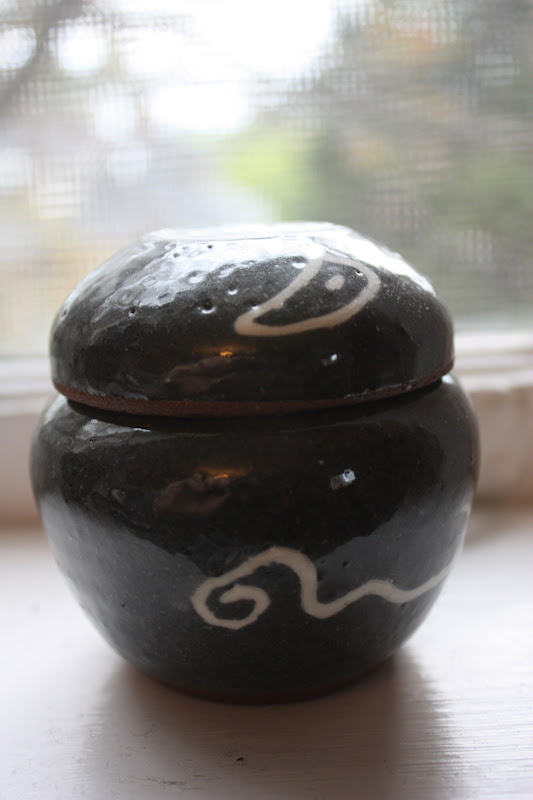
After re-roasting some stale green tea last month, a large portion of the nicely roasted tea was stored in a ceramic tea jar by master Kim Kyoung Soo. The tea jar was filled about 4/5 full of this green tea. Every week one tried some of the tea in the jar to see how this re-roasted tea evoloves. Below are some general comments on how this tea changed over the course of the last month.

In the first week of storage the green tea lost some of its superficial fire, that roasted quality which tastes as if the tea just came out of the pan. The other characteristics of taste, smell, mouthfeel, and qi sensation were holding from the re-roast. Higher notes did not become more vibrant but were more noticable without the roasted tastes stealing attention away. This is often refering to as "mellowing"- where the superficial fire is given time to disapate and the balance of the yin and yang of tea solidifies.

Into the second week of storage this tea held its own but started to wane near the end of the week. Into the third week this tea developed soft brackish, bitter notes which resembled the tea prior to re-roasting. Its qi started to turn as well, becoming more stagnant in the guts.

After the third week the tea continued to move closer to where the tea was before roasting. In the fourth week the tea has become pretty undrinkable once again with a qi which beats down on the stomach and abdomen. It is said that the longer the roast or drying the longer that the properties of fire will remain in the leaf, this is as true for initial production as it is for re-roasting.  This tea had undergone only minutes of re-roasting which may have lead to the short lived changes in the tea.


It should be noted that the ceramic Kim Kyoung Soo tea jar was not sealed air tight. As the month passed less and less tea was taking up space in the jar and the tea consumed later would have been exposed to more air as the lid was opened every time to fetch more tea. Perhaps next time one re-roasts some older tea there should be some type of control- a zip lock bag to compare.

Peace

Thursday, May 10, 2012

Appreciation & Wear of Kim Kyoung Soo's Grey and White Style: Three Cups


Hot water passes from the serving pot and into the cups to warm them. Its stream contact the bottom of the cup- the water poured from a short distance echos peace. The cups are each filled 1/3 with water and left until they become warm. They are purposefully picked up with the right hand and brought to the dan tian where they symbolically contact the purity of the white hemp cleaning cloth held in the left hand. The hot water is slowly tilted towards the distant edge of the cup and then slowly angled clockwise around the lip of the cup. This clockwise direction indicates a filling of the cup with energy and creating energetic space for the tea which will so arrive here. Obviously, it is also done to warm the full inside surface area of each cup.


The hot water is then poured into the dirty water bowl, the small bead of water is wiped away with the pure white hemp cloth, and the cup makes its way back on to the table. This exact routine is now completed with the other two cups.


When the tea is prepared and poured into the serving pot from the teapot it makes its way into the cup closest and furthest left to the person preparing tea. The sound of the tea hitting the empty, warm cups now sound even more peaceful than just minutes later. The tea is poured from a short distance from each cup creating a sound that resembles a trickling stream. Pouring too fast, this sound and feeling is lost and a hurried feeling is added to the tea room. Pouring too slow, this sound and feeling is also lost and a stagnant over-restrained feeling is added to the tea room.


Half of the first cup is poured, then half of the second cup, the cup above or to the immediate right of the first cup, then the third cup is fully filled, the second cup is then topped up, then the first topped up. A few small bubbles float softly on the surface of the liquid.


The white of the inside of the cup represents the purity or reverence that we show to the tea- it the surface contacting the tea. It is the purity and peace which we all strive for while drinking tea, the peace inside us. In the ChaSinJeon white cups are best for drinking tea so that the full colour of tea can be fully appreciated. The inside of each cup is crackled and stained from the tea oils, each also has small air holes. This is each cup's fingerprint, its impression on us, on our tea experience.


It is glazed with a simple grey fieldspar glaze on the outside representing the modesty we should project outwardly when enjoying tea. Each cup has the pictograph of a moon, a yin symbol. The functions of cups are too hold, a yin function. Reminding us of our inner nature and quietude as we sip from its insides.

Peace

Monday, November 28, 2011

Appreciation & Wear of Kim Kyoung Soo's Grey and White Style: The Serving Pot


Hot water gets passed from the cooling bowl to the teapot, from the teapot to the serving pot, then from the serving pot to the cups. After the serving pot is preheated and the tea steeped, the serving pot is the first to receive the gift of infused tea from the teapot. It is the first to receive and the first to give. It reminds us that the tea ceremony is about giving and receiving- about host serving guest.

The serving pot contains the same yin and yang motifs as the cooling bowl and tea pot. Its most noticeable feature is its shape and form.The shape and form of this grey and white Kim Kyoung Soo serving pot reflects both its practical and energetic function.

Warm infused tea passes from the spout of the teapot and through the relatively narrow collar of the serving pot. This opening at the top of the serving pot is a bit smaller than the opening of the cooling pot. The smaller opening is to retain the heat and the qi of the infused tea. The serving pot also has a more distinct bulbous interior than the more open interior of the cooling pot. This more bulbous shape acts to amplify the sound of the pour and give it more of a beautiful echoing reverberation- a feeling of closeness, of being grounded and held, a feeling of safety. More importantly this deeper bulbous shape acts to contain the warmth and qi (taste and smell) of the tea inside. It also reminds us that host should always retain warmth and feeling in every tea meeting.


There is beautiful contrast from the wear of this Kim Kyoung Soo serving pot. The inside of the pot was once as white and pure as the cooling bowl. Now only the crackled top collared rim shows evidence of what was. The choice to leave it covered in tea oil obscuring its pure white inside is simply to not remove qi that has accumulated from all the green tea that has passed through this vessel manifesting as this brown, terracotta coloured layer. Some feel that the presentation of purity to the guest is more important than accumulation of qi- you will see both in Korea.


The most stunning feature of this interior is no doubt the contrasting white flecks on the interior's bottom. These were made by a guest who doubted that there would be white under the thick coat of tea oils. They scraped their finger nail on the bottom of this serving pot, only when the white ceramic was exposed did they believe that such drastic change had taken place. These exposed white flecks remind one to experience that which is beyond the senses when enjoying tea poured from this serving pot.


The form of this pot looks as if it is reaching, stretching from handle to spout a little bit. This represents the relationship between the person preparing tea and their guests. On one end, the maker of the tea has his hand around the looped handle. This looped handle is almost identical to that of the teapot. It too contains ghostly faint, cloud-like globs of glaze.


On the other end is a long reaching spout. It is a bit longer than that of the teapot. It truly gives the impression of stretching from host to guest- of reaching out, of touching with warmth, with tea.


The tea oiled insides interconnect with the oil stains that descend down the exterior of the pot. They reaching down the long spout connecting almost flawlessly to the exposed clay of the pot's base. What is inside is out and what is out is inside. The green tea within connecting with Earth, with the host, with the guest.

Peace

Monday, September 5, 2011

Appreciation & Wear of Kim Kyoung Soo's Grey and White Style: The Teapot


Hot water passes from the cooling bowl into the empty teapot to warm it, preparing it for leaves. Water rests in there briefly then is poured into the serving pot. The leaves are then added and, in time, cooled water embraces these leaves...


The knob of the lid feels glossy and smooth between the fingers. The side walls of the lid show the wear of the original clay and its constant interaction with liquid tea which has approached to close to the rim of the teapot.


The form of this grey and white teapot is simple enough not to be pretentious. The comfortable flat looped handle on the far end feels like shaking an old friends hand. It hugs one's slightly large fingers nicely. A cloudy white blotch adorns the handle. It acts to remind those preparing tea of the light hand, like that of a floating cloud, required to make a good pot of tea. Where the handle connects with the body of the pot there is some slight staining contrasting the white cloudy blotch nicely. Underneath the handle rests a somewhat hidden chop of Kim Kyoung Soo- the only one on this piece.


The spout at the other end of the pot sufficiently balances the handle, if not stretching your vision more to that end anyways. This slight emphasis is deliberate as energetics and concentration flow out this spout along with freshly infused tea liquor. The end of the spout is ridged so as to liberate the last drops of tea from the teapot- a patient but necessary moment in every pour. Done to ensure that no water is left over the delicate tea leaves.


The most stunning aspect of this pot's wear is the rustic-earthy staining that has occurred from the last drips of tea clinging to this spout, refusing to depart from its home. It forms an orange-brown stripe that makes its way from the tip to the exposed clay circle at the bottom of the pot's base. Its raw nature is appreciated. The exposed clay is at the very bottom of this pot, grounding it- a reminder of the earth it has come from.


The sides of the pot sport the ancient pictographs for moon and wind, yin and yang. These pictographs balance and remind us of the connection of nature to the process of steeping tea. The shinny grey sides of the pot are marked with some beautiful dimpling allowing the pot to take an extra deep breath while holding tea leaves and warm water inside. There is noted staining around the pots rim as well.


Peaking inside the pot, you can see a large white blob of glaze- the most bold marking on the pot. It is left for the leaves and water to enjoy or perhaps the keen and patient observer before and after the tea has been prepared. The crackling of the white blob is a measure of all the tea that has passed through this pot, passed through this mind.

Peace

Tuesday, June 21, 2011

Appreciation & Wear of Kim Kyoung Soo's Grey & White Style: The Water Cooling Bowl


Water first enters the field of the tea table and is poured into the water cooling bowl (Kor: Na Num Sa Bal) from the hot water kettle (Kor: Soo Joo). As it enters the table it does so slowly and mindfully. The water flows from the spout of the hot water kettle like the water trickling down a mountain stream. When it hits the bottom of the water cooling bowl the sound reverberates into a calm mind- quieting the minds of all those present. The goal is to achieve a sound that mirrors a trickle of a mountain spring.


This Kim Kyoung Soo water cooling bowl produces a wonderful sound. As the water meets the hollows of this bowl the sound that springs fourth is amplified by the bowls lip which traverses the rim of the bowl. Kim Kyoung Soo's water cooling bowls opt for a distinctive shape which does wonders for achieving a deep, relaxing, natural sound. The shape of the cooling bowl's lip also allows you to gracefully and carefully pour out the hot water that rests inside without burning the fingers- a technique that takes a bit of practice.


The inside of this lip is pure white in colour, a stark contrast to the grey that covers the outside of the bowl and the patina that covers the once pure white inside of the serving pot that sits on the opposite side of the teapot. This pure white is maintained because only water and never tea enters the water cooling bowl. However the water cooling bowl nevertheless develops a patina. It is a patina of mineral salt that fills the cracked glaze- a reminder of its close relationship with water. Like a winter's frost covering the mountain, so too does the minerals of water cover the fine cracks of the cooling bowl. In this way, imparting it with not only a cooling function, but also a cooling look and feel.
This frosty white patina goes through a breathtaking metamorphosis every time water first comes in contact with it. The once frosty cracks turn light grey as the water first fills the dry bowl. Slowly the grey cracks disappear to white, blending with the rest of the inside.


The white mineral patina can also be found on the spout where water is poured from the cooling bowl. The contrast with the grey glaze is stunning as white sneaks over into grey. The outside of the cooling pot has the pictograph of the wind through the clouds facing the person preparing the tea and a pictograph of the moon facing the person receiving the tea. In this way water maintains its natural balance here.


The use of the water cooling bowl teaches us patience- nothing we can do but wait can cool the water as it rests in this bowl. In fact when this bowl is turned upside down its shape resembles that of a snail- this is no coincidence. The raw unglazed clay is also exposed here, grounding the bowl at its base.

Peace