Sunday, April 26, 2009

2009 Goomtee Estate FTGFOP 1 Clonal, 1st Flush Darjeeling


One visited the Goomtee Estate and was blown away by its majestic beauty at heights of around 6000 feet above sea level in South Kurseong. A beautiful place to raise tea.

Today one samples Goomtee again. The dry leaves are a diverse mix of light colors and darks with some hair and others not. The smell is of strong fruity grape with high bitter notes and soft muscatel background.


After this tea is carefully prepared, the first infusion flaunts flowery top notes with sweet juicy grape. The flowery aroma dominates the mouth and the mind. A full mouthfeel is immediately felt from the first sip onward. This tea is nicely coating with slight muscatel dryness lingering around.

In the next few infusions an engulfing dryness allows for more flowery notes in strong grape. Sometimes the grape is more prominent then the flower. There is much the same grape taste as the white tea from this estate. In fact after looking at the notes from this sample one really questions whither it isn't the same sample.

The faint Muscatel tones fade in later infusions leaving light cheery spring flavors. This tea is very 'spring', very contemporary Darjeeling, very hip.


In the end this tea left one with faint grape on the roof of the mouth before disappearing hastily into mouthfeel. Actually, near the end it was mainly just mouthfeel and a lingering energy that make one feel warm and very much alive.

Peace

Friday, April 24, 2009

2009 Giddapahar Estate FTGFOP 1 CH (SPL) 1st Flush Darjeeling


This tea from Giddapahar Estate is picked at an elevation as high as 4864 feet in the scenic hills of South Kuseong. One had a beautiful visit of this estate back a few months ago while they were producing their first tea of 2009, most likely the very tea one will sample today...

The foil pack reveals a scent of green sweet foresty muscatel. There is a wonderful deep stinkweed-like flowery smell- a good kind of stinkweed (if one could image that).

Prepared, this tea first comes on quite nicely with a nice full deep muscatel that rides on the coattails of pure, very sweet not-to-grape high notes. This initial very sweet taste permeates the saliva while riding about in the mouth. The vibrant yellow of the liquor is like the sun on a spring day without clouds. A wonderful sight indeed. Wonderful sights are matched with wonderful feelings in the mouth, soft and fuzzy.

The following infusions confirm that this tea is deep and foresty, sweet but not so much flowery if only a bit in the nose, and results in a nice dry muscatel coating in the mouth.

Later as black teas loose their grips under the exhaustive exercise of gong fu, this one holds its own as the taste transforms. The sweetness here becomes creamier and more well rounded as opposed to watery and weak. The sweetness comes first, then mild muscatel, followed by a hardly flowery finish that is airy. The muscatel notes seem to be the first to really drop off. Lacking these stronghouses, room is made for more subtle berry then fruity grape undertones. There is something to be said about this teas enduring smooth, sleek Darjeeling sweetness.

Under a stern alertness that only black tea can bring about, one exhausts this enjoyable tea.

Peace

Thursday, April 23, 2009

2009 First Flush Darjeeling Marathon

With a collection of samples from Rajiv at Lochan Teas of the very first Darjeeling pickings of 2009(many of which are special premium picks), one thought to share some detailed tasting notes on these teas with you the reader. Expect a post a day for about a week on these teas.

One decided to brew them 'Korean Style' using a large yixing pot in the tradition of gong fu style, not at all the tradition way these black teas are consumed. The infusion times started at 30 seconds and increased progressively. Just off boiling water was always used. One found that this method allowed one to see how these teas unfolded and also tested the limits at which these teas still remained flavorful. This method seemed to really put the bitter, flowery, and fruity elements on the spot. The use of gong fu with a large yixing pot was part habit; one has never preferred the less intimate grandpa cupping style of tea drinking, part convince; the pot that one wanted to use for this tea is still packed up, and part practicality; one needed a large pot because often family and friends were around.

Hopefully you will get something from these notes. Perhaps they will give you a better idea of what first flush teas you may be wishing to purchase. Or perhaps they will give you better insight into the individual character of each of these famously old estates. Enjoy them for what they are. Please feel free to add your comments if you've tried any.

Peace

Tuesday, April 21, 2009

Sam Do Tea Bowl Style- A Look At The Ju Sam Do Subtype


This style of tea drinking bowl can be traced back to June 6th, 1565 where it is described in written records by the Japanese. The name ‘Sam Do’ or ‘Three Islands’ refers to the three islands in the south of Korea where the Japanese first stumbled across this style. It most likely erroneously alludes to two islands and part of the peninsula which was mistaken as being completely surrounded by water.

These bowls are marked with white. Most, but not all, have short slashes of white just inside and/or outside the lip of the bowl. These dashes give the bowls a feeling of movement and depth. At the bottom of these bowls there is a rather short simple, even cut ‘Haes Moo Ri’ style foot. These pieces are often heavily glazed.

There are many subclasses of ‘Sam Do’ bowls the most popular and probably most spectacular being the ‘Hwa Sam Do’. ‘Hwa’ means flower so these bowls are ‘Flowered Three Island’ Bowls. They carry this name because there are white flowers that are stamped onto the bowl using a stone or wood carved stamp. Quite often there are thousands of these little white flowers that cover the inside and sometimes the outside of these bowls creating a wonderful blossoming effect.

These bowls, like many others from this early time, were coveted by the Japanese. Today, however this style is not in vogue, and is quite a rarer sight.


This bowl is a different subtype of the sam do style- 'Ju Sam Do'. All 'Ju Sam Do' bowls, from a far distance , look completely identical. Only upon close inspection can you notice the subtleties that divide amateur 'Ju Sam Do' bowls from the 'Ju Sam Do' bowls of masters.

This wonderful example of the ‘Ju Sam Do’ style is by buncheong master Kim Jeong Oak. This piece looks quite respectable in shape and form. When cupped in the palms of the hands this bowl feels wild and uncut as flesh senses the criss-crossing white divots.


The flowers are not overdone in this piece and linger near the bottom. They serve to balance and give elegance to the many white slashes that hover above. The cloudy glaze around the foot of this bowl hints at its genius, a last attempt at turning simple and wild into soft stable sophisticated beauty. You can feel the movement and balance in this bowl from top to bottom, from rough to refined.

Doesn’t our restless mind also follow this progression after taking time in our busy days to drink tea?

Surely drinking matcha from this bowl would bring about such an affect.

Peace

Monday, April 20, 2009

Enjoying the Mundane: 2008 Tam Chan Southern Vietnamese Oolong


One picked this one up in Hoi An. The company’s broken-English website lets us know that this oolong was produced using organic methods on a 400 hecter patch of land in the Southern Lam Dong Province at an altitude of 800-1600 meters above sea level. Let’s check out this tea

The dry leaves are a mix of light medium and medium green tightly rolled pellets most of which contain a yellowish stem wrapped tightly into the pellet. These leaves smell very green with a quiet, fresh hay over flowers-in-a-greenhouse smell.


One prepares these leaves in a Kim Jeong Pill buncheong set using near boiling water. As leaves and thoughts unravel, this tea presents a nicely milky green flavour, slippery smooth in the mouth as much as thin. Sometimes this tea teases at a dry green floral taste but presents itself dimly in the nose instead. Some sessions that use longer infusion times completely drowned out the floral, leaving one questioning, “Where is that floral oolong taste that everyone loves?”

This tea presents very little in the way of sweetness. It spends its energy striving for a full feeling in the mouth, which it can’t quite actualize.


Although this insanely cheap tea doesn’t excite, it keeps calling one back. Its very nature of plainness and everydayness is its strength. Its mild energy taps about in the guts as one sits in meditation with this tea. Enjoying this tea is to enjoy the normal everyday, seemingly mundane things that normally pass us by in a day. As one sips this tea one enjoys such things to their fullest. One enjoys this tea.

Peace

Friday, April 17, 2009

A Wood Fired Na Noom Sa Bal (Serving Pot) by Lee Tae Ho


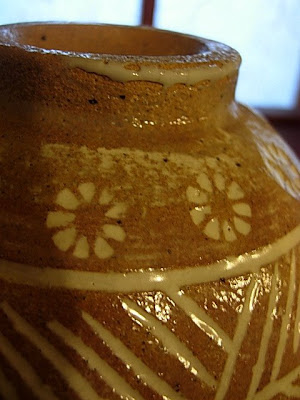
This is the only wood fired piece by Lee Tae Ho that one ever came across. Its wood kiln created micro details make this piece a little treasure. The closer you look, the more you get pulled into this world of imperfect fine detail. These pictured beauty marks add unpretentious sophistication to crude molten surfaces. The unearthed brownish red outer exudes both nature's look and touch in a way his gas fired pieces could never hope to replicate.

Peace

Thursday, April 16, 2009

2008 Yong Pin Hao Lan Xiang Wild Arbor


This sample was kindly sent by Hobbes and is the first infant shang peurh consumed after ones recent round of digestion problems. It's a big test but, finally those cravings are quenched. Let's see how it goes...

Looking through the plastic baggie ones eyes are already pleasured by the healthy chunk of very loosely compressed leaves, some of which are the fuzzy baby variety, others seem bigger but not too big. It looks like some very nice spring growth. The smell of these distinctly different leaves is of tobacco lost in a sweet mysterious musk.

These leaves are effortlessly freed from the chunk and stuffed into yixing where very hot water brings them to life again.

The first infusions invite soft acidic and mild bitter grapefruit-like high notes to challenge creamy woody tobacco low notes. The 'wild' natural grapefruit sourness is that which would only be expected from arbour trees. There is lots going on in the mouth with this one, but no chaos or confusion, an easy transition. In all of this there is still a certain gritty, wild, toughness about this tea that doesn't overpower, only adding to its whole. The mouthfeel is unpretentious, when given attention it deserves a nod as it does a nice job of coating fully the tongue, mouth, and throat in softness. Its cha qi is very noticeable from the first infusions on.

Middle infusions bring more creamy and tobacco and less acidic and grapefruit. Later ones fetch more sour high notes. This teas flavour is nice throughout.

This tea is a dichotomy of sorts. It is creamy and smooth yet wild and rough, a plethora of rich low notes and acidic vibrant top notes. Its mouthfeel is full but not distracting, and its energy is edgy yet smooth. Its cha qi is amazing. Ones body takes cues from this dichotomy and is nudged into balance inducing long bouts of meditation. This tea makes one glow. It doesn't seem to cause any ill affects to ones systems. Although one can sense its mild edginess nothing happens. Nothing happens...

On this gloomy day where grey skies give nothing but rain, one feels completely energized and relaxed.

As infusions push on the liquid becomes more mild and a bit minty and rubbery before not much is left of these smallish and very stemy spent leaves.

Peace