Tuesday, February 12, 2013

Victoria Tea Festival Review: Greg Demmons' Mediative Korean Tea Ceremony


While, there always seems to be something at each annual Victoria Tea Festival that makes it unique. This year there were, at least, a few things which made the festival worth a visit. There was one exhibitor which was really impressive and where one had spent the majority of time at (more on that later). Met a few fans of MattCha's Blog which was also really nice and said "hi" to some of the festival veterans as well. The presenters David Caudwell and Greg Demmons were both extraordinarily good. With a special interest in Korean tea, Greg Demmons' performance of his Meditative Korean Tea Ceremony was the highlight.

Greg could be spotted in the busy crowd of the festival before his presentation walking through the crowds in full Confucian Joseon Dynasty governmental official hanbok. For his presentation he was doing a demonstration of the version of Korean tea ceremony which his master taught him from a modest mountain teashop on a mountain in a city just outside Seoul. He received the blessing of his master to preform the ceremony which he planned to do for the first time in North America at the Victoria Tea Festival.

Towering much taller than almost any other Korean man, Greg humbly set his tea setting in preparation for the ceremony. He mindfully brought the wooden slab with covered teaware out after placing the cusion down. Then he brought out the warm water kettle and waited to be anounced, to start his presentation.

He gave a simple synopsis of the Korean Tea Ceremony explaining that normally he would not ware the formal clothing and that the ceremony would include a longer duration of mediation than what will be demonstrated today. He said that the movements of the Korean tea ceremony (the purpose of the movements and the speed of the movements) are not only aesthetically pleasing but that they are also done for the purpose of getting the water to an appropriate temperature. He then went on to preform his meditative tea ceremony...

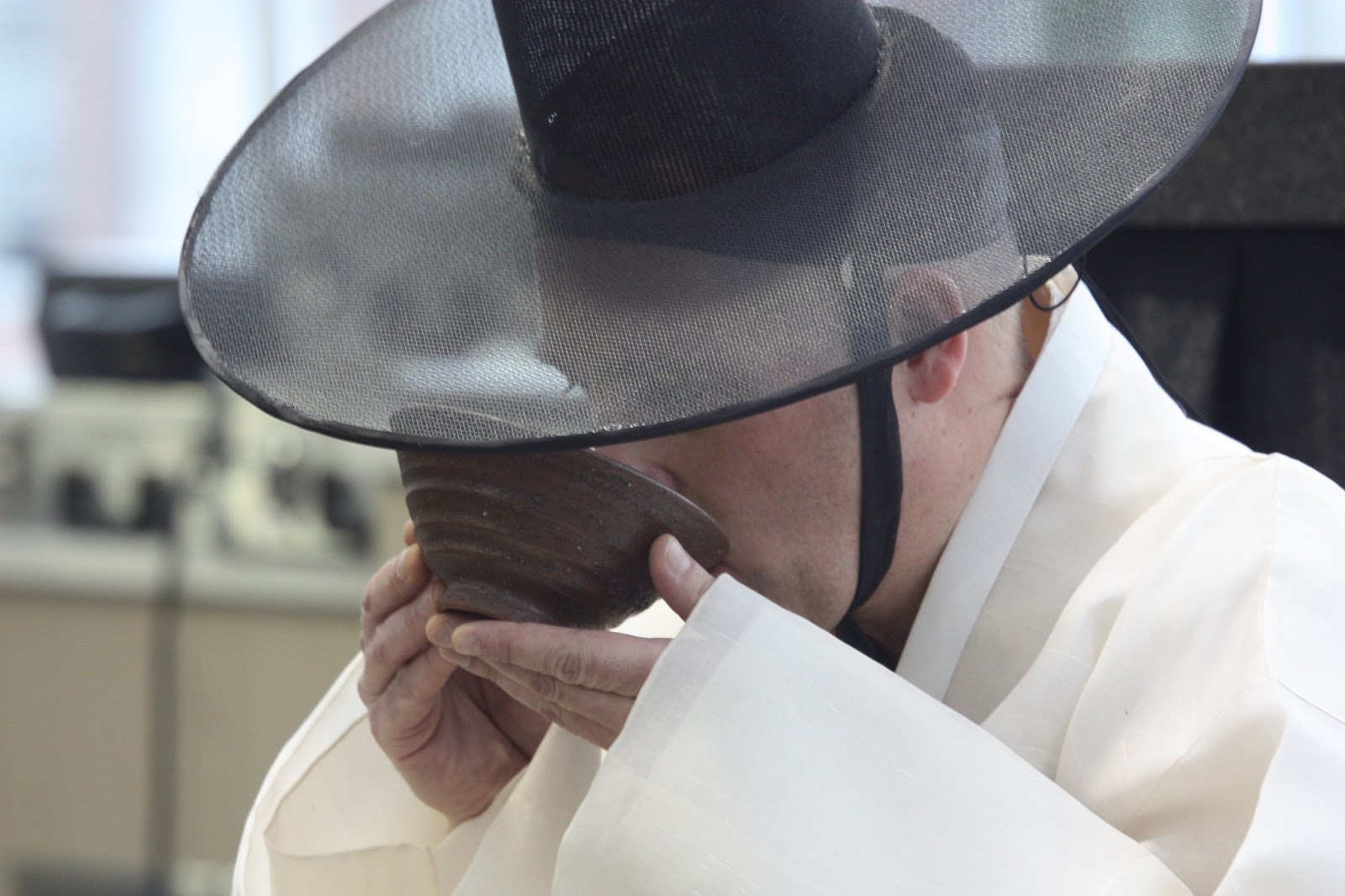


He moved very deliberately and with such mindful concentration. Those in the audience marveled at the beauty of this movements. They weren't overly exaggerated, drawn out, or artificial nor were they matter of fact, lazy, or without exact intent. Every movement was done to make a wonderful bowl of matcha (Kor: malcha). Deliberate, soft and graceful- one of the best Korean powdered tea ceremonies one has witnessed. Some of the hand movements, especially with the white hemp cloth was extraordinary.


After the performance Greg took some questions from the crowd. He answered all questions true to the Korean Way of Tea even squeezing in a quote from the Saint of Korean tea, Cho'Ui. He explained that in Korea there are no lineages of masters or families with strict rules. He also explained how each person slightly changes their ceremony. He also answered questions on the intent of the person preparing the tea- they are placing all their energy, their qi, into the bowl of tea. They then transmit their intent to those receiving the tea through the performance but mostly through the tea - this is the Korean Way of Tea.

Peace

Tuesday, February 5, 2013

Two Korean Tea Vendors Describe Balhyocha (aka. Hwang Cha, Korean Yellow Tea)

Thought that readers of this blog would enjoy these two great articles from two Korean vendor blogs. They both deal with a difficult topic, describing what exactly is balhyocha?

In this article by Arthur Park of Morning Crane Tea, he covers the confusion and ambiguity of Korean tea naming conventions as it pertains to balhyocha. Interestingly, he draws comparisons to very very rare tea productions such as Korean oolongs (such as this tea) and Korean red teas (such as this tea).

In this article by Gabriel Furnari of Jirisan Tea Company, he covers an important point- that teas in East Asia are named not by the colour of their leaves but by the colour of the liquor. He explains how this naming convention pertains to balhyocha. He also goes over some details of the production of balhyocha as well.

For more information on these topics and other points not covered in the articles please see the detailed three part series of posts on balhyocha:

Part 1

Part 2

Part 3

Peace

Sunday, February 3, 2013

2012 Soa Tea Certified Organic Boseong Balhyocha


A few weeks ago one had sampled a green tea from the Boseong grower, Soa Tea. Today, as promised, the balhyocha from the same producer is under some serious enjoyment. Gabe Fife, fellow Korean tea lover and blogger of the Korean Dojang, had purchased a large quantity of this tea. He felt that for its price, the Soa Tea balhyocha cannot be beat. This organically certified tea from the popular Boseong tea growing region sells for 9,000 KRW (approx $9.00 USD) for 40g, a very good value. The water is boiling in the clay brazier, it has not been sunny in a week or so, it is the perfect time to see what this tea has to offer...

The slightly curled, black dry leaves release an odour of deep cherry wood with soft, deep fruity apricot notes underneath. These leaves are piled into the small warm teapot.


The first infused liquor pours a browny-orange colour. It starts with robust, woody deep tastes which reach into the mid-throat. The tea evolves quickly in the mouth and finishes off with spicy-cinnamon and persimmon. These gradually trail off as well leaving the taste of smooth apricot on the tongue. The mouthfeel is full and throaty but still light, a characteristic of balhyocha.


The second infusion has a distinct cherry wood start which immediately grips the mid-throat. There are deep oxidized notes of deep forests then suggestions of sesame and vague tangerine and apricot. The mouthfeel coats the throat and is mainly felt in the back of the mouth. Cinnamon-persimmon notes are the last to be detected a minute or so after swallowing. These tastes appear in the sandy-pasty mouthfeel in the back of the mouth.

The third infusion has even more cinnamon-persimmon. This infusion has a smoother profile with these distinct fruity notes stretching through the taste profile. The deeper-woodsier tastes tastes linger underneath- sweet fruit in a soft pasty mouthfeel. The fourth infusion is much the same. The chaqi is very light, soft, and smooth. It travels gingerly throughout ones body.


The fifth infusion is more dry-wood-bark tastes with the lighter fruity notes sitting softy below. There is also a very soft sour citrus note that appears now as well adding another layer of simple complexity. The mouthfeel becomes slightly more coarse and drying now.

The sixth infusions smooths out with woody-bark over soft, sour citrus undertones. The taste is much more simple now. The mouthfeel is still very full.


The seventh infusion is much the same as the sixth now maybe a bit more fruity as the dry notes smooth even further. Still lots of depth and mouthfeel. Even under longer steeps late into the tea session there is still much flavour to enjoy. The fruit notes are very faint under dry wood flavours in this eighth infusion.

The tea is put to an 24 hour steeping to leach out what is left. Strong cherry wood varnish like tastes mingle with very distinct orange-grapefruit tastes the taste has a rose and rosehip-like flavour which overlaps with the wood taste. Interesting tea.


Thanks again Gabe.

Peace
Thursday, January 31, 2013

2013 Victoria Tea Festival (There is going to be a Korean Tea Ceremony!)

One has written extensively about the Victoria Tea Festival over the last 4 years and have seen it change dramatically in that time (click this link then scroll down to see all the posts). This year there are some noticeable changes to the festival. First, this years festival will only be one day (held on Febuary 9th) instead of two. Second, maybe the most obvious, is the open invitation for coffee roasters and other non-tea related exhibitors. This was happening more and more over the years anyways and last year it was very apparent that this wasn't a tea exclusive event. The third is the absence of local tea shops sponsoring the event. A few years ago the sponsors were mainly all local tea shops, now there is only one, the juggernaut DavidsTea. The fourth difference is the absence of the most popular tea shop among local Victorians, Silk Road. In all the previous years Silk Road was a main sponsor, occupied much of the main tea floor, and was guaranteed a presentation slot. Silk Road's absence in the festival will definitely be felt, especially considering how brilliant their displays and decoration were.

So then, what is there in this year's Victoria Tea Festival to look forward too?

Here is four good reasons to go to this years Victoria Tea Festival...

Well there are still some great returning exhibitors. Jagasilk, Chado Tea House, and May Ip Tea Gallery have great, passionate exhibitors that are worth a good chat and a sample of their teas.  Secondly, one has meet some of my best tea buds at previous Victoria Tea Festivals If you are passionate about a certain kind of tea, chances are that you will find someone at the tea festival who is just as passionate as you.  Thirdly, there are two presentations that one is really looking forward to. There is a presentation on medicinal herbal tea blends by David Cauldwell. If you haven't heard David speak you should go, he is full of interesting knowledge on how herbs heal! There is (finally) a presentation on the Korean Tea Ceremony! The presentation will be given by Greg Demmons the description of his presentation is as follows:

"Originally from Newfoundland, Greg and his wife, Patricia, moved to South Korea to teach in 2003. Greg began individual study of the Korean tea ceremony with local Tea Master, Kim Kyungui, after a chance meeting at a mountain hermitage. One year later, she requested that he remain for 4 more years of individual instruction. In November 2007, he was granted permission to teach the dado (Korean Tea Ceremony), by his Master and the city."

His twitter feed describes the following:

"Studied under Kim Kyung-ui, aka, Cho INmok, in Ich'on, South Korea for several years. I specialize in the meditation ceremony."

Have never heard of Greg before but can't wait to meet the guy and experience his master's take on the Korean tea ceremony!

The fourth reason is that the event is a charity event, so why not go support the local charity?

See you there.

Peace

Thursday, January 24, 2013

2012 Soa Tea Jungjak? Certified Organic Boseong Green tea


Have taken a bit of an unintended break from tea blogging. Things are well but have gotten more busy, lost some spare time in the mornings so the time to drink in ceremony and blog has been lost. Today one enjoys a pot in the late afternoon. It is a sample that was picked up at at the Busan Tea Festival by fellow Korean blogger, Gabe Fife of The Korean Dojang. The sample is by Korean tea producer Soa Tea from the Bosong tea producing area of Korea. One found a wild flower growing in a field near by, struggling against the elements, and thought to pick it- company to enjoy this green tea with...


The small sample packages are opened into the warmed tea pot. They contain dark green-brownish, medium large jungjak grade leaves. The smell given off is of roasted nuts and soft subtle grains. There is just a slight suggestion of almost menthol, more woody-forest odours.


The first infusion is prepared and yields a light, watery, melon, juicy grass taste. A faint goji berry taste finishes in the mouth as well as a slight tree bark taste which is somewhat brackish. The mouthfeel is very soft, like softened mineral water, that safely glides over the tongue. The first cup embraces the stomach but is not harsh to it.


The second infusion has a slight medicinal-menthol taste which lingers in the mouth. There is a menthol, woody-bark taste that comes later with subtle faded choke-cherry notes that pop into the profile. The mouthfeel has a slight sticky consistency which is found mainly on the roof of the mouth and tongue. Minutes later a distinct black licorice taste fills the mouth, dancing on the breath.


The same medicinal-menthol taste lingers on in the third infusion and in every infusion thereafter. It dominates much of the profile and is likely an indication of some oxidization that has took place either from packing and repacking and/or from shipping. Melon-grass notes slip in and out of the profile for a minute or so after swallowing. The fourth infusion is much the same but the mouthfeel is noticeably heavier and slightly sticky/pasty in the mouth. The fifth infusion is much the same, the taste is what ddok cha tastes like after a year or two- still enjoyable.


The next few infusions are much the same but have a lighter-grassy-bark quality to them. The sample of balhyocha of the same tea garden should gives us a better example of what Soa Tea is all about...

Until then...

Peace

Monday, November 19, 2012

2012 Sourenee FTGFOP 1 CH Muscatel Second Flush Darjeeling


With the long summer and early start to Winter here in Victoria, Autumn has seem to come and gone way too fast. Now most leaves are in piles on the ground and the temperature is typical wet and cold- Winter's familiar feel. Today, in an attempt to warm up, a sample of second flush Darjeeling tea is nothing but comforting. This sample from Sourenee Estate was gifted by the Lochan's of Lochan Tea. The 2011 harvest of this tea is also available from Tea Trekker, where their page for this tea offers brief but valuable info on Sourenee's recent organic certification, its history, and its name.

The redish coloured dry leaves are sweet and smell of candy, lilac, and is overly light, airy, and sweet with very faint suggestions of woody-licorice-grape.


The first infusion is prepared and a sweet, candied, soft grape like taste is left in the mouth from this reddish broth. This taste turns slightly into a forest wood and yam taste before turning slightly licorice and sweet with just an edge of grape. The mouthfeel is full and turns the tongue and lips somewhat rubbery. Minutes later a licorice grape taste is left in the throat. There is a unnoticeable menthol taste and feel which is slightly cooling in the mouth especially in the aftertaste. The qi is more leaning to a warm-neutral and is not harsh on the stomach. It brings about a strict but not edgy alertness.


The second starts off with that same candy-like, but now almost more rubbery, and distinctly soapy-floral sweetness which carries a muscatel edge. There is a quick muted suggestion of coco that is quickly and powerfully suppressed by the predominant soapy-grape taste which is reminiscent of Thrills gum, a Canadian classic. There are some woody tones that pop up later with licorice then fade into a rubbery, slightly soapy-grape taste. The mouthfeel is still full but not so stimulating for the tongue and lips.


The third gives off a soft, smooth simple monotone soapy-floral-grape taste that spans the simple profile. It becomes just slightly woody for a few seconds then slightly sour in the aftertaste. The mouthfeel weakens a bit but is still slightly rubbery on the lips and tongue. The fourth infusion is even softer now with bland notes encroaching now.


Peace

Sunday, November 18, 2012

2012 "Roasting Sejak" Ssang Kye Semi-wild Jiri Mountian Green Tea


First things first... Yes, there is an obvious mis-translation here. The translation of this tea should actually be "Roasted Sejak" not "Roasting Sejak". The name differentiates it from Ssang Kye's other saejak, their "Jaksul Saejak". This is Ssang Kye's premium saejak offering that is all hand picked in late April and undergoes special, traditional, all hand made processing. The traditional processing that this tea undergoes uses oak firewood and mulberry leaves to heat the iron cauldron rather than the much more economical and easier to control gas heat. This tea is finished off with a sandalwood charcoal roasting.

This tea was purchased in an order from Good Green Tea this summer. Sam still has this tea available. Have been drinking it off and on for a few months now- the onset of cool damp weather has put one off regular green tea consumption. Well, let's see if all this effort produces a superior saejak?


The pale, deep green dry leaves smell of fresh, smooth, almost creamy, minty-forest odours. They are added to the warm pot...


The first infusion is very sweet. Light sprouts and creamy-milky-foresty tastes appear with deeper forest taste lingering underneath The aftertaste is very sweet, light, soft vegital-celery taste. The mouthfeel is light velvet and slippery and is felt mainly at the back of the mouth and into the throat. It is not that present in the front half of the mouth.


The second infusion starts once again very sweet, light, creamy-forest. It ends with creamy floral notes and almost unnoticeable dry wood notes lingering underneath. It develops into a creamy-chalky, candy-like sweetness in the mouth. The mouthfeel is felt slightly cooling in the mid and upper throat. It now fills out the rest of the mouth with nice stimulation. The qi warms the chest and the heart and makes them light along with the head. The limbs feel of a slight coolness so does the back.


The third infusion starts off with a soft, unassuming, minty-forest taste which turns slightly sweet, barely woody, and very creamy-chalky. It flourishes into a chalky full taste in the mouth and leaves a somewhat long aftertaste. A faint, sweet melon taste lingers in the mouth. The high notes drop a bit in this infusion.


The fourth infusion sees a more wood-forest , barely sweet, minty-cool-melon initial taste. A woody finish becomes more pronounced now. Then it transforms to a slightly cereal note before quickly disappearing into faint roasted barley. The barley stretches into some barely noticeable fruit notes that hide under faint roasted cereal suggestions. The longer the aftertaste the more distinct the melon taste becomes. The qi brings one into a relaxed alertness.


The fifth infusion has sweet, dry, woody-forest initial tastes. These tastes turn slightly chalky then slowly stretch into a taste which has sweet edges of melon that hide under dry wood tastes. The dry wood taste is now predominant throughout the profile of this tea even masking some of the aftertaste. The full mouthfeel becomes dry and stimulates the mouth and offers a slight cooling in the throat still.


The sixth is much the same as the fifth but it is more watery now. Loosing the stronger wood tastes of last infusion, it is much smoother throughout the profile. The mouthfeel has softened and the aftertaste is much more creamy. The seventh is pretty much the same as the sixth, a bit more watery.

Peace